
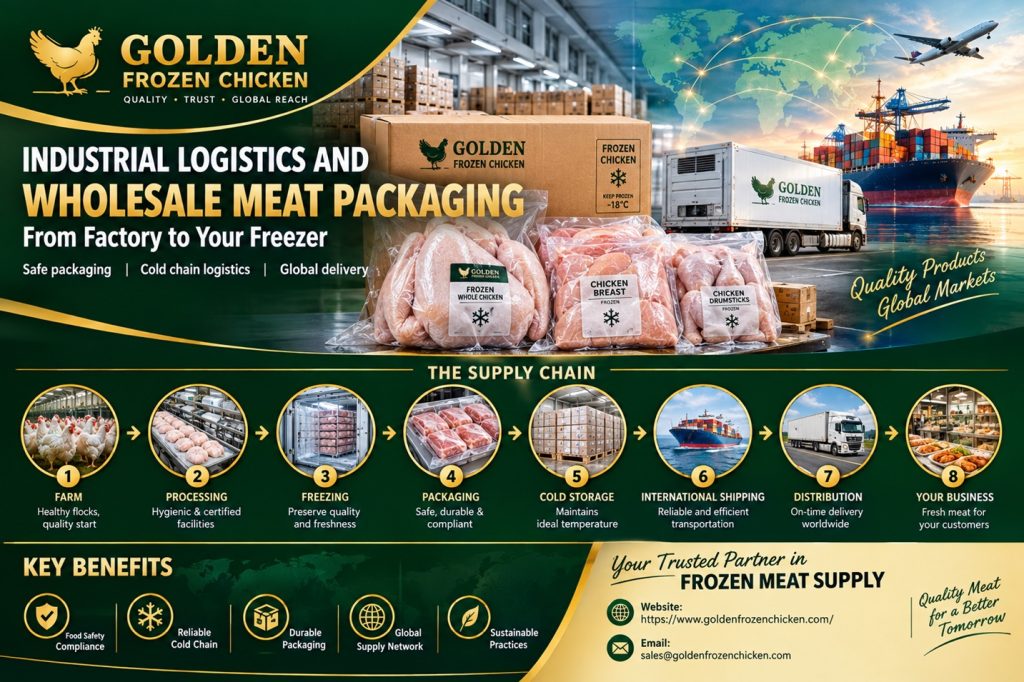
Why Frozen Chicken Is Essential for the Modern Food Business
Frozen chicken has become an important part of the global food supply chain because it combines convenience, availability, storage flexibility, and consistent product supply. Restaurants, supermarkets, food-service companies, wholesalers, distributors, and importers rely on frozen chicken to maintain inventory throughout the year.
Behind every carton of frozen chicken is a supply network connecting farms, processing facilities, exporters, wholesalers, logistics companies, cold-storage warehouses, distributors, and final buyers. Understanding how these businesses work together is essential for companies purchasing frozen chicken in commercial quantities.
For a restaurant owner, supermarket purchasing manager, food-service distributor, or entrepreneur entering the meat-trading business, choosing the right supplier involves more than comparing prices. Product specifications, certifications, packaging, traceability, transportation, import requirements, storage, and delivery capability all influence the overall value of a frozen chicken shipment.
This guide explains the frozen chicken supply chain, how to evaluate suppliers and exporters, cold-chain requirements, wholesale purchasing, import procedures, packaging, and the factors that can influence international frozen chicken trade.
1. Understanding the Frozen Chicken Supply Chain
The frozen chicken supply chain begins with poultry production and continues through processing, freezing, packaging, storage, transportation, international shipping, and distribution.
Each participant has a specific role, and understanding those roles can help buyers select the right business partner.
Frozen Chicken Suppliers
A frozen chicken supplier generally operates close to the production and processing stage. Birds are processed into whole chickens or individual cuts, frozen, packaged, and prepared for commercial distribution.
A supplier may offer products such as:
- Frozen chicken legs
- Chicken wings
- Chicken breast
- Chicken thighs
- Chicken drumsticks
- Leg quarters
- Chicken feet
- Gizzards
- Chicken liver
- Whole frozen chickens
Different markets require different product combinations. For example, certain markets may have strong demand for chicken feet and gizzards, while restaurants and food-service companies may focus primarily on breast, wings, thighs, and drumsticks.
A supplier may also provide customized cutting, portioning, skin-on or skinless products, bone-in or boneless options, and different packaging formats.
Frozen Chicken Wholesalers
A frozen chicken wholesaler generally purchases products in larger quantities and sells them to restaurants, supermarkets, distributors, food-service companies, and other commercial buyers.
Wholesalers may maintain regional warehouses, allowing buyers to purchase products without directly managing international sourcing or large-scale production relationships.
Frozen Chicken Exporters
A frozen chicken exporter focuses on international trade. Exporters need to coordinate documentation, transportation, customs requirements, cold-chain logistics, and destination-market requirements.
For international buyers, the exporter must be able to coordinate the movement of frozen products from the processing facility through ports, refrigerated containers, customs, and the destination country.
Frozen Chicken Distributors
Distributors usually operate closer to the final market. They may receive imported products, store them in temperature-controlled warehouses, and deliver them to restaurants, supermarkets, retailers, hotels, and other customers.
Some distributors also provide services such as labeling, repackaging, inventory management, and scheduled delivery.
2. Choosing a Frozen Chicken Supplier Worldwide
Selecting a Frozen Chicken Supplier Worldwide requires evaluating several factors rather than focusing only on the quoted price.
Product Certification and Compliance
Commercial buyers should verify which food-safety and market certifications are available for the products they intend to purchase.
Depending on the destination market and product, buyers may need documentation or certifications relating to food safety, production standards, halal requirements, veterinary controls, or other regulatory requirements.
Always confirm that the supplier’s certifications are appropriate for your destination country before placing a large order.
Production Capacity
Production capacity is another important consideration.
A restaurant requiring several pallets per month may have different requirements from an importer purchasing multiple containers. Buyers should discuss:
- Monthly production capacity
- Available inventory
- Minimum order quantities
- Seasonal supply
- Production lead times
- Container-loading capacity
- Ability to increase supply when demand changes
A supplier that understands your purchasing schedule can help reduce stock shortages.
Product Portfolio
A broad product portfolio can simplify procurement. Instead of sourcing every chicken cut from different companies, buyers may be able to consolidate purchases through one supplier.
Common wholesale products include frozen chicken breast, wings, legs, thighs, drumsticks, feet, leg quarters, gizzards, liver, and whole birds.
Traceability
Traceability is particularly important for international meat purchasing.
Buyers should understand how batches are identified and how production information is recorded. Batch numbers, production dates, product specifications, packaging information, and shipment documentation can help businesses manage inventory and respond to quality or compliance questions.
Transparent Pricing
A professional quotation should clearly identify what is included in the price.
Depending on the transaction, buyers may need to consider:
- Product cost
- Processing
- Packaging
- Inland transportation
- Port charges
- Freight
- Insurance
- Customs-related expenses
- Destination delivery
Understanding the complete landed cost provides a more useful comparison than looking at the product price alone.
3. Wholesale Frozen Chicken Purchasing
Wholesale purchasing requires planning around volume, product specifications, packaging, delivery schedules, and storage capacity.
Before requesting a quotation, buyers should prepare a clear purchasing specification.
Include:
- Product name
- Cut specification
- Bone-in or boneless
- Skin-on or skinless
- Frozen weight
- Packaging format
- Carton or bag weight
- Required quantity
- Destination port
- Delivery terms
- Required certifications
- Preferred shipment schedule
For example, a buyer purchasing frozen chicken wings for a restaurant chain should specify the required cut, packaging, quantity per shipment, delivery destination, and expected purchasing frequency.
This makes it easier for suppliers to prepare comparable quotations.
4. Frozen Chicken Packaging
Packaging protects frozen chicken during storage, handling, transportation, and distribution.
For wholesale buyers, packaging may include bulk bags, cartons, palletized cases, or customized commercial formats.
Bulk packaging can be appropriate for wholesalers and food-service operators that purchase large quantities. Retail packaging, on the other hand, is designed for direct consumer presentation and may include smaller packs, nutritional information, dates, and other required product information.
Packaging should also support efficient warehouse handling.
A well-designed commercial package should be:
- Strong enough for stacking
- Suitable for frozen storage
- Resistant to handling damage
- Properly sealed
- Clearly labeled
- Appropriate for transportation
- Compatible with palletization
For international shipments, buyers should confirm packaging specifications before production begins.
5. Cold-Chain Logistics for Frozen Chicken
Cold-chain management is one of the most important parts of frozen chicken distribution.
The product must remain within the required frozen-storage conditions throughout processing, storage, transportation, loading, unloading, and delivery.
Important cold-chain stages include:
Freezing
After processing, chicken is frozen using industrial freezing systems. The source article identifies blast freezing as a key part of the process because rapid freezing helps prepare products for frozen storage and distribution.
Cold Storage
Frozen chicken should be stored in an appropriate temperature-controlled facility. Warehouse operators must consider temperature monitoring, airflow, pallet organization, stock rotation, and handling procedures.
Reefer Transportation
International frozen chicken shipments commonly use refrigerated containers, often called reefers.
For large-volume international orders, reefer containers can transport substantial quantities of frozen chicken by sea. The source material describes sea freight as particularly suitable for bulk frozen chicken and frozen chicken parts, while air freight can be used when speed is more important.
Temperature Monitoring
Temperature records can provide useful evidence that the cold chain has been maintained.
Buyers should discuss:
- Temperature monitoring systems
- Data logging
- Reefer settings
- Loading procedures
- Transit arrangements
- Unloading procedures
- Emergency procedures for temperature deviations
Good logistics planning helps reduce the risk of product deterioration and delivery problems.
6. Air Freight vs. Sea Freight
The transportation method depends on shipment size, urgency, destination, product value, and logistics budget.
Air Freight
Air freight can provide faster transportation and may be appropriate for urgent replenishment or smaller quantities of higher-value products.
However, freight costs per kilogram are generally higher.
Sea Freight
Sea freight using refrigerated containers is commonly associated with larger commercial shipments. It can be suitable for bulk frozen chicken and long-distance international trade.
The source article identifies longer transit times as a consideration when choosing sea transportation, making cold-chain planning particularly important.
For businesses with predictable demand, sea freight may form part of a regular replenishment program, while faster transportation can be considered for urgent requirements.
7. Storage and Inventory Management
Once frozen chicken arrives at its destination, appropriate cold storage becomes essential.
A commercial frozen-food warehouse should have suitable:
- Freezer capacity
- Temperature monitoring
- Pallet storage
- Air circulation
- Product identification
- Inventory controls
- Loading and unloading procedures
Stock rotation is also important.
A first-in, first-out approach can help businesses manage inventory and reduce the possibility of older products remaining in storage unnecessarily.
Barcode systems and digital inventory management can further improve visibility, particularly for businesses handling multiple products, batches, and customers.
8. How to Import Frozen Chicken
Importing frozen chicken involves several steps and should be planned before the shipment leaves the exporting country.
Step 1: Identify a Suitable Supplier
Review the supplier’s product specifications, capacity, documentation, certifications, packaging, and export experience.
Step 2: Confirm Import Requirements
Import regulations vary by destination. Buyers should identify the requirements of the relevant food, veterinary, customs, and import authorities before ordering.
Step 3: Request a Commercial Quotation
The quotation should clearly state product specifications, quantity, packaging, price, delivery terms, and destination.
Step 4: Arrange International Freight
The buyer or exporter arranges appropriate refrigerated transportation and shipping documentation.
Step 5: Obtain Required Health Documentation
Depending on the destination, health or veterinary certificates and other documentation may be required.
Step 6: Customs Clearance
The importer or customs broker submits the required documents to the relevant authorities.
Step 7: Cold-Chain Verification
Temperature records and shipment documentation should be reviewed as part of the receiving process.
Step 8: Transfer to Cold Storage
After clearance, the products should be moved into an appropriate frozen-storage facility.
The original source emphasizes supplier verification, import licensing, freight arrangements, health certificates, customs clearance, temperature documentation, and warehouse receipt as key stages of the importing process.
9. Managing Wholesale Frozen Chicken Prices
Price is an important part of any wholesale purchasing decision, but the lowest quotation does not necessarily represent the lowest overall cost.
Buyers should compare the complete commercial package.
Factors that can influence the final cost include:
- Product specification
- Order volume
- Packaging
- Origin
- Freight
- Insurance
- Currency
- Destination
- Delivery terms
- Import duties
- Storage
- Handling charges
Large-volume purchasing may provide opportunities for negotiated pricing, while longer-term supply arrangements can help businesses plan inventory and purchasing.
Buyers should also be careful when comparing quotations from different suppliers because two apparently similar products may have different specifications, packaging weights, delivery terms, or freight arrangements.
10. The Role of Beef and Pork in Frozen Meat Supply
Many international meat suppliers work with several categories rather than chicken alone.
Frozen beef and pork can be managed through similar commercial networks involving processing, packaging, cold storage, international transportation, wholesalers, and distributors.
For businesses purchasing multiple meat categories, consolidating procurement can simplify supplier management and logistics planning.
A restaurant group, food manufacturer, supermarket chain, or distributor may therefore benefit from working with a supplier capable of providing several frozen meat products.
The source material specifically notes that businesses involved in frozen beef and pork may also purchase frozen chicken through the same broader supply network.
11. What Buyers Should Ask Before Placing an Order
Before committing to a large frozen chicken purchase, prepare a supplier checklist.
Ask:
- What chicken cuts are available?
- What are the product specifications?
- What packaging options are available?
- What is the minimum order quantity?
- What is the production lead time?
- Which export markets are currently served?
- What certifications and documentation are available?
- How is product traceability managed?
- How is the cold chain monitored?
- What delivery terms are offered?
- What are the payment conditions?
- How are damaged cartons or quality claims handled?
- Can the supplier support regular container shipments?
- Can the supplier provide additional meat categories?
- What information is included in the final commercial invoice and packing list?
A detailed supplier evaluation helps buyers compare companies using consistent information rather than relying solely on a product price.
12. Building a Reliable Frozen Chicken Supply Strategy
Successful frozen chicken purchasing is ultimately about building a reliable supply system.
The right partner should be able to support the buyer across several stages, including product sourcing, processing, packaging, documentation, cold-chain management, export logistics, and delivery.
For growing businesses, the relationship should also be scalable. A supplier that can accommodate increasing volumes, additional products, new destinations, or different packaging requirements can become an important part of long-term procurement planning.
The source article highlights product variety, certification, production capacity, traceability, transparent pricing, logistics, packaging, and import compliance as important areas when evaluating frozen chicken supply partners.
Conclusion
Frozen chicken is an important component of the modern international food supply chain. From farms and processing facilities to exporters, refrigerated containers, cold-storage warehouses, wholesalers, distributors, restaurants, and supermarkets, every stage contributes to the final product reaching the customer in suitable condition.
For companies searching for a Frozen Chicken Supplier Worldwide, the purchasing process should go beyond price comparison. Product specifications, certifications, production capacity, packaging, traceability, cold-chain management, shipping arrangements, documentation, and destination-market requirements should all be considered.
A structured purchasing strategy allows restaurants, supermarkets, food-service companies, wholesalers, and importers to better manage inventory and develop dependable international supply relationships.
For businesses operating in the frozen meat sector, understanding these interconnected processes can also create opportunities to manage chicken, beef, pork, and other meat products through a more coordinated global procurement strategy.
Contact GLOBAL FROZEN CHICKEN