
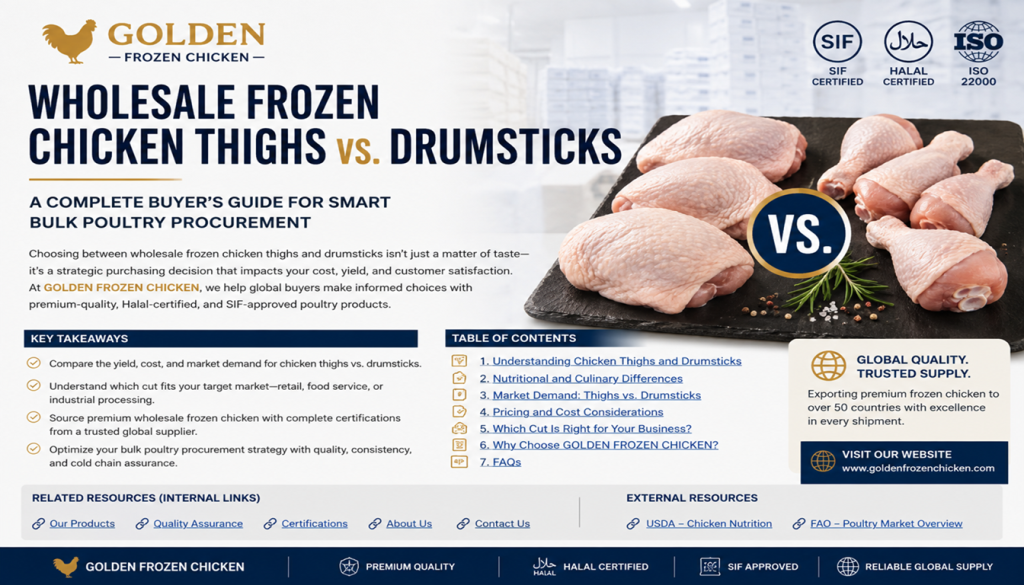
Wholesale Frozen Chicken Thighs vs. Drumsticks: A Complete Buyer’s Guide
When purchasing poultry at commercial scale, choosing between wholesale frozen chicken thighs and drumsticks is more than a simple matter of preference. The right cut can affect product yield, menu applications, customer demand, storage requirements, and overall procurement costs.
For retailers, restaurants, food-service distributors, and international importers, understanding the commercial differences between these two popular dark-meat cuts makes it easier to build a reliable frozen poultry supply chain.
At GOLDEN FROZEN CHICKEN, we help international buyers source premium frozen poultry with a focus on quality, Halal certification, food-safety standards, and dependable cold-chain logistics.
Key Takeaways
- Compare chicken thighs and drumsticks based on culinary use, yield, customer demand, and procurement requirements.
- Understand why thighs are often selected for meat-rich applications and drumsticks for portion-controlled retail and food-service products.
- Evaluate frozen chicken based on grade, packaging, certification, storage temperature, and consistency.
- Use a reliable supplier when importing wholesale frozen chicken from Brazil.
- Maintain an uninterrupted cold chain throughout international transportation.
Table of Contents
- Understanding Chicken Thighs and Drumsticks
- Chicken Thighs vs. Drumsticks: Key Differences
- Market Demand and Commercial Applications
- Pricing and Procurement Considerations
- Quality, Certification, and Cold-Chain Requirements
- Which Cut Is Right for Your Business?
- Why Choose GOLDEN FROZEN CHICKEN?
- Frequently Asked Questions
Understanding Chicken Thighs and Drumsticks
Chicken thighs and drumsticks are both dark-meat portions from the chicken leg, but they serve different commercial purposes.
Chicken thighs are located between the chicken body and the drumstick. They contain a relatively substantial amount of meat and are valued for their rich flavor and moist texture. They can be supplied bone-in or boneless and with or without skin, depending on the buyer’s specification.
GOLDEN FROZEN CHICKEN currently lists A Grade frozen chicken thighs in 10 kg cartons, with IWP and IQF freezing options, a stated storage condition of -18°C or lower, and a 27 MT minimum order for a 40-foot container.
Drumsticks, meanwhile, are the lower portion of the chicken leg. Their recognizable shape makes them especially attractive for retail packs, catering, restaurants, barbecues, and portion-controlled food-service menus.
For buyers comparing the two, the important question is not simply which cut is “better.” It is which cut best matches the customer’s application and purchasing model.
Chicken Thighs vs. Drumsticks: Key Differences
| Factor | Frozen Chicken Thighs | Frozen Chicken Drumsticks |
|---|---|---|
| Meat profile | Meatier, rich dark meat | Dark meat with a convenient bone-in format |
| Common applications | Restaurants, meal production, food service | Retail, catering, restaurants, grilling |
| Portion format | Flexible | Naturally portioned |
| Product versatility | Very high | High |
| Consumer appeal | Popular for tenderness and flavor | Popular for convenience and presentation |
| Processing options | Bone-in, boneless, skin-on/skinless | Usually bone-in |
| Commercial use | Food service and processing | Retail and food service |
| Procurement priority | Yield and specification consistency | Size consistency and presentation |
The best purchasing decision depends on the final destination of the product.
Chicken Thighs: A Versatile Commercial Cut
Thighs are particularly useful for manufacturers and food-service operators that need a versatile dark-meat ingredient.
Their relatively substantial meat content makes them suitable for:
- Prepared meals
- Restaurant dishes
- Grilled chicken products
- Curries and stews
- Food-service portions
- Meat processing
- Retail packs
Because thighs can be supplied in different configurations, buyers can also specify the processing format that best fits their production line.
Chicken Drumsticks: A Convenient Portion
Drumsticks have a major commercial advantage: their shape naturally lends itself to individual portions.
They are commonly used for:
- Retail frozen chicken packs
- Restaurants
- Catering
- Barbecue products
- Fried chicken menus
- Food-service promotions
- Institutional catering
For distributors selling directly to consumers, the visual appeal and recognizable portion size of drumsticks can make them particularly attractive.
Market Demand and Commercial Applications
Both cuts occupy an important position in the international frozen poultry market.
The choice often comes down to who is buying the product.
A restaurant may prefer thighs because they provide flexibility for multiple recipes. A supermarket may favor drumsticks because they are easy to portion and package for consumers.
Food manufacturers can also have highly specific requirements. A processor may prioritize:
- Individual piece weight
- Bone-in or boneless specifications
- Skin-on or skinless format
- Consistent sizing
- Freezing method
- Carton configuration
- Production traceability
This is why a wholesale poultry contract should define specifications before the purchase order is finalized.
For buyers exploring a wider range of products, the GOLDEN FROZEN CHICKEN frozen chicken range includes thighs, drumsticks, wings, breasts, leg quarters, feet and paws, and other poultry cuts.
Pricing and Procurement Considerations
Wholesale frozen chicken pricing is influenced by much more than the cut itself.
Buyers should consider the complete landed cost, including:
- Product price
- Product grade
- Piece-size specifications
- Packaging
- Minimum order quantity
- Container utilization
- Freight
- Insurance
- Import duties
- Destination-country requirements
- Cold-chain handling
A lower quoted price is not necessarily the lowest total procurement cost.
For example, inconsistent sizing can create additional labor and processing costs. Poor packaging can increase storage losses. Weak temperature control can compromise product quality.
For this reason, experienced importers evaluate the supplier as carefully as they evaluate the product.
Packaging Matters
Commercial buyers should confirm:
- Net weight per carton
- Carton dimensions
- Number of cartons per container
- Labeling requirements
- Production and expiry dates
- Batch identification
- Storage instructions
- Export documentation
GOLDEN FROZEN CHICKEN’s published thigh specification includes 10 kg cartons and a 27 MT minimum order for a 40-foot container.
For large-volume procurement, confirming these details before shipment helps prevent costly surprises at the destination.
Quality, Certification, and Cold-Chain Requirements
Quality control is central to successful frozen poultry importing.
Commercial buyers should verify the supplier’s applicable certifications, inspection procedures, traceability system, product specifications, and export documentation before placing a large order.
For international buyers, Halal certification can be particularly important when supplying Muslim-majority markets or Halal-focused distribution channels.
GOLDEN FROZEN CHICKEN’s published product information identifies its frozen chicken thighs as A Grade and lists HALAL, ISO 9001:2008, and FSSC 22000:2010 certifications, with storage at -18°C and lower.
Maintaining the Frozen Cold Chain
Frozen poultry should remain properly frozen throughout storage and transportation.
Buyers should therefore evaluate:
- Freezer storage capability
- Reefer-container procedures
- Temperature monitoring
- Loading procedures
- Port handling
- Documentation
- Delivery arrangements
For food safety, USDA guidance states that poultry should reach a minimum internal cooking temperature of 165°F (73.9°C) when measured with a food thermometer.
Importers should also follow the food-safety and import requirements applicable in their destination country.
Which Cut Is Right for Your Business?
There is no universal winner between frozen chicken thighs and drumsticks.
Choose Frozen Chicken Thighs If:
- You need a versatile dark-meat ingredient.
- Your customers prioritize tenderness and rich flavor.
- You operate restaurants or prepared-meal production.
- You need multiple processing configurations.
- Meat yield and recipe flexibility are important.
Choose Frozen Chicken Drumsticks If:
- You sell consumer-ready portions.
- You supply catering or institutional food service.
- Your customers prefer recognizable bone-in pieces.
- Presentation and portion consistency are important.
- Your market has strong demand for grilled, fried, or roasted chicken legs.
Consider Both If:
You operate a large distribution business.
Offering both products allows wholesalers to serve different customer segments while building a broader frozen poultry portfolio.
Why Choose GOLDEN FROZEN CHICKEN?
Selecting a wholesale poultry supplier is ultimately about consistency.
GOLDEN FROZEN CHICKEN focuses on supplying international buyers with frozen poultry products supported by quality controls, certification, product specifications, and global logistics.
Our published frozen chicken range includes multiple commercial cuts, allowing importers and distributors to source several poultry products through one supplier.
For buyers seeking premium frozen chicken products from GOLDEN FROZEN CHICKEN, the goal is straightforward: consistent product quality, professional export support, and dependable international supply.
If your company is comparing wholesale frozen chicken thighs vs. drumsticks, contact GOLDEN FROZEN CHICKEN to discuss your required cut, grade, packaging, certifications, MOQ, and destination market.
Frequently Asked Questions
Are chicken thighs better than drumsticks for wholesale?
Neither is universally better. Thighs are highly versatile and well suited to restaurants, food processing, and prepared meals, while drumsticks are particularly convenient for retail, catering, and portion-controlled food service.
What is the difference between chicken thighs and drumsticks?
Both are dark-meat cuts from the chicken leg. The thigh is the upper portion near the body, while the drumstick is the lower portion.
What should I check before buying wholesale frozen chicken?
Check the product specification, grade, piece size, packaging, certifications, MOQ, storage requirements, production traceability, export documentation, and cold-chain procedures.
What temperature should chicken reach when cooked?
USDA guidance recommends that all poultry reach a minimum internal temperature of 165°F (73.9°C), measured with a food thermometer.
What packaging is available for wholesale frozen chicken thighs?
GOLDEN FROZEN CHICKEN currently lists frozen chicken thighs in 10 kg cartons, with IWP and IQF freezing options.
Does GOLDEN FROZEN CHICKEN supply other frozen chicken cuts?
Yes. The company’s frozen chicken category includes products such as chicken breasts, drumsticks, thighs, wings, leg quarters, feet and paws, and half chicken.
Final Thoughts
The choice between wholesale frozen chicken thighs and drumsticks should be based on your target market, product specifications, processing requirements, and total landed cost.
Thighs offer versatility and strong food-service applications, while drumsticks provide convenient portions and strong retail and catering potential. For serious importers, however, the supplier’s consistency, certifications, packaging, traceability, and cold-chain performance are just as important as the cut itself.
GOLDEN FROZEN CHICKEN can help buyers build a dependable wholesale poultry supply program tailored to their market and volume requirements.