

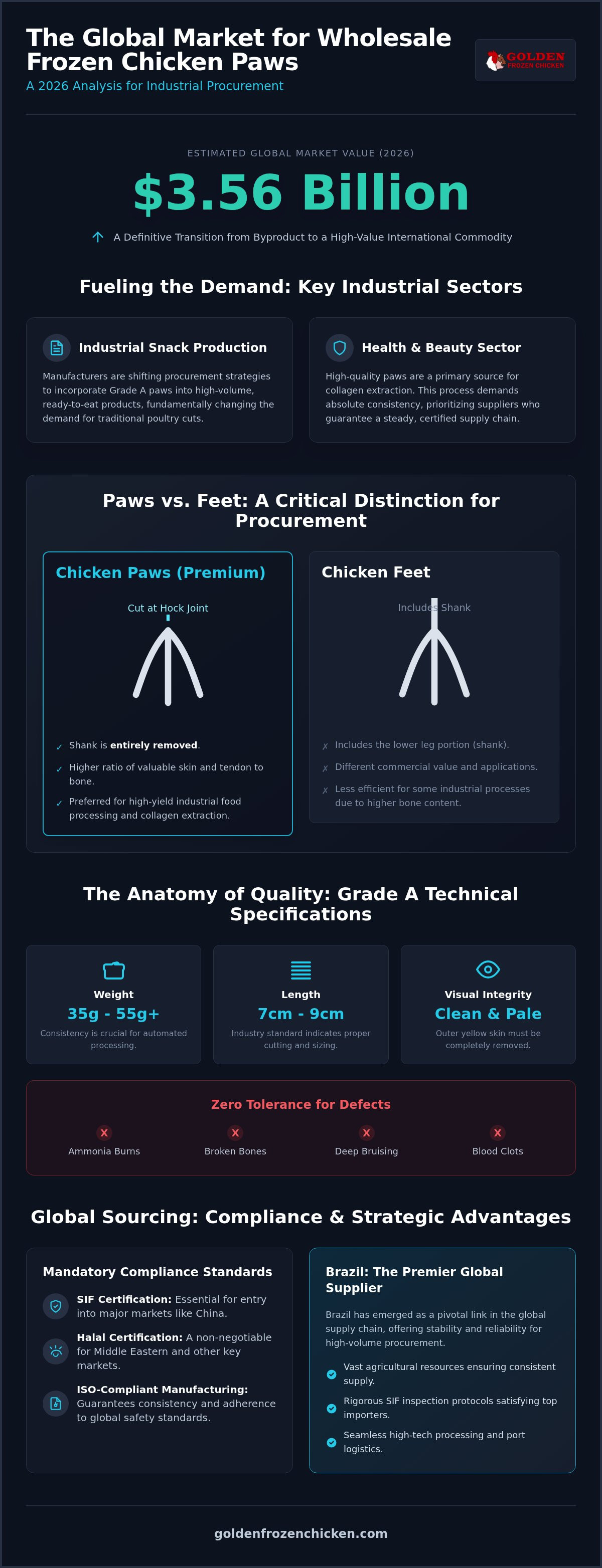
The global market for frozen chicken paws is estimated at USD $3.56 billion in 2026. This valuation reflects a definitive transition from a secondary byproduct to a high-value international commodity. For large-scale procurement officers, this growth presents a significant opportunity. However, it also highlights the difficulty of securing a reliable, Grade A supply of wholesale frozen chicken paws. You’re likely aware that the challenge isn’t just finding stock; it’s ensuring that every container meets the rigorous SIF-approved and Halal-certified standards required for entry into major markets like China.
By reading this analysis, you’ll gain a comprehensive understanding of surging global demand and learn how to master the technical standards of international meat sourcing. We’ll clarify the industry distinction between paws and feet. We’ll also examine the necessity of ISO-compliant manufacturing and the logistical protocols that ensure food safety from the production floor to the final port. This guide serves as your roadmap to establishing a stable, ethical, and high-performance supply chain in a complex trade environment.
Global Demand Trends for Wholesale Frozen Chicken Paws in 2026
In 2026, the international trade of poultry parts has reached a sophisticated equilibrium. The global market for frozen chicken paws is estimated at USD $3.56 billion this year, proving that these items are no longer treated as secondary byproducts. Instead, they’ve become a premium export commodity. Large-scale buyers in East Asian and Middle Eastern industrial food sectors drive this surging demand. These regions require high-volume shipments of wholesale frozen chicken paws that meet specific weight and skin integrity standards. Brazil has emerged as the pivotal link in this supply chain, leveraging its vast agricultural resources and rigorous SIF inspection protocols to satisfy the world’s most demanding importers.
The Rise of the Industrial Snack and Collagen Markets
The growth of processed poultry snacks in international retail has fundamentally changed procurement strategies. Manufacturers are shifting away from traditional cuts to incorporate Grade A paws into ready-to-eat products. Beyond the food aisle, the health and beauty sector has become a major consumer. High-quality paws are a primary source for collagen extraction; this process demands absolute consistency in the raw material. Industrial buyers prioritize partners who can guarantee a steady flow of organic, Halal-certified stock. This reliability is essential because even minor fluctuations in supply can halt large-scale production lines.
Shifts in Global Poultry Trade Routes
Global trade agreements in 2026 have redirected traditional export paths, favoring nations with established, ISO-compliant infrastructures. While geopolitical shifts create volatility in other regions, the Brazilian poultry sector offers a steady hand for international distributors. Many large corporations are moving toward multi-year supply contracts with Brazilian wholesalers to hedge against market instability. This preference stems from the seamless transition between high-tech processing facilities and international shipping ports. By securing wholesale frozen chicken paws through these reliable channels, importers ensure their supply chain remains resilient against regulatory changes and logistical disruptions.
Grading Standards: Distinguishing Chicken Paws from Chicken Feet
Precision in terminology is the foundation of successful meat logistics. While the terms are sometimes used interchangeably in casual conversation, the professional export market maintains a strict anatomical distinction. Chicken paws are cut exactly at the hock joint, removing the shank entirely. In contrast, chicken feet include the lower leg portion. This distinction is vital for industrial food processors who calibrate their machinery to specific dimensions for snack production or collagen extraction. For buyers securing wholesale frozen chicken paws, understanding these anatomical boundaries is the first step in ensuring the shipment matches the intended industrial application.
Technical Specifications for Grade A Paws
Grade A classification isn’t a subjective label; it relies on measurable metrics that define the commercial value of the lot. Premium lots must adhere to the following rigorous standards:
- Weight Requirements: Individual pieces typically range from 35g to 55g or more. Consistency across the container is essential for automated processing.
- Length Specifications: The industry standard for paws is a length of 7cm to 9cm. Anything outside this range often indicates improper cutting or poor bird sizing.
- Visual Integrity: The skin must be clean and pale yellow. There must be a total absence of the outer yellow skin, which should be removed during the scalding process.
- Defect Tolerance: High-quality shipments have zero tolerance for ammonia burns, commonly known as black pads. There should be no broken bones, deep bruising, or blood clots, as these defects compromise the safety and aesthetics of the final product.
Paws vs. Feet: A Commercial Comparison
The commercial preference for paws over feet is driven by yield efficiency. In the production of traditional East Asian delicacies and industrial collagen, the paw offers a higher ratio of skin and tendon to bone compared to the shank-heavy foot. This efficiency makes paws a more versatile ingredient for high-output manufacturing lines. Consequently, paws often carry a higher wholesale value per metric ton than feet. While certain regional markets in Southeast Asia still utilize feet for specific soups and broths, the premium snack and beauty industries almost exclusively demand Grade A paws. Securing a Grade A supply of organic poultry ensures these technical benchmarks are consistently met, providing the reliability required for large-scale international distribution. By prioritizing these standards, importers avoid the hidden costs associated with high defect rates and inconsistent sizing in lower-grade lots.
Regulatory Compliance and SIF Certification in Poultry Export
In the high-stakes environment of international meat trade, regulatory compliance serves as the ultimate barrier to entry. For bulk importers, the integrity of a shipment of wholesale frozen chicken paws depends on a transparent and verifiable certification framework. 2026 trade standards require more than just physical quality; they demand a comprehensive audit trail that spans from the processing facility to the destination port. This level of scrutiny ensures that every metric ton of poultry meets the safety, hygiene, and ethical requirements of the importing nation. Without these credentials, cargo risks rejection at customs, leading to catastrophic financial losses for the distributor.
SIF Approval: The Gold Standard for Safety
The SIF (Serviço de Inspeção Federal) is the Brazilian government’s regulatory body responsible for ensuring the quality of meat products. This federal stamp isn’t merely a label; it represents a meticulous inspection process that monitors every stage of production. SIF-approved facilities must adhere to strict sanitary protocols that exceed standard international requirements. This certification is recognized by major global authorities, facilitating smoother customs clearance in destination countries. Professional wholesale halal chicken suppliers brazil rely on these standards to demonstrate their commitment to global food safety. By choosing SIF-certified stock, buyers secure a product that has undergone rigorous government-backed testing for pathogens and chemical residues.
Halal Certification and Ethical Sourcing
For Middle Eastern markets and Islamic consumers worldwide, Halal certification is a non-negotiable requirement. This process involves specific slaughter and processing methods that adhere to Islamic dietary laws. Beyond the religious significance, Halal certification acts as an additional layer of quality control. It requires that birds are healthy at the time of slaughter and that the facility maintains a high level of cleanliness. Third-party Halal auditors play a critical role in the global supply chain, conducting regular on-site inspections to verify compliance. This integrity builds deep trust with large-scale distributors, ensuring that every lot of wholesale frozen chicken paws is both ethically sourced and religiously compliant.
Traceability remains the final pillar of a secure supply chain. Modern ISO-compliant systems allow exporters to track wholesale lots with surgical precision. Each container is linked to a specific production date and batch number, providing total transparency regarding the product’s origin. This end-to-end control minimizes risk and reinforces the brand’s position as a steady hand in the global marketplace. When logistical excellence meets rigorous certification, the result is a resilient supply chain that can withstand the complexities of 2026 international trade.
Strategic Sourcing and Logistical Integrity for Bulk Imports
Success in the international meat trade depends on a robust “global-local” connection. This bridge allows high-volume producers to meet the specific needs of distant markets without compromising quality. When procuring wholesale frozen chicken paws, the logistical phase is just as critical as the initial processing. A dependable partner manages the entire transition, from the SIF-approved facility to the international shipping terminal. This end-to-end control minimizes the risk of delays and ensures that the organic, Grade A integrity of the product is preserved during long-haul transport. It’s this meticulous attention to detail that separates a standard supplier from a premier global partner.
Maintaining the Cold Chain
Temperature stability is the most vital factor in preserving the cellular structure and safety of frozen poultry. Every shipment utilizes advanced reefer containers specifically calibrated to sustain a deep-freeze environment. Monitoring systems provide continuous data logs, allowing exporters to verify that the cargo remained within acceptable parameters throughout the journey. Current 2026 logistical protocols mandate that all reefer units maintain a constant internal temperature of -18°C or lower, supported by real-time telemetry to prevent any thermal fluctuations during transit. This technical precision prevents freezer burn and bacterial growth, ensuring the product arrives in the same condition it left the plant.
Wholesale Packaging and Documentation
Industrial buyers require packaging that facilitates efficient storage and distribution. Standard bulk configurations are designed to maximize container space while protecting the product’s physical integrity. These options include:
- Standard 10kg and 15kg Cartons: Optimized for specific industrial batches or regional retail requirements.
- 20kg Master Cartons (4x5kg): The common industry standard for high-volume distribution, offering a balance between protection and ease of handling.
- Custom Labeling: Professional branding and mandatory technical data are printed directly on the packaging to support the distributor’s inventory management.
Logistical integrity also extends to the administrative layer. Each shipment of wholesale frozen chicken paws is accompanied by a complete set of documentation, including Health Certificates, Certificates of Origin, and Halal Certificates. These documents are essential for clearing customs and verifying compliance with international food safety audits. To secure a reliable supply chain that prioritizes both technical excellence and logistical transparency, you can partner with a Grade A poultry wholesaler today. By integrating these risk mitigation strategies, importers protect their investment and ensure a steady flow of premium product to their local markets.
Brazil’s Role in the Global Halal Chicken Supply Chain
Brazil has established itself as the premier global supplier of Halal-certified poultry. This status is driven by a unique synergy between vast agricultural resources and sophisticated, high-tech processing facilities. As the world’s largest exporter of Halal chicken, the nation provides a level of scale and safety that remains unmatched in the international market. For large-scale buyers, the Brazilian origin represents more than just a geographic label; it’s a guarantee of rigorous federal oversight and ethical consistency. The demand for wholesale frozen chicken paws continues to rise as East Asian markets expand their industrial food sectors. By 2035, the global market for these products is projected to reach USD $5.68 billion, growing from a valuation of USD $3.56 billion in 2026. This trajectory highlights the necessity of a resilient supply chain rooted in a stable, high-output region.
The Brazilian Advantage: Scale and Quality
The industrial capacity of Brazilian poultry processing plants allows for the seamless integration of organic and Halal standards into high-volume production. Unlike smaller regional producers, Brazilian facilities utilize vertically integrated systems that control every stage of the bird’s lifecycle. This control ensures that Grade A quality isn’t just a target but a baseline standard for every shipment. International buyers prioritize Brazilian origin for long-term contracts because it offers a hedge against the supply volatility seen in other parts of the world. The combination of ISO-compliant manufacturing and the ethical integrity of Halal slaughtering makes Brazil the definitive source for premium poultry parts.
Partnering with Golden Frozen Chicken
In a complex global trade environment, success depends on the reliability of your logistical partner. Golden Frozen Chicken bridges the gap between Brazilian production floors and international ports with a focus on professional authority and transparency. We understand that large-scale distributors require more than just a product; they need a “steady hand” to manage the intricacies of SIF-approved exports and temperature-controlled shipping. Our commitment to excellence ensures that every lot of wholesale frozen chicken paws meets the exact weight, length, and skin integrity specifications required by your industrial processing lines.
The future of the poultry export market demands a partner who can navigate shifting trade routes and evolving regulatory landscapes with precision. We pride ourselves on being a logistical powerhouse that prioritizes the integrity of our output above all else. You can secure your 2026 supply and establish a stable, ethical supply chain by contacting Golden Frozen Chicken today. Our team is prepared to facilitate your bulk procurement needs with the professional clarity and logistical expertise your corporation deserves.
Securing Your Global Supply Chain for 2026 and Beyond
The transition of poultry parts into a high-value global commodity requires a procurement strategy rooted in technical precision and regulatory transparency. Mastering the 2026 market demands a clear understanding of grading standards and the rigorous SIF inspection protocols that define Brazilian exports. By prioritizing Grade A quality and maintaining a strict cold chain at -18°C, importers can protect their industrial yields and ensure seamless customs clearance. The surging demand for wholesale frozen chicken paws in East Asian and Middle Eastern markets highlights the necessity of a partner who can bridge the gap between production and international distribution with absolute reliability.
Golden Frozen Chicken stands as a meticulous manufacturer and logistical powerhouse, providing the stability required in a complex industry. As a SIF Approved Exporter with 100% Halal Certified facilities and a worldwide logistics network, we ensure your supply chain remains resilient and ethical. It’s time to elevate your procurement standards and secure a consistent source of organic poultry for your large-scale operations. Partner with Golden Frozen Chicken for your wholesale export needs and experience the benefits of a premier international partnership. We look forward to supporting your long-term growth in the global marketplace.
Frequently Asked Questions
What is the difference between chicken paws and chicken feet in wholesale?
The distinction is primarily anatomical. Chicken paws are cut exactly at the hock joint, which removes the lower leg or shank entirely. Chicken feet include this shank portion. Industrial processors often prefer paws for their higher yield of skin and tendons, which are essential for collagen production. Understanding this difference is critical when sourcing wholesale frozen chicken paws to ensure the product matches your specific machinery and yield requirements.
Is all frozen chicken from Brazil Halal certified?
While Brazil is the world’s leading exporter of Halal poultry, certification depends on the specific producer and facility. Not every plant adheres to these religious and ethical standards. However, premier exporters like Golden Frozen Chicken ensure that all poultry products are 100% Halal certified. This involves rigorous third-party audits and adherence to specific slaughtering protocols, providing a stable and ethical supply chain for Islamic markets and global distributors.
What are the minimum order quantities for wholesale frozen chicken paws?
Minimum order quantities in the international export market typically start at one full container load, which is usually a 40ft reefer container. This standard ensures logistical efficiency and maintains the integrity of the cold chain during transport. Large-scale distributors often secure multiple containers per month to maintain a steady inventory. These bulk volumes allow for more competitive shipping rates and ensure a consistent supply of wholesale frozen chicken paws for industrial processing lines.
How is the quality of Grade A chicken paws verified during export?
Quality verification relies on a combination of federal oversight and international standards. The SIF inspection process monitors every stage of production to ensure hygiene and safety. Additionally, Grade A status is verified through rigorous visual and technical audits. These checks confirm the absence of black pads, broken bones, and ammonia burns. ISO-compliant manufacturing processes provide a final layer of documentation, ensuring that every wholesale lot meets global food safety benchmarks.
What temperature must be maintained during the shipping of frozen poultry?
Maintaining a strict thermal environment is essential for food safety. All frozen poultry shipments must be transported in reefer containers set to -18°C or lower. This deep-freeze temperature prevents bacterial growth and preserves the cellular structure of the meat. Advanced monitoring systems track the internal temperature throughout the voyage, providing a data log that verifies the cold chain remained intact from the processing facility to the destination port.
Does Golden Frozen Chicken provide SIF-approved products for all global markets?
Yes, we provide SIF-approved poultry products that meet the stringent requirements of major international markets. SIF certification is the Brazilian federal standard for quality and safety, recognized by customs authorities in East Asia, the Middle East, and beyond. This approval facilitates smoother entry into destination countries. Our status as a seasoned global player ensures that our products comply with the specific health and safety audits required by your local jurisdiction.
What documentation is required to import frozen chicken paws from Brazil?
Importing frozen poultry requires a comprehensive set of international trade documents. Key requirements include the Federal Inspection Health Certificate (SIF), the Certificate of Origin, and the Halal Certificate. Additionally, a Bill of Lading, Commercial Invoice, and Packing List are necessary for customs clearance. These documents provide total transparency regarding the product’s origin, processing methods, and logistical integrity, ensuring that the shipment complies with both Brazilian export laws and destination country regulations.
Can packaging be customized for large-scale industrial orders?
Customization is a core component of our wholesale service. We offer various packaging configurations, such as 10kg, 15kg, or the standard 20kg master cartons. For industrial buyers, we can provide custom labeling that includes specific batch data, barcodes, and branding. This flexibility allows distributors to integrate the product seamlessly into their existing inventory management systems while ensuring the physical integrity of the Grade A paws during international transit.