

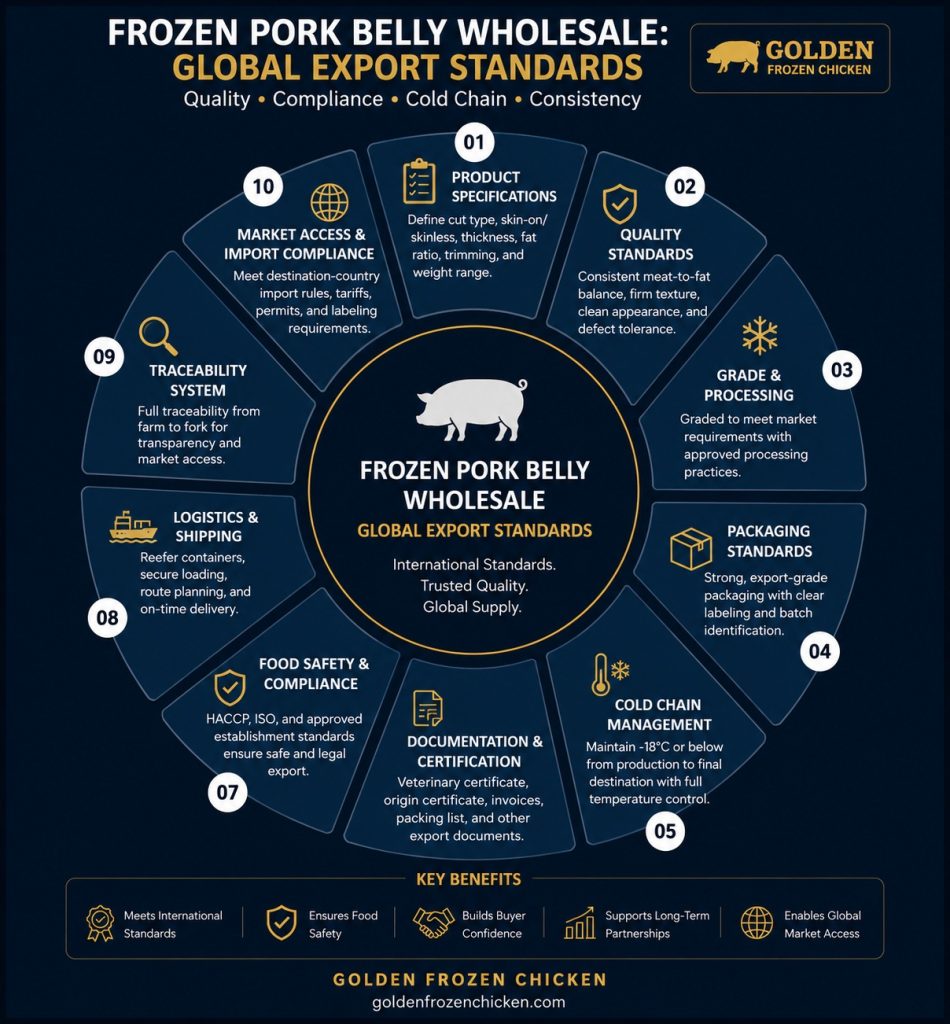
When purchasing pork at commercial scale, Frozen Pork Belly Wholesale requires more than simply comparing prices per metric ton. International buyers must evaluate cut specifications, fat-to-meat balance, grading, food-safety controls, veterinary documentation, cold-chain management, packaging, and destination-country import requirements.
For retailers, food-service distributors, processors, restaurants, and international importers, understanding the standards surrounding Frozen Pork Belly Wholesale can help reduce procurement risk and build a more dependable global meat supply chain.
At GOLDEN FROZEN CHICKEN, our focus is international frozen-food sourcing and export expertise. Buyers evaluating new meat supply opportunities should apply the same principles of specification control, documentation, traceability, and logistics when assessing frozen pork suppliers.
Key Takeaways
- Understand the commercial specifications buyers should evaluate when sourcing Frozen Pork Belly Wholesale.
- Learn how pork belly quality, trimming, fat distribution, skin condition, and sizing can affect commercial value.
- Understand the importance of veterinary certification and destination-country import requirements.
- Evaluate suppliers based on traceability, food-safety systems, packaging, and cold-chain performance.
- Learn how international standards can affect the movement of frozen pork products between exporting and importing countries.
Table of Contents
- Understanding Frozen Pork Belly for International Trade
- Global Export Standards for Frozen Pork Belly
- Pork Belly Quality and Grading Specifications
- Packaging and Cold-Chain Requirements
- Veterinary Certification and Import Documentation
- Market Applications for Wholesale Frozen Pork Belly
- Choosing a Reliable International Supplier
- Why Global Procurement Standards Matter
- Frequently Asked Questions
Understanding Frozen Pork Belly for International Trade
Pork belly is one of the most commercially recognized pork cuts in the international meat trade. It is valued for its combination of meat and fat and is used across retail, food service, restaurant, processing, and further-manufacturing applications.
For international buyers, however, the term “pork belly” does not provide enough information to complete a bulk purchase.
A professional procurement specification should identify factors such as:
- Bone-in or boneless
- Skin-on or skinless
- Trim specification
- Weight range
- Thickness
- Fat distribution
- Meat-to-fat ratio
- Individual-piece or block format
- Freezing method
- Packaging configuration
- Production date and shelf life
- Country of origin
- Required certifications
This level of detail is particularly important when purchasing Frozen Pork Belly Wholesale, because differences between lots can affect processing yields, retail presentation, cooking performance, and final product costs.
Why Specification Consistency Matters
A restaurant chain may require consistent belly portions for menu preparation, while a meat processor may require larger standardized pieces for slicing or further processing.
Likewise, a retail distributor may prioritize appearance, uniformity, packaging, and consumer-facing labeling.
The most competitive supplier is therefore not necessarily the supplier offering the lowest initial quotation. It is the supplier capable of delivering the agreed specification consistently.
Global Export Standards for Frozen Pork Belly
International pork trade operates within a framework of animal-health, food-safety, sanitary, and import requirements.
The World Organisation for Animal Health (WOAH) explains that international animal-health standards are designed to support safe trade in animals and animal products while helping countries avoid unnecessary sanitary barriers.
For buyers sourcing Frozen Pork Belly Wholesale, this means that product quality is only one part of the purchasing equation.
Exporters and importers may need to address:
- Veterinary certification
- Approved slaughter and processing establishments
- Animal-health requirements
- Disease-status requirements
- Traceability
- Sanitary controls
- Product labeling
- Country-specific import permits
- Customs documentation
- Cold-chain records
Requirements can differ significantly between destination countries. Therefore, buyers should confirm the current import rules with the relevant authorities before finalizing an international pork contract.
Animal-Health Compliance
Pork is particularly sensitive to animal-health regulations because certain diseases affecting pigs can have major implications for international trade.
WOAH’s Terrestrial Animal Health Code provides international standards addressing animal health and safe trade in animal products.
For pork importers, the practical lesson is simple: country of origin and approved supply chain matter.
A shipment that meets the exporter’s domestic requirements may still require additional documentation or conditions before it can enter the destination market.
Pork Belly Quality and Grading Specifications
Quality assessment should begin before the product is loaded into a container.
When sourcing Frozen Pork Belly Wholesale, buyers should establish measurable specifications instead of relying on general descriptions such as “premium” or “high quality.”
Important Quality Factors
1. Meat-to-Fat Balance
The balance between lean meat and fat is one of the most important commercial characteristics of pork belly.
Different customers have different preferences. Food manufacturers may require a particular fat ratio, while restaurants and retail customers may prioritize visual marbling and presentation.
2. Thickness and Uniformity
Consistent thickness can improve slicing, portioning, cooking, and further processing.
A buyer should establish acceptable minimum and maximum dimensions before production begins.
3. Skin Condition
For skin-on products, the condition and appearance of the skin can influence the commercial value of the shipment.
Buyers should specify acceptable standards for:
- Skin cleanliness
- Hair removal
- Discoloration
- Surface damage
- Bruising
- Foreign material
4. Trimming
Trimming specifications should be clearly defined in the purchase contract.
Depending on the intended application, buyers may request different levels of trimming to balance product yield against processing requirements.
5. Defect Tolerance
Commercial specifications should identify unacceptable defects and define the tolerance permitted within a shipment.
This can include:
- Excessive bruising
- Bone fragments
- Foreign material
- Severe discoloration
- Improper trimming
- Packaging damage
- Evidence of temperature abuse
Clear specifications protect both the supplier and the buyer.
Packaging and Cold-Chain Requirements
The integrity of Frozen Pork Belly Wholesale does not end at the processing facility.
Frozen meat must remain appropriately controlled during storage, loading, transportation, port handling, and delivery.
Cold-Chain Management
A professional international frozen-meat supply chain should address:
- Freezer storage
- Reefer-container loading
- Temperature monitoring
- Container pre-cooling
- Port handling
- Transit time
- Destination unloading
- Final warehouse storage
Temperature-control procedures should be documented and integrated into the overall quality-management system.
Buyers should ask suppliers how temperature is monitored and what records are available if a shipment experiences a logistical disruption.
Wholesale Packaging
Depending on the buyer’s requirements, frozen pork belly may be supplied in bulk cartons, vacuum-packed formats, or other commercial configurations.
Before placing an order, confirm:
- Net weight
- Gross weight
- Carton dimensions
- Pieces per carton
- Packaging material
- Vacuum-pack requirements
- Labeling
- Lot or batch identification
- Production date
- Expiration or best-before information
- Storage instructions
The objective is to make the product easy to identify, store, inspect, and distribute after arrival.
Veterinary Certification and Import Documentation
Documentation is one of the most important elements of international meat procurement.
For Frozen Pork Belly Wholesale, buyers should determine which documents are required by the destination country’s authorities before the shipment leaves the exporting country.
Depending on the market and origin, documentation can include:
- Veterinary or health certificate
- Certificate of origin
- Commercial invoice
- Packing list
- Bill of lading
- Import permit, where applicable
- Establishment approval information
- Product specification
- Traceability information
- Halal certificate, where applicable
- Other sanitary or customs documentation
WOAH standards specifically address international trade in animal products and emphasize the role of veterinary services and sanitary requirements in safe international commerce.
Why Traceability Matters
Traceability gives buyers greater visibility into the product’s origin and production history.
A robust system should allow relevant product information to be associated with:
- Production batches
- Processing dates
- Establishment information
- Product specifications
- Shipment documentation
- Destination details
This becomes particularly important when supplying large retail chains, food manufacturers, or regulated markets.
Market Applications for Wholesale Frozen Pork Belly
The commercial versatility of pork belly supports demand across several sectors.
Food Service
Restaurants and food-service operators use pork belly in a wide range of preparations, including roasted, braised, grilled, smoked, and sliced products.
Consistent sizing can help commercial kitchens standardize recipes and portions.
Retail
Retailers may sell pork belly as:
- Whole pieces
- Sliced portions
- Vacuum-packed products
- Marinated products
- Ready-to-cook products
Packaging and visual presentation can therefore be important purchasing criteria.
Meat Processing
Food processors may use pork belly as an input for further manufacturing.
In this environment, procurement teams may prioritize:
- Consistent fat distribution
- Piece size
- Trimming
- Yield
- Freezing characteristics
- Reliable monthly supply
International Distribution
Large distributors often require predictable container volumes and repeatable specifications.
For these buyers, a long-term supplier relationship can reduce the risks associated with inconsistent product availability.
Choosing a Reliable International Supplier
The supplier evaluation process should go beyond a product quotation.
When comparing suppliers for Frozen Pork Belly Wholesale, buyers should assess five major areas.
1. Product Consistency
Can the supplier repeatedly meet the same weight, trimming, fat, skin, and packaging specifications?
2. Food-Safety Systems
Does the supplier operate under appropriate food-safety controls and provide the documentation required by the destination market?
3. Export Experience
International meat shipments require coordination between processors, freight providers, ports, customs authorities, veterinary authorities, and importers.
Experience in these processes can reduce logistical problems.
4. Traceability
A professional supplier should be able to identify relevant production and shipment information for each lot.
5. Communication
Fast and accurate communication is particularly important when buyers need:
- Product specifications
- Samples
- Certificates
- Production schedules
- Shipping updates
- Documentation
- Container information
For international buyers, supplier communication is part of supply-chain quality.
Why Global Procurement Standards Matter
The biggest mistake in international frozen-meat procurement is treating the transaction as a simple commodity purchase.
Frozen Pork Belly Wholesale is a technical procurement process.
The buyer must align:
Product specification → Quality control → Certification → Documentation → Cold chain → Shipping → Import clearance → Distribution
If one element is overlooked, the entire shipment can face unnecessary delays or additional costs.
International standards also continue to evolve as countries strengthen animal-health and food-safety controls. WOAH notes that its standards are based on current scientific and technical information and provide a framework for safe international trade.
For this reason, importers should verify the current requirements applicable to their specific destination rather than relying on an old supplier specification or previous shipment.
Food Safety: What Buyers Should Know
Wholesale buyers should distinguish between frozen storage requirements and safe cooking requirements.
For consumer preparation, the USDA Food Safety and Inspection Service recommends cooking whole cuts of pork, including steaks, chops, and roasts, to a minimum internal temperature of 145°F (62.8°C) followed by at least a three-minute rest. Ground pork has a higher recommended minimum of 160°F (71.1°C).
These cooking recommendations are different from the requirements governing commercial frozen storage and international transportation.
For authoritative food-safety information, buyers can consult the USDA Food Safety and Inspection Service temperature guidance.
Why Choose GOLDEN FROZEN CHICKEN for Global Frozen-Food Sourcing?
GOLDEN FROZEN CHICKEN is positioned around international frozen-food sourcing, export logistics, product consistency, and professional supply-chain management.
Our existing frozen poultry portfolio provides international buyers with access to multiple commercial poultry cuts and demonstrates the importance of specification-driven procurement.
You can explore the GOLDEN FROZEN CHICKEN product range or learn more about our international wholesale poultry sourcing approach.
For buyers expanding into additional frozen-meat categories, supplier qualification should always be based on the actual product offered, applicable certifications, export eligibility, and destination-market requirements.
If your company is evaluating Frozen Pork Belly Wholesale opportunities, contact your prospective supplier and request the complete product specification, certification package, MOQ, packaging details, country of origin, and destination-market documentation before placing an order.
Frequently Asked Questions
What is Frozen Pork Belly Wholesale?
Frozen Pork Belly Wholesale refers to the commercial purchase of pork belly in frozen condition, generally involving bulk quantities for retailers, restaurants, distributors, processors, or international importers.
What should I check before buying wholesale frozen pork belly?
Check the product specification, weight range, trimming, skin condition, fat distribution, packaging, freezing method, shelf life, certifications, origin, MOQ, and export documentation.
Why is country of origin important for frozen pork?
Country of origin can affect veterinary requirements, disease-status considerations, import eligibility, tariffs, documentation, and buyer requirements. Always verify current destination-country regulations before importing.
What certifications are required for frozen pork exports?
Requirements vary by exporting and importing country. Depending on the trade route, buyers may need veterinary health documentation, establishment approval information, certificates of origin, and other sanitary or customs documents.
How important is cold-chain management?
It is critical. Frozen pork should remain under appropriate temperature control during storage and transportation. Buyers should ask for information about freezer storage, reefer containers, loading procedures, and temperature monitoring.
Is pork belly suitable for food processing?
Yes. Pork belly is used in restaurant, retail, food-service, and further-processing applications. The appropriate specification depends on the final product and processing method.
What temperature should pork be cooked to?
USDA FSIS recommends a minimum internal temperature of 145°F (62.8°C) for whole cuts of pork, with a three-minute rest period. Ground pork should reach 160°F (71.1°C).
What is the most important factor when buying Frozen Pork Belly Wholesale?
There is no single factor. Successful procurement depends on a combination of consistent specifications, food safety, certification, traceability, documentation, pricing, and dependable cold-chain logistics.
Final Thoughts
The global trade of frozen pork requires a procurement strategy built around more than price.
For companies sourcing Frozen Pork Belly Wholesale, product specifications, trimming, fat distribution, packaging, traceability, veterinary documentation, animal-health requirements, and cold-chain integrity all contribute to the success of an international shipment.
WOAH’s international standards provide an important framework for animal health and safe international trade, while national authorities establish the specific import requirements applicable to individual markets.
For buyers, the best approach is to establish detailed specifications before purchasing, verify the supplier’s eligibility for the destination market, and ensure that every shipment is supported by the required documentation.
GOLDEN FROZEN CHICKEN can support international buyers with professional frozen-food sourcing knowledge and export-oriented supply-chain expertise.