
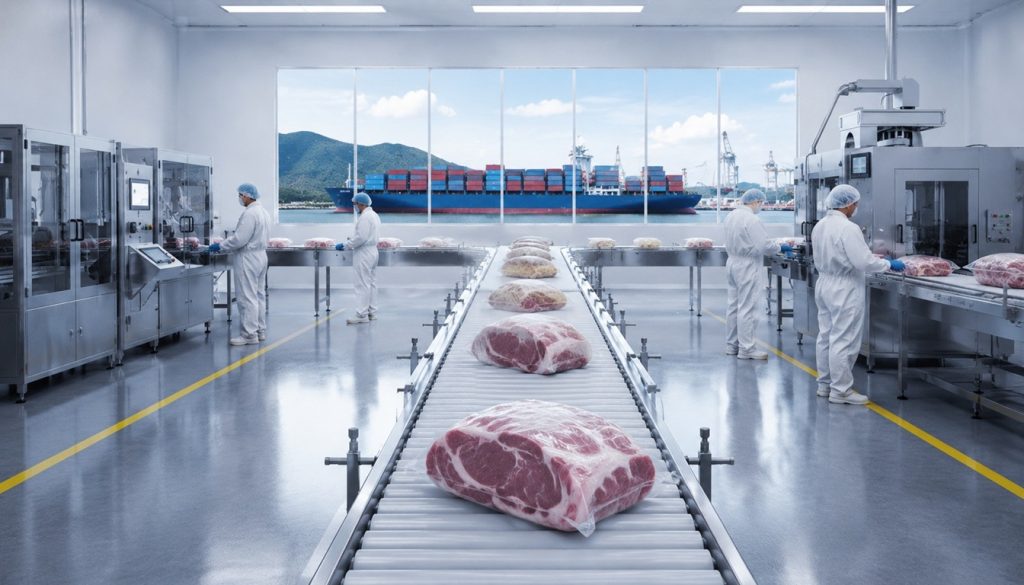
For food manufacturers, choosing the right raw material is essential for controlling production costs, maintaining consistent product quality, and meeting the specifications of downstream customers. Wholesale frozen pork shoulder is a particularly useful option for manufacturers because of its versatility, rich flavor, and suitability for further processing.
From sausages and seasoned meat products to ready meals, pulled pork, ground pork, and processed-food applications, pork shoulder can serve as a flexible ingredient for high-volume production.
For manufacturers importing frozen meat, however, product selection is only one part of the equation. Buyers also need to consider cut specifications, fat content, packaging, freezing, certification, traceability, cold-chain management, and destination-country import requirements.
At GOLDEN FROZEN CHICKEN, we supply frozen chicken, pork, and beef through an international sourcing and distribution network. The company’s website identifies frozen pork as one of its product categories and states that it works with certified and ISO-compliant manufacturers in Brazil.
Key Takeaways
- Understand why wholesale frozen pork shoulder is valuable for food manufacturers.
- Compare pork shoulder with other pork cuts based on processing flexibility and application.
- Evaluate suppliers based on specifications, consistency, packaging, certification, and traceability.
- Understand the importance of SIF and destination-market requirements when sourcing Brazilian meat.
- Build a procurement strategy around reliable cold-chain logistics and documentation.
- Choose product specifications according to the manufacturer’s actual production process rather than purchasing solely on price.
Table of Contents
- What Is Wholesale Frozen Pork Shoulder?
- Why Food Manufacturers Choose Pork Shoulder
- Commercial Applications of Frozen Pork Shoulder
- Key Specifications for Bulk Buyers
- Pricing and Procurement Considerations
- Quality, Certification, and Food Safety
- Cold-Chain and International Logistics
- Choosing the Right Wholesale Pork Supplier
- Why Choose GOLDEN FROZEN CHICKEN?
- Frequently Asked Questions
What Is Wholesale Frozen Pork Shoulder?
Wholesale frozen pork shoulder refers to pork sourced from the shoulder region of the pig and supplied in commercial quantities for manufacturers, processors, distributors, food-service companies, and other large-volume buyers.
The shoulder is a practical manufacturing cut because it can be incorporated into a wide variety of products. Depending on the specification, it can be processed further into diced pork, ground pork, seasoned products, sausages, fillings, cooked products, and prepared meals.
For manufacturers, consistency is often more important than simply purchasing the cheapest available raw material.
A purchasing specification may include:
- Cut and anatomical description
- Bone-in or boneless
- Skin-on or skinless
- Fat-content requirements
- Weight range
- Trim level
- Frozen condition
- Packaging format
- Product grade
- Country of origin
- Production date
- Shelf life
- Certification
- Lot and batch traceability
This level of detail allows a manufacturer to match incoming raw material with its own production specifications.
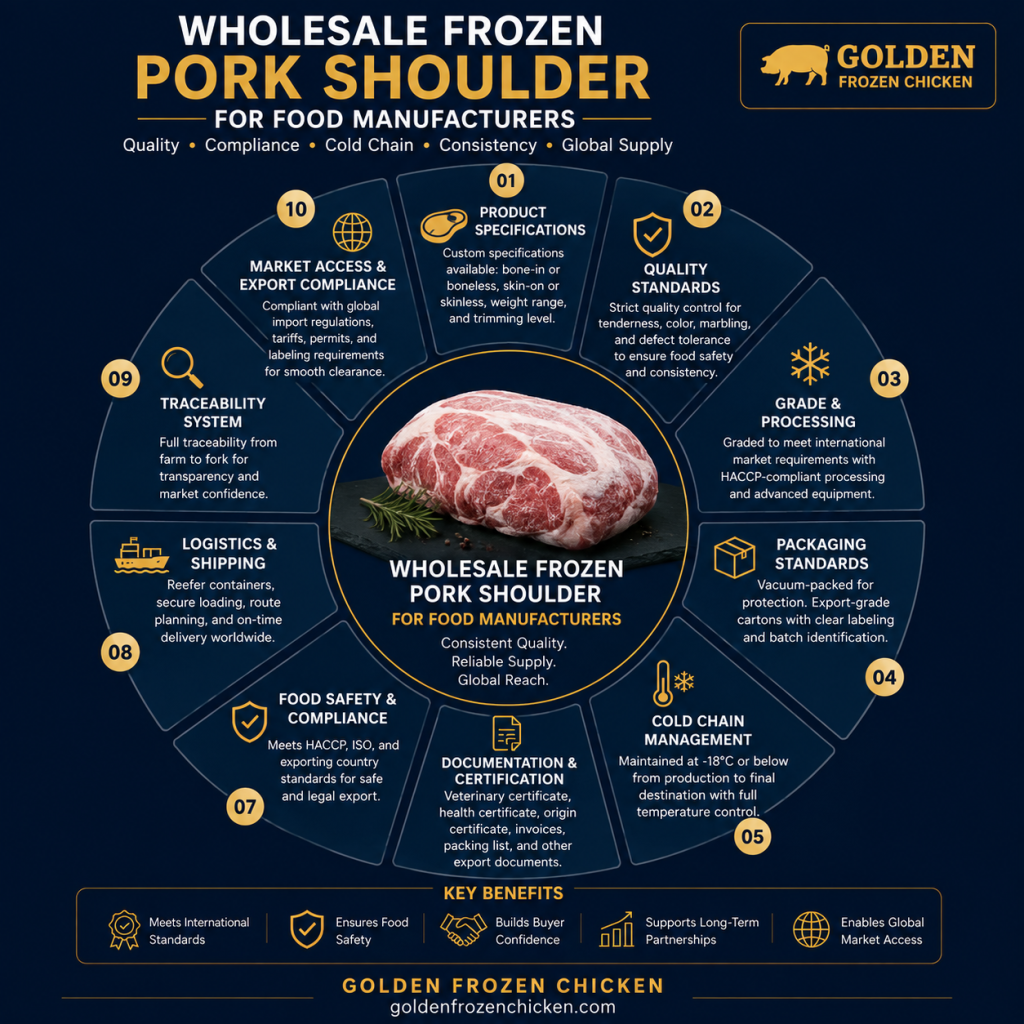
Why Food Manufacturers Choose Pork Shoulder
The main advantage of pork shoulder is processing flexibility.
Manufacturers rarely purchase meat simply to sell the original cut. Instead, the raw material may become an ingredient in another product.
That makes the relationship between raw-material characteristics and manufacturing yield extremely important.
1. Versatility
Pork shoulder can be incorporated into many different food products and recipes.
Potential applications include:
- Sausages
- Ground pork
- Dumpling and filling products
- Ready meals
- Pulled-pork products
- Canned meat
- Marinated products
- Processed pork products
- Food-service preparations
- Frozen prepared foods
The exact application depends on the buyer’s formulation, processing equipment, and required specification.
2. Flavor and Fat Balance
Pork shoulder is valued for its combination of lean meat and fat.
For food manufacturers, this can be useful when developing products where moisture, flavor, texture, and mouthfeel are important.
However, manufacturers should not assume that every pork shoulder lot has the same fat-to-lean ratio.
Fat percentage and trimming specifications should therefore be established before purchase.
3. Processing Efficiency
A consistent raw-material specification can help manufacturers reduce variation during production.
If incoming pork varies substantially in:
- Weight
- Trim
- Fat level
- Temperature
- Packaging
- Frozen condition
the manufacturer may experience additional trimming, formulation adjustments, labor, or production downtime.
This is why professional procurement teams evaluate total production yield, not simply the purchase price per kilogram.
Commercial Applications of Frozen Pork Shoulder
The versatility of wholesale frozen pork shoulder makes it relevant to multiple food-manufacturing sectors.
Sausage Manufacturing
Pork shoulder can be used as a component in sausage formulations where manufacturers need a controlled combination of lean meat and fat.
For industrial sausage production, buyers should clearly define:
- Lean-to-fat requirements
- Particle size
- Temperature specification
- Bone-free status
- Foreign-material controls
- Microbiological specifications
- Packaging
Ready Meals
Food manufacturers producing frozen or chilled meals may use pork shoulder in dishes such as:
- Pork stews
- Asian-inspired meals
- Rice dishes
- Noodle dishes
- Pasta products
- Sandwich fillings
- Pulled-pork meals
The right specification depends on whether the manufacturer requires whole muscles, diced material, or further-processed pork.
Ground Pork Products
Pork shoulder can also be processed into ground pork or used as a component of blended formulations.
In this application, consistency is especially important because variations in fat content can affect:
- Texture
- Cooking yield
- Flavor
- Appearance
- Nutritional formulation
- Finished-product consistency
Food-Service Manufacturing
Large food-service manufacturers may use pork shoulder to produce standardized products for restaurants, hotels, catering businesses, and institutional customers.
For these buyers, reliable volume and repeatable specifications can be more valuable than spot-market purchasing.
Key Specifications for Bulk Buyers
Before purchasing wholesale frozen pork shoulder, manufacturers should create a detailed product specification sheet.
Product Specification
Confirm:
- Pork shoulder cut
- Bone-in or boneless
- Skin-on or skinless
- Trim specification
- Weight range
- Fat percentage
- Product grade
- Frozen or chilled status
- Country of origin
Packaging Specification
Packaging should be selected around the manufacturer’s handling system.
Important questions include:
- What is the net weight per carton?
- How many cartons fit into the container?
- Is individual wrapping required?
- Is vacuum packaging available?
- Is bulk packing acceptable?
- What labeling information is required?
- Can cartons be customized?
GOLDEN FROZEN CHICKEN states that packaging can be tailored for wholesale and retail requirements and that its supply network serves importers, manufacturers, wholesalers, supermarket chains, restaurants, hotels, airlines, and distributors.
For a manufacturer, packaging should ultimately reduce handling costs while protecting the product throughout storage and transportation.
Pricing and Procurement Considerations
The price of wholesale frozen pork shoulder should never be evaluated in isolation.
A more useful calculation is the total landed and processed cost.
This may include:
- Product price
- Packaging
- Freight
- Insurance
- Import duties
- Port charges
- Customs clearance
- Warehousing
- Internal transportation
- Processing losses
- Trimming losses
- Financing costs
A cheaper product may become more expensive if it produces lower manufacturing yield.
Price vs. Yield
Imagine two suppliers offer pork at different prices.
Supplier A has the lower purchase price, but its product has greater variation in trimming and fat content.
Supplier B costs slightly more but provides a consistent specification that requires less additional processing.
For a high-volume manufacturer, Supplier B may produce the lower cost per finished kilogram.
This is why procurement teams should calculate:
Cost of raw material ÷ usable production yield = effective ingredient cost
The exact calculation should be based on the manufacturer’s own production data.
Quality, Certification, and Food Safety
Food manufacturers need confidence that the raw material entering their production facility meets both their internal specifications and applicable regulatory requirements.
International meat trade involves multiple layers of food-safety control.
In Brazil, the Serviço de Inspeção Federal (SIF) operates under the Ministry of Agriculture and Livestock and is responsible for inspection of animal-origin products intended for domestic and foreign markets. Brazil’s government states that products under SIF oversight are registered and approved according to applicable national and international legislation.
For manufacturers importing into a particular country, however, buyers must still confirm the destination market’s own eligibility and documentation requirements.
For example, USDA FSIS explains that meat imported into the United States must originate from eligible countries and establishments and must meet applicable inspection, labeling, and import requirements.
HACCP and Preventive Food Safety
Food manufacturers should also examine the supplier’s food-safety management system.
Codex guidance recommends a HACCP-based approach to food hygiene and describes HACCP as a systematic method for identifying hazards and establishing controls focused on prevention.
For manufacturers, supplier verification should therefore include consideration of:
- HACCP systems
- Good hygiene practices
- Sanitation procedures
- Traceability
- Microbiological controls
- Product testing
- Corrective-action procedures
- Documentation
- Recall procedures
Cold-Chain and International Logistics
Frozen pork is only as reliable as the logistics system supporting it.
A manufacturer purchasing large quantities should evaluate the entire supply chain from processing facility to receiving warehouse.
Key points include:
Temperature Management
Frozen product should remain within the appropriate frozen-storage conditions throughout transportation and storage.
Manufacturers should verify:
- Freezer capacity
- Reefer-container procedures
- Loading conditions
- Temperature monitoring
- Port handling
- Transit times
- Receiving procedures
- Emergency protocols
Documentation
Depending on the origin and destination, international shipments may require documents such as:
- Health certificates
- Certificates of origin
- Commercial invoices
- Packing lists
- Bills of lading
- Product specifications
- Inspection documentation
- Import permits
- Additional destination-specific certificates
USDA FSIS notes that imported meat products entering the United States are subject to documentation and inspection requirements, illustrating why import compliance needs to be considered before shipment rather than after cargo arrives.
Choosing the Right Wholesale Pork Supplier
Selecting a supplier is one of the most important decisions in a food manufacturer’s procurement strategy.
A suitable supplier should be evaluated across five areas.
1. Product Consistency
Can the supplier repeatedly deliver the same specification?
2. Production Capability
Can the supplier support your required monthly or quarterly volume?
3. Documentation
Can the supplier provide the documentation required for your destination market?
4. Logistics
Does the supplier have reliable refrigerated and frozen transportation arrangements?
5. Communication
Can the supplier respond quickly when specifications, shipping schedules, or documentation change?
These factors become particularly important when manufacturers move from spot purchases to long-term supply contracts.
Why Choose GOLDEN FROZEN CHICKEN?
GOLDEN FROZEN CHICKEN positions itself as an international producer and distributor of frozen chicken, pork, and beef. Its website identifies Frozen Pork as a dedicated product category and states that it supplies customers across multiple international markets.
The company’s stated supply-chain model includes procurement, processing, transportation, and distribution, with products sourced from certified and ISO-compliant manufacturers in Brazil.
For manufacturers, this type of integrated approach can simplify procurement by connecting product specifications with international logistics.
If you are sourcing wholesale frozen pork shoulder, your purchasing team should provide the supplier with:
- Required cut
- Bone-in or boneless preference
- Fat and trim specification
- Target weight
- Packaging requirements
- Monthly volume
- Destination country
- Required certifications
- Delivery schedule
- Target commercial terms
You can then request a quotation based on the actual manufacturing specification rather than a generic pork price.
Contact GOLDEN FROZEN CHICKEN to discuss bulk frozen pork requirements and international delivery.
Frequently Asked Questions
What is wholesale frozen pork shoulder used for?
Wholesale frozen pork shoulder is commonly suited to food manufacturing applications such as sausages, ground pork, prepared meals, fillings, pulled-pork products, and other processed foods. The appropriate application depends on the product specification and manufacturing process.
Why is pork shoulder useful for food manufacturers?
Its combination of meat and fat, together with its versatility, makes pork shoulder useful as a raw material for a variety of processed and prepared-food applications.
What should manufacturers specify when buying frozen pork shoulder?
Manufacturers should define the cut, bone status, skin status, fat percentage, trimming requirements, weight range, packaging, freezing condition, certification, shelf life, and destination-market requirements.
Is frozen pork suitable for large-scale food production?
Yes. Frozen pork can be particularly useful for manufacturers that need inventory flexibility and predictable raw-material availability. Proper frozen storage and cold-chain management remain essential.
What certifications should buyers look for?
Requirements vary by destination and application. Buyers should verify applicable government inspection, food-safety, HACCP, Halal where required, quality-management, and export certifications with the supplier and relevant authorities.
What is SIF certification?
SIF, or Serviço de Inspeção Federal, is Brazil’s federal inspection service for products of animal origin. Brazil’s Ministry of Agriculture states that SIF oversees establishments and products for domestic and international markets.
Can pork packaging be customized?
Packaging options depend on the product and supplier. GOLDEN FROZEN CHICKEN states that packaging can be tailored to wholesale and retail requirements.
Does GOLDEN FROZEN CHICKEN supply frozen pork?
Yes. The company’s website identifies frozen pork as one of its core product categories and lists multiple frozen pork products.
Final Thoughts
For food manufacturers, wholesale frozen pork shoulder can be a highly practical raw material when its specification matches the manufacturing process.
The best procurement strategy goes beyond obtaining the lowest quotation. Manufacturers should evaluate yield, consistency, fat content, packaging, certifications, traceability, documentation, and cold-chain performance alongside the purchase price.
A reliable supply relationship can help manufacturers reduce production variability, plan inventory more effectively, and serve customers with consistent finished products.
For international buyers looking for frozen pork and other meat products, GOLDEN FROZEN CHICKEN provides a broader frozen-meat sourcing platform covering pork, chicken, and beef.
Ready to source wholesale frozen pork for your manufacturing operation? Contact GOLDEN FROZEN CHICKEN for your bulk procurement requirements.