
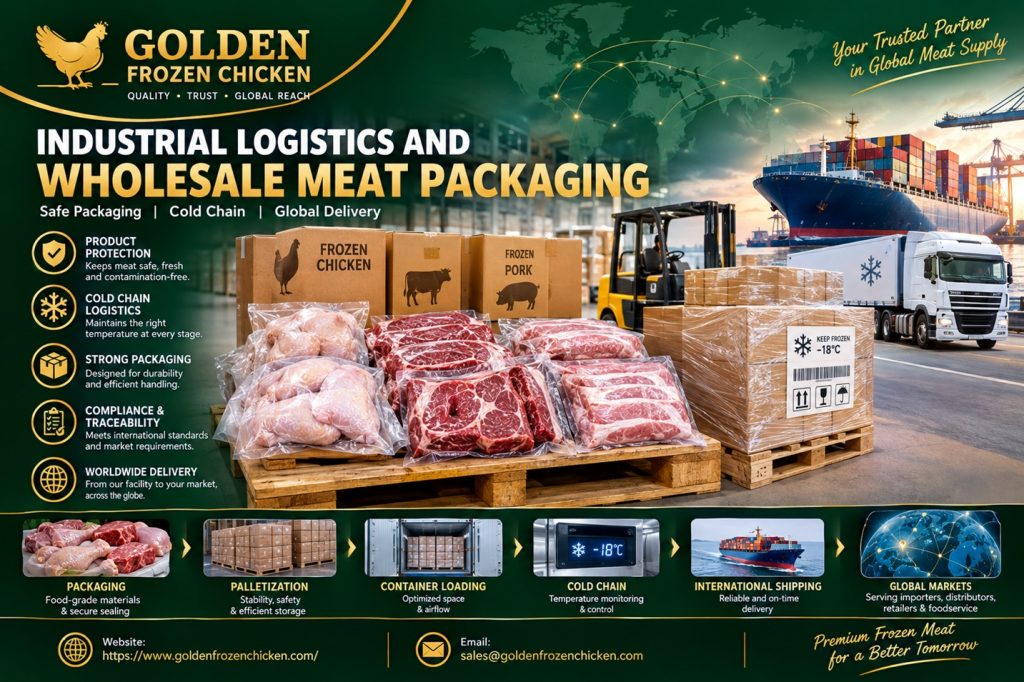
The international frozen meat industry depends on more than producing and freezing quality products. For importers, wholesalers, distributors, food manufacturers, retailers, restaurants, hotels, and foodservice companies, the way frozen meat is packaged, stored, handled, transported, and delivered can have a direct impact on product quality and supply-chain efficiency.
For this reason, Wholesale Frozen Meat Packaging should be considered an essential part of the complete export strategy rather than simply a final step before shipping.
At GOLDEN FROZEN CHICKEN, we supply frozen chicken, chicken parts, beef, beef parts, and pork products to international markets. Our website states that we work with international buyers across multiple sectors and provide wholesale products with worldwide shipping capabilities.
Explore our Golden Frozen Chicken product range to see examples of frozen meat products available for international buyers.
In this guide, we examine the key principles behind industrial frozen meat packaging and logistics, including packaging materials, carton specifications, palletization, labeling, cold-chain management, container loading, traceability, and international delivery.
What Is Wholesale Frozen Meat Packaging?
Wholesale Frozen Meat Packaging refers to the systems and materials used to protect frozen meat products during processing, storage, handling, transportation, and distribution.
Unlike small retail packaging, wholesale packaging must be designed around significantly larger quantities and more demanding logistics.
A wholesale frozen meat shipment may travel through several stages:
Processing → Freezing → Primary Packaging → Cartoning → Palletization → Cold Storage → Container Loading → Ocean Freight → Port Clearance → Distribution → Customer Storage
Every stage presents opportunities for temperature changes, physical damage, contamination, labeling errors, or handling problems.
The packaging therefore needs to provide several functions at the same time:
- Product protection
- Hygiene
- Physical strength
- Moisture protection
- Temperature stability
- Identification
- Traceability
- Efficient warehouse handling
- Efficient container utilization
- Regulatory compliance
Codex guidance states that food packaging should provide adequate protection against contamination and damage and should accommodate appropriate labeling. It also emphasizes that food transportation should protect products and maintain conditions necessary for food safety and quality.
Why Packaging Matters in the Frozen Meat Industry
Frozen meat can spend weeks or months moving through the international supply chain.
During this period, the product may be exposed to:
- Mechanical handling
- Forklift movement
- Pallet stacking
- Container loading
- Port operations
- Long-distance transportation
- Temperature fluctuations
- Condensation
- Humidity
- Repeated loading and unloading
Strong packaging helps protect the product during these activities.
FAO guidance on meat cold stores notes that frozen meat is commonly handled using pallets and mechanical equipment and emphasizes the importance of package strength, palletization, identification, and controlled storage.
For an importer purchasing an entire container of frozen chicken or beef, packaging quality can therefore be just as important as the product specification.
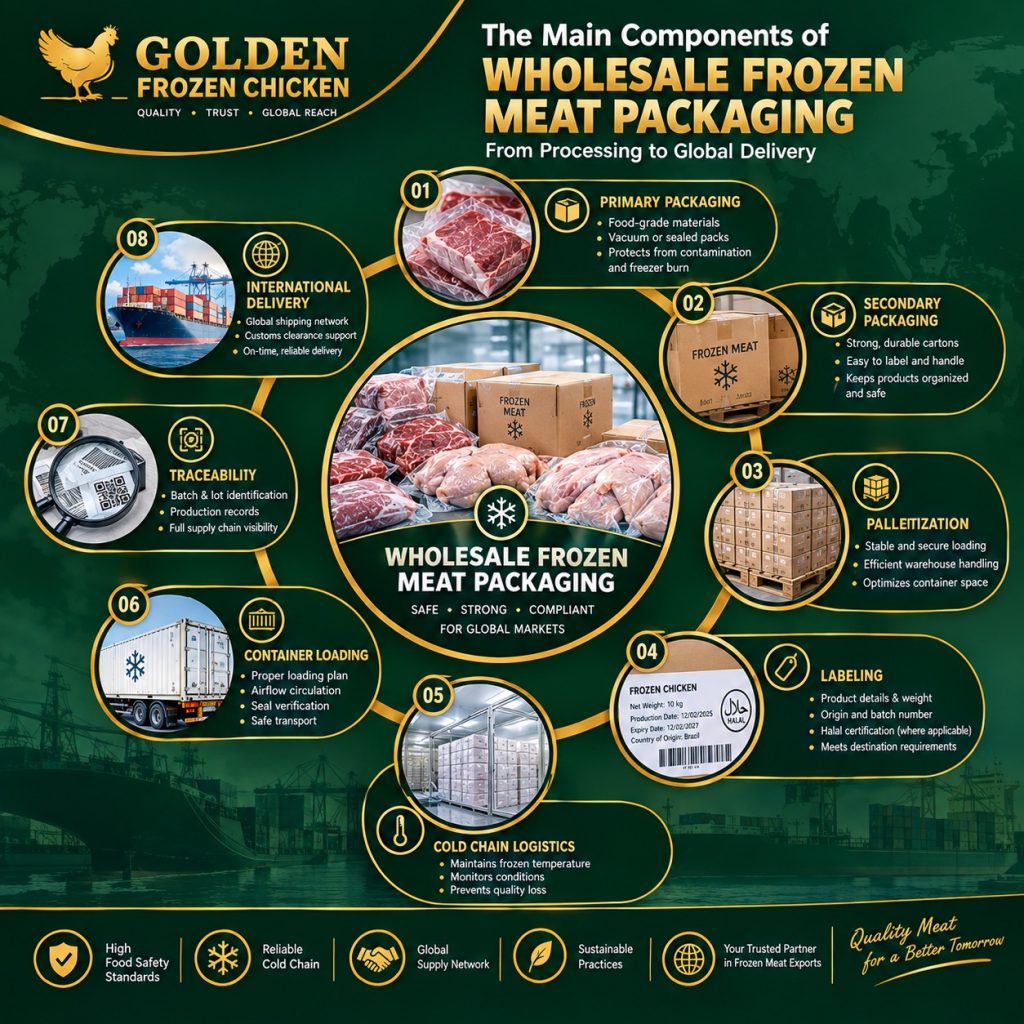
The Main Components of Wholesale Frozen Meat Packaging
A professional packaging system normally includes several layers.
1. Primary Packaging
Primary packaging is the material that directly protects the meat.
Depending on the product, this can include:
- Food-grade plastic
- Polyethylene film
- Vacuum packaging
- Individual wrapping
- Inner bags
- Other approved food-contact materials
The purpose is to reduce exposure to contamination, moisture loss, freezer burn, and physical damage.
The specific packaging method should be selected according to the product, freezing process, destination market, storage period, and buyer requirements.
2. Secondary Packaging
Secondary packaging normally groups individual products into a larger commercial unit.
For frozen meat, cartons are commonly used because they are easy to:
- Stack
- Label
- Move
- Store
- Count
- Inspect
- Load into containers
Golden Frozen Chicken publishes different carton specifications across its product range. For example, its frozen beef striploin page lists 10/15/20 kg cartons, illustrating how commercial packaging can be structured around wholesale requirements.
Packaging specifications should always be agreed with the buyer before production.
3. Outer Carton Strength
A frozen meat carton needs sufficient structural strength to withstand stacking and mechanical handling.
Weak cartons can lead to:
- Crushed boxes
- Damaged labels
- Product exposure
- Pallet instability
- Difficult warehouse handling
- Increased product loss
The correct carton specification depends on factors such as:
- Product weight
- Carton dimensions
- Storage duration
- Stacking height
- Pallet configuration
- Humidity
- Transportation method
- Container loading pattern
Packaging should therefore be designed around the entire logistics chain rather than only the factory.
4. Palletization
Palletization is an important part of industrial frozen meat logistics.
A pallet creates a standardized handling unit that can be moved with:
- Forklifts
- Pallet jacks
- Warehouse equipment
- Container-loading equipment
Good palletization can improve:
Handling speed + Warehouse efficiency + Container utilization + Product protection
Poor palletization can result in unstable loads, crushed cartons, inefficient use of container space, and additional handling.
FAO guidance describes the use of pallets and mechanical handling as common practices in frozen meat storage and recommends that storage layouts allow products to be identified and moved efficiently.
5. Carton Weight and Container Utilization
For international wholesale buyers, carton weight is not simply a packaging decision.
It can influence:
- Number of cartons per container
- Pallet configuration
- Handling requirements
- Warehouse capacity
- Freight efficiency
- Labor requirements
- Inventory management
For example, a buyer may request a specific carton size because its warehouse, distribution center, or retail operation is already designed around that format.
Golden Frozen Chicken states that packaging sizes can be tailored for wholesale and retail purposes according to buyer requirements.
This flexibility can be useful when developing long-term supply arrangements.
6. Product Labeling
Correct labeling is an essential component of Wholesale Frozen Meat Packaging.
A commercial meat carton may need to identify:
- Product name
- Product type
- Cut
- Net weight
- Gross weight
- Country of origin
- Production date
- Expiry or best-before information
- Batch number
- Lot number
- Establishment information
- Storage conditions
- Certification information
- Importer information
- Other destination-specific information
Codex guidance emphasizes lot identification and product information so that food can be properly handled, stored, traced, and used throughout the food chain.
Labeling requirements vary by destination, so international exporters should confirm the requirements of the importing authority before production.
7. Traceability and Batch Identification
Traceability is particularly important for international meat distribution.
Every commercial shipment should be connected to identifiable production information.
A simplified traceability chain might look like:
Production → Processing → Batch → Packaging → Cold Store → Container → Bill of Lading → Importer
If a quality or documentation issue occurs, traceability allows the affected products to be identified more efficiently.
Useful information can include:
- Batch number
- Lot number
- Production date
- Processing establishment
- Product code
- Carton identification
- Container number
- Seal number
- Shipping date
- Destination
For large-scale importers and distributors, this information can also support inventory management and stock rotation.
Frozen Meat Cold-Chain Logistics
Packaging cannot replace proper cold-chain management.
A high-quality carton will not protect a frozen meat product if the product is exposed to inappropriate temperatures for extended periods.
Codex guidance states that food transportation should provide conditions capable of maintaining the temperature and other environmental conditions required to protect food from deterioration and microbial growth.
The frozen-food supply chain should therefore be managed as one continuous system.
The cold chain generally includes:
Processing
↓
Freezing
↓
Cold Storage
↓
Pre-Loading Inspection
↓
Reefer Container
↓
Port Handling
↓
Ocean Transportation
↓
Destination Port
↓
Customs Clearance
↓
Cold Storage
↓
Final Distribution
Any unnecessary interruption can increase the risk of quality deterioration.
Maintaining Frozen Temperatures
International quick-frozen food guidance uses -18°C as a reference temperature for storage and distribution of quick-frozen foods. FAO and WHO reported in 2026 that the Codex Code of Practice for Processing and Handling of Quick Frozen Foods currently establishes -18°C as the reference temperature.
However, exporters and importers should always follow the applicable product specification and destination-country regulations.
Golden Frozen Chicken product specifications also commonly identify frozen storage and transportation conditions; for example, its whole beef carcass page lists storage and transportation specifications for the product.
The important principle is consistency: frozen products should remain within the required conditions throughout the supply chain.
Reefer Containers for Wholesale Frozen Meat
For international sea freight, refrigerated containers—commonly called reefers—are central to frozen meat logistics.
A properly managed reefer shipment should involve:
- Container inspection
- Pre-cooling where appropriate
- Temperature setting
- Cleanliness inspection
- Loading plan
- Airflow management
- Seal verification
- Temperature monitoring
- Shipping documentation
Codex guidance for quick-frozen foods emphasizes that refrigerated transport equipment should be suitable for maintaining the required temperature and that loading should be organized to permit proper circulation of refrigerated air.
Efficient Container Loading
Container loading is one of the most important stages in international frozen meat logistics.
The objective is not simply to put as much product as possible into the container.
The loading plan should balance:
Capacity + Stability + Airflow + Weight Distribution + Product Protection
The cargo should be arranged so that refrigerated air can circulate appropriately.
Improper loading can create:
- Blocked airflow
- Uneven temperature distribution
- Unstable cartons
- Damaged products
- Poor container utilization
Codex guidance recommends standardized load units and appropriate loading practices for quick-frozen foods to reduce exposure to uncontrolled environmental conditions.
Packaging and Airflow
An important point in frozen-food logistics is that packaging should protect the product without unnecessarily obstructing refrigeration airflow.
The container’s refrigeration system is intended primarily to maintain the required conditions of cargo that has already been properly frozen and prepared for transport.
The international quick-frozen-food code notes that transport equipment is generally designed to maintain cargo temperature rather than rapidly remove heat gained during loading.
This is why loading frozen products efficiently and minimizing exposure to warm environments are important.
Industrial Warehouse Management
Wholesale frozen meat packaging must also work within the warehouse.
A commercial cold store should be organized to support:
- Product identification
- FIFO/FEFO systems where applicable
- Pallet movement
- Inventory control
- Batch traceability
- Safe forklift operations
- Temperature monitoring
- Cleaning and sanitation
The packaging format should allow warehouse staff to identify products without repeatedly opening cartons.
This is especially important for businesses handling hundreds or thousands of cartons.
Packaging for Different Frozen Meat Products
Different meat categories may require different packaging strategies.
Frozen Chicken Packaging
Frozen chicken may be supplied as:
- Whole chicken
- Chicken breast
- Chicken thighs
- Chicken wings
- Drumsticks
- Leg quarters
- Chicken feet and paws
- Offals
- Other chicken parts
Golden Frozen Chicken’s product range includes multiple frozen chicken cuts and parts.
The packaging specification should reflect the cut, weight, freezing method, intended market, and buyer’s requirements.
For example, a restaurant distributor may require a different carton configuration from a supermarket wholesaler.
Frozen Beef Packaging
Beef products can have very different shapes, weights, and handling requirements.
Golden Frozen Chicken’s published product range includes beef cuts such as:
- Rib eye
- Striploin
- T-bone
- Short rib
- Chuck
- Shank
- Shoulder
Its product pages demonstrate different commercial specifications and carton formats for frozen beef products.
For buyers, it is important to establish whether products are:
- Bone-in
- Boneless
- Vacuum packed
- Individually packed
- Bulk packed
- Carton packed
before confirming a purchase order.
Frozen Pork Packaging
Frozen pork also requires packaging designed around the specific cut and application.
Wholesale pork buyers may require:
- Pork belly
- Pork shoulder
- Pork hock
- Pork loin
- Pork neck
- Pork feet
- Specialty cuts
Packaging requirements may vary significantly between food manufacturers and distributors.
Golden Frozen Chicken’s published pork sourcing information emphasizes the importance of cut specifications, packaging, documentation, cold-chain performance, and custom requirements for wholesale buyers.
Custom Packaging for Wholesale Buyers
One of the biggest advantages of working directly with an international supplier is the possibility of establishing packaging specifications around the buyer’s requirements.
Depending on product and market, buyers may discuss:
- Carton weight
- Carton dimensions
- Product quantity per carton
- Label design
- Private-label requirements
- Pallet configuration
- Individual wrapping
- Bulk packaging
- Vacuum packaging
- Language requirements
- Barcode requirements
Golden Frozen Chicken states that packaging sizes can be tailored for wholesale and retail purposes.
This can be especially valuable for importers supplying multiple distribution channels.
Packaging and International Regulations
Packaging is also a regulatory issue.
An export shipment may need to comply with the food-import regulations of the destination country.
Requirements can cover:
- Food-contact materials
- Labeling
- Country of origin
- Product identification
- Weight declarations
- Establishment information
- Health certificates
- Storage instructions
- Language
- Importer details
Exporters should therefore confirm requirements with the importer and relevant government authorities before production.
The Codex Alimentarius food hygiene codes provide internationally recognized food-hygiene guidance, including the General Principles of Food Hygiene and the Code of Practice for the Processing and Handling of Quick Frozen Foods.
Hygiene and Packaging Controls
Packaging operations should be integrated into the facility’s food-safety system.
Controls can include:
- Clean packaging areas
- Approved food-contact materials
- Supplier verification
- Packaging inspections
- Pest control
- Employee hygiene
- Equipment sanitation
- Foreign-material controls
- Temperature controls
- Batch identification
Codex guidance emphasizes that packaging materials should not pose a food-safety risk and that transportation equipment should be clean and suitable for food.
Reducing Packaging Damage During Transportation
International frozen meat can travel thousands of kilometers before reaching its final customer.
The packaging therefore needs to withstand:
- Forklift handling
- Pallet movement
- Container vibration
- Stacking
- Loading and unloading
- Port operations
- Long-distance shipping
A good logistics plan should minimize unnecessary manual handling.
FAO’s meat cold-store guidance describes mechanical handling and palletized frozen meat as important methods for efficient movement and storage.
The Importance of Documentation
Packaging and logistics are closely connected to export documentation.
A commercial shipment may involve:
- Commercial invoice
- Packing list
- Certificate of origin
- Health certificate
- Veterinary documentation
- Halal certificate where applicable
- Bill of lading
- Container number
- Seal number
- Product specification
- Import documentation
The information on cartons should be consistent with the shipping documents.
A mismatch between the physical shipment and documents can create unnecessary delays at customs.
How Buyers Should Evaluate Frozen Meat Suppliers
When selecting a wholesale frozen meat supplier, buyers should look beyond product price.
Consider the supplier’s:
Product Capability
Can the supplier consistently provide the required cuts, grades, weights, and specifications?
Packaging Capability
Can packaging be adapted to your wholesale or retail requirements?
Cold-Chain Capability
Can the supplier maintain frozen conditions through storage and transportation?
Documentation
Can the supplier provide the required export documentation?
Traceability
Can products be linked to batches and production information?
Logistics
Does the supplier have experience arranging international refrigerated transportation?
Communication
Can the supplier provide clear specifications, quotations, production details, and shipping information?
These factors can have a major influence on the real cost and reliability of an international frozen meat supply program.
GOLDEN FROZEN CHICKEN: International Frozen Meat Supply
GOLDEN FROZEN CHICKEN is an international producer and distributor of frozen chicken, beef, and pork products. The company’s website states that it serves importers, manufacturers, wholesalers, supermarket chains, restaurants, hotels, airlines, and distributors in international markets.
Our Frozen Chicken Products provide access to a range of poultry products and parts for wholesale buyers.
Our Frozen Beef Products include multiple commercial beef cuts for international markets.
Buyers can also explore our complete product portfolio for additional frozen meat options.
For specific poultry requirements, our Chicken Drumsticks page provides product information for one of the commercial cuts available from Golden Frozen Chicken.
For beef buyers, our Beef Striploin Steak provides an example of the packaging and storage information available for selected products.
Our Halal Meat Wholesale for Middle East Markets article provides additional information for buyers sourcing Halal frozen meat for Middle Eastern markets.
Buyers interested in compliance can also read our Halal Meat Export Standards: A Compliance Checklist.
For buyers comparing poultry cuts, our Wholesale Frozen Chicken Thighs vs. Drumsticks provides additional product-selection information.
Our About Golden Frozen Chicken page provides more information about our international business and product supply network.
For quotations, product specifications, packaging requirements, and international orders, buyers can Contact Golden Frozen Chicken.