
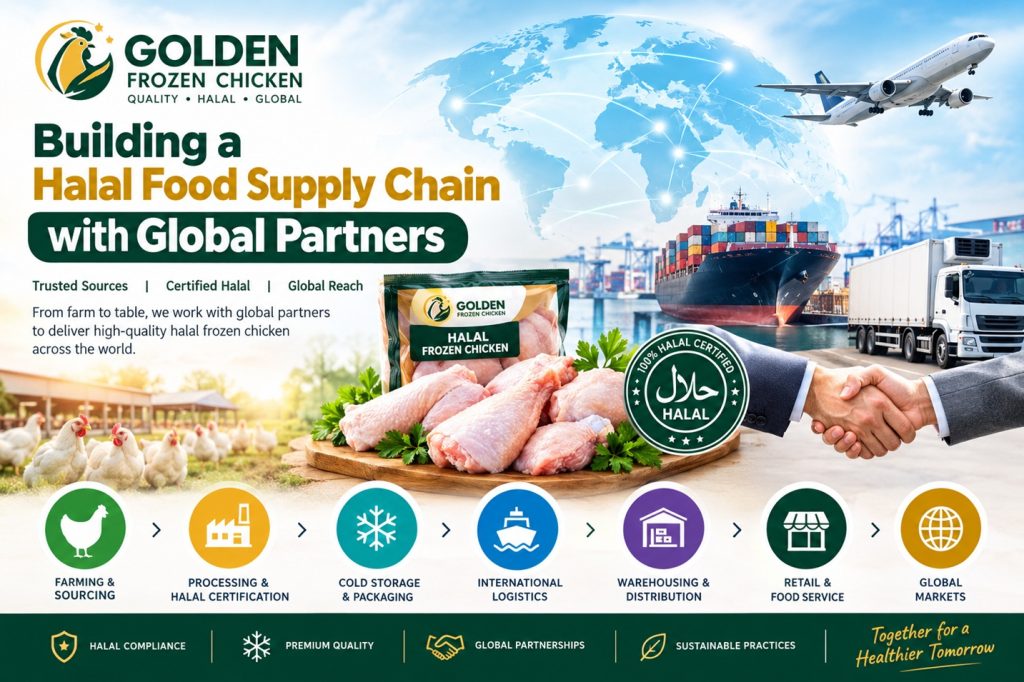
The global halal food industry is becoming increasingly interconnected. Consumers, retailers, wholesalers, restaurants and food-service companies are looking for reliable suppliers that can provide halal products while maintaining consistent standards for quality, safety, traceability and delivery.
For businesses operating internationally, building a successful Halal Food Supply Chain with Global Partners requires much more than simply purchasing halal-certified products. A dependable supply chain must bring together farmers, poultry processors, manufacturers, certification organizations, cold-chain providers, logistics companies, importers, distributors and retailers.
For a frozen poultry business such as Golden Frozen Chicken, developing strong international partnerships can help create a supply network capable of serving customers across different markets while maintaining product integrity from origin to destination.
International halal standards increasingly address the entire food chain rather than focusing only on the final product. For example, OIC/SMIIC 1:2019 establishes general halal requirements applicable at different stages of the food chain, while related standards cover halal certification, transportation, warehousing and other areas.
This article explores the key elements involved in creating an effective Halal Food Supply Chain with Global Partners.
What Is a Halal Food Supply Chain?
A halal food supply chain is the network of businesses, processes and logistics systems involved in producing, processing, storing, transporting and delivering food that complies with applicable halal requirements.
The supply chain can begin with animal feed and farming and continue through:
- Animal production
- Processing and slaughter
- Halal certification
- Food preparation
- Packaging
- Cold storage
- Transportation
- Import and export
- Wholesale distribution
- Retail
- Food service
- Final consumption
Halal integrity therefore needs to be considered throughout the journey.
The Codex Alimentarius Commission has published guidelines concerning the use of the term “halal” in food labelling and recognizes that interpretations can differ between Islamic schools of thought and importing-country authorities.
For international businesses, this makes understanding the requirements of individual destination markets particularly important.
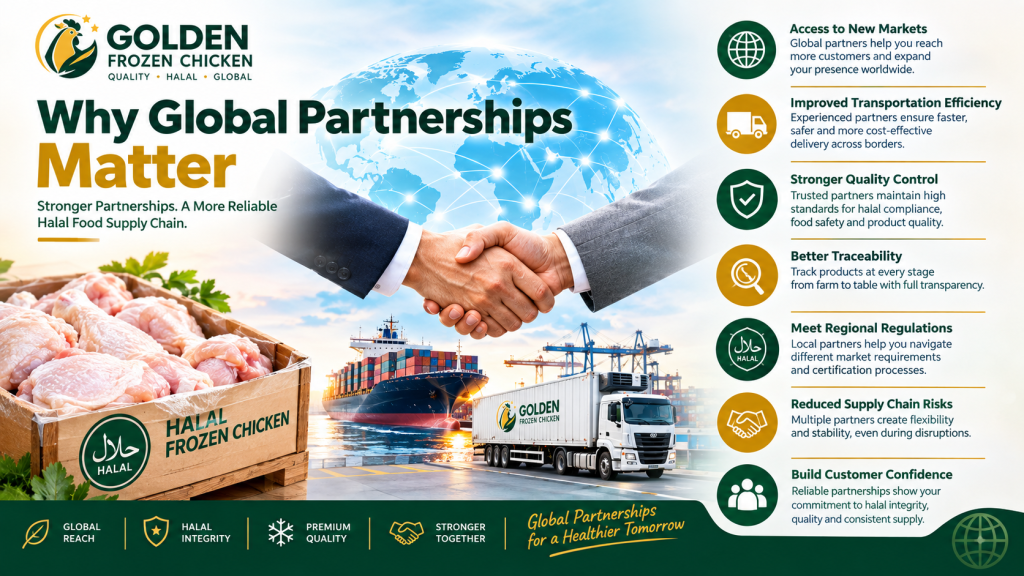
Why Global Partnerships Matter
International food distribution depends on cooperation.
A single company may not control every stage of the supply chain. Instead, it may rely on specialized partners for production, certification, transportation, warehousing, customs clearance and distribution.
The right partners can help businesses:
- Access new markets
- Increase product availability
- Improve transportation efficiency
- Maintain cold-chain requirements
- Strengthen quality control
- Improve traceability
- Reduce supply interruptions
- Meet market-specific regulatory requirements
- Build customer confidence
- Expand product ranges
For Golden Frozen Chicken, developing long-term relationships with dependable international partners can create a more resilient distribution network for halal frozen poultry products.
1. Establish Clear Halal Requirements
The first step in creating a Halal Food Supply Chain with Global Partners is establishing exactly what halal requirements apply to the products and markets involved.
Different markets may have different certification, labelling, import and documentation requirements.
Businesses should therefore identify:
- Applicable halal standards
- Approved certification organizations
- Import requirements
- Product documentation
- Labelling requirements
- Slaughter requirements
- Storage requirements
- Transportation requirements
- Traceability expectations
- Food-safety obligations
OIC/SMIIC maintains standards covering areas including general halal food requirements, halal certification bodies, preparation and storage, food additives and halal supply-chain management.
The Codex guidelines also emphasize that importing countries can have specific requirements concerning halal claims and certification.
This means businesses should avoid assuming that one certification automatically satisfies every destination market.
2. Work With Reliable Halal Suppliers
Supplier selection is one of the most important components of a global halal supply chain.
A supplier should be evaluated based on more than price.
Important considerations include:
Halal certification
Businesses should verify whether the supplier’s products and processes are covered by recognized halal certification arrangements applicable to the intended market.
Product quality
Quality specifications should be established before purchasing, including:
- Product type
- Weight
- Packaging
- Frozen condition
- Shelf life
- Storage requirements
- Country of origin
- Production standards
Food safety
Halal status and food safety are closely connected within a responsible food supply chain. SMIIC notes that food safety and traceability are prerequisites within its halal framework.
Reliability
A supplier should have the capacity to maintain consistent supply volumes and agreed specifications.
Documentation
International shipments may require appropriate commercial, food-safety, origin, certification and customs documentation.
Building supplier relationships around transparency and documentation can significantly reduce supply-chain problems.
3. Protect Halal Integrity During Processing
Halal integrity does not end when an animal is processed.
Processing facilities should have systems designed to prevent contamination or mixing with products that do not meet applicable halal requirements.
This may involve controls covering:
- Processing equipment
- Utensils
- Production lines
- Cleaning
- Storage
- Packaging
- Product identification
- Personnel procedures
- Transportation
OIC/SMIIC 1:2019 addresses halal requirements relating to production, processing, machinery, utensils, storage, transport, hygiene, verification, traceability, packaging and labelling.
For businesses building international partnerships, suppliers should be able to explain how these controls are implemented and documented.
4. Build Strong Traceability Systems
Traceability is one of the foundations of a modern food supply chain.
A strong traceability system should allow a company to determine where products came from, how they were processed and where they were distributed.
For frozen poultry, useful information can include:
- Supplier identification
- Production facility
- Production date
- Batch or lot number
- Product specification
- Certification information
- Packaging information
- Storage location
- Shipping documentation
- Destination
- Distribution records
Traceability becomes particularly important when products cross international borders.
If a quality issue occurs, businesses need to be able to identify the affected batch quickly rather than disrupting their entire inventory.
5. Develop a Reliable Cold Chain
Frozen poultry requires controlled temperatures throughout its journey.
The cold chain can involve:
Processing → Freezing → Cold Storage → Loading → Transportation → Port → Import → Warehouse → Distribution → Customer
Every transition creates an opportunity for temperature control to fail.
Global partners should therefore agree on:
- Required storage temperatures
- Transportation conditions
- Loading procedures
- Container requirements
- Temperature monitoring
- Emergency procedures
- Delivery documentation
- Product inspection
Cold-chain management should be considered when selecting logistics companies, warehouses and distribution partners.
A strong halal supply chain is not only about whether a product meets halal requirements. It is also about preserving its quality and safety throughout transportation.
6. Select Experienced International Logistics Partners
International logistics can involve multiple parties.
Depending on the shipment, these may include:
- Freight forwarders
- Shipping companies
- Port operators
- Customs brokers
- Cold-storage providers
- Trucking companies
- Importers
- Local distributors
Each partner should understand the requirements associated with frozen food.
Communication is especially important when shipments cross multiple jurisdictions.
Documentation errors, customs delays, inadequate cold storage or poor communication can create significant costs.
For this reason, companies developing a Halal Food Supply Chain with Global Partners should assess logistics providers as carefully as they assess food suppliers.
7. Create Transparent Documentation
Documentation provides the evidence behind the supply chain.
Depending on the market and shipment, documentation may include:
- Commercial invoices
- Packing lists
- Certificates of origin
- Health certificates
- Halal certificates
- Product specifications
- Shipping documents
- Temperature records
- Import permits
- Customs documentation
Codex guidance on food import and export inspection systems emphasizes the importance of systems that protect consumers while facilitating international food trade.
Businesses should therefore establish a document-management process before shipments leave the origin country.
8. Understand Country-Specific Requirements
One of the biggest challenges of international halal trade is that requirements can vary between markets.
A company exporting halal frozen chicken may need to consider the rules of both the exporting and importing countries.
These requirements can relate to:
- Halal certification
- Animal slaughter
- Labelling
- Food safety
- Veterinary documentation
- Import approval
- Customs
- Packaging
- Product registration
Codex specifically notes that importing countries may have their own requirements relating to halal claims and certification.
Therefore, international businesses should verify requirements with the relevant authorities, certification bodies and experienced import partners before beginning shipments.
9. Develop Long-Term Global Partnerships
Successful supply chains are usually built around relationships rather than individual transactions.
A company should aim to develop long-term partnerships with:
Producers
Reliable producers provide consistency in product specifications and availability.
Halal certification organizations
Certification partners can help businesses understand applicable halal requirements and maintain certification processes.
Logistics providers
Experienced logistics partners can help maintain temperature control and coordinate international shipments.
Importers
Local importers understand the destination market and can help navigate documentation and regulatory requirements.
Wholesalers
Wholesale partners can expand market reach and help connect suppliers with retailers and food-service businesses.
Retailers and food-service operators
Understanding customer requirements helps suppliers develop products that meet actual market demand.
10. Use Technology to Improve Supply-Chain Visibility
Technology can make global supply chains easier to monitor.
Businesses can use digital systems to manage:
- Inventory
- Purchase orders
- Batch numbers
- Certifications
- Shipping information
- Temperature records
- Supplier information
- Customer orders
- Delivery status
Digital traceability can help businesses respond more quickly when there is a problem.
It can also make communication between international partners more efficient.
As halal food supply chains become increasingly global, digital documentation and data-sharing can become important tools for maintaining transparency.
11. Build a Strong Supplier Verification Process
A supplier should be reviewed before entering a long-term partnership.
A practical supplier assessment can examine:
Certification: Is the supplier’s halal certification current and appropriate?
Quality: Does the product meet agreed specifications?
Capacity: Can the supplier maintain expected volumes?
Traceability: Can batches be tracked through the supply chain?
Food safety: Does the supplier maintain appropriate food-safety systems?
Documentation: Can required export documents be provided?
Cold chain: Can frozen products be stored and transported correctly?
Reliability: Does the company have a history of dependable supply?
Communication: Can the supplier respond quickly to questions and problems?
This process helps businesses avoid selecting suppliers based solely on price.
12. Maintain Halal Compliance Throughout Storage
Warehousing is an important part of the Halal Food Supply Chain with Global Partners.
Products should remain identifiable and properly controlled after arriving at a warehouse.
Important warehouse controls may include:
- Product identification
- Batch tracking
- Segregation where required
- Temperature monitoring
- Cleaning procedures
- Stock rotation
- Access control
- Documentation
- Loading and unloading procedures
OIC/SMIIC maintains specific standards for halal transportation and warehousing, demonstrating that supply-chain integrity extends beyond production itself.
13. Create Contingency Plans
Global food supply chains can experience unexpected disruptions.
Potential challenges include:
- Port congestion
- Shipping delays
- Weather events
- Equipment failure
- Customs problems
- Supplier shortages
- Transport interruptions
- Regulatory changes
- Unexpected increases in demand
A resilient supply chain should have contingency plans.
For example, businesses may establish relationships with multiple qualified suppliers or logistics providers rather than depending entirely on one source.
However, alternative suppliers should be evaluated carefully to ensure they meet the same product, quality, halal and regulatory requirements.
14. Focus on Quality as Well as Halal Compliance
Halal certification is an important component of halal food, but customers also expect quality.
For frozen chicken, quality considerations can include:
- Product appearance
- Weight consistency
- Packaging integrity
- Frozen condition
- Shelf life
- Storage
- Food safety
- Delivery reliability
Building a reputation around consistent quality can help a company develop long-term relationships with wholesalers, retailers, restaurants and food-service businesses.
The goal should be to create a supply chain where halal compliance and product quality work together rather than being treated as separate responsibilities.
15. Communicate Clearly With Global Partners
International supply chains often involve businesses operating in different languages, time zones and regulatory environments.
Clear communication can prevent misunderstandings.
Before beginning a partnership, businesses should establish:
- Product specifications
- Order quantities
- Delivery schedules
- Payment arrangements
- Certification requirements
- Documentation responsibilities
- Packaging requirements
- Temperature requirements
- Quality expectations
- Complaint procedures
Written agreements and standardized documentation can make international cooperation easier.
16. Build Consumer Confidence
Ultimately, the purpose of a halal supply chain is to deliver trustworthy food to consumers.
Customers increasingly want confidence in where food comes from and how it has been handled.
A company can strengthen confidence by communicating clearly about:
- Product origin
- Halal certification
- Quality procedures
- Food safety
- Traceability
- Storage
- Distribution
The information provided to customers should always be accurate and supported by appropriate documentation.
Businesses should avoid making broad halal claims that cannot be substantiated.
The Role of Golden Frozen Chicken
For a company such as Golden Frozen Chicken, the development of international halal partnerships can provide a framework for connecting reliable suppliers, logistics providers, distributors and customers.
A strong supply chain can support the movement of frozen chicken products across international markets while emphasizing:
- Product quality
- Halal integrity
- Reliable sourcing
- Cold-chain management
- Traceability
- Professional logistics
- International partnerships
- Customer service
Businesses looking to develop relationships in the frozen poultry sector can explore the company’s website at Golden Frozen Chicken.
A well-organized supply chain can also help wholesalers and food-service businesses plan their purchasing more effectively.
The Future of Global Halal Food Supply Chains
The future of halal food distribution is likely to involve increasing cooperation between suppliers, certification organizations, governments, logistics providers and international buyers.
Standards organizations are continuing to develop and refine halal-related standards. SMIIC, for example, currently maintains standards addressing halal food, certification, warehousing, transportation, food additives and other areas of the halal ecosystem.
SMIIC has also been conducting training and capacity-building activities in 2026 aimed at strengthening knowledge and implementation of halal standards.
This highlights the importance of businesses keeping their knowledge and compliance systems up to date.
As international halal food trade continues to develop, companies that invest in supplier relationships, documentation, traceability, cold-chain systems and transparent communication will be better positioned to participate in global markets.
Conclusion
Building a successful Halal Food Supply Chain with Global Partners requires coordination across the entire journey of a food product.
From sourcing and processing to certification, packaging, cold storage, transportation, importation and distribution, every stage can influence product integrity.
For Golden Frozen Chicken and its international partners, the objective should be to establish a supply chain based on quality, transparency, traceability, halal compliance and dependable international cooperation.
The strongest partnerships are built through clear standards, reliable communication, accurate documentation and consistent performance.
By bringing together trusted suppliers, qualified certification organizations, experienced logistics providers, importers, wholesalers and distributors, businesses can develop a more resilient and transparent halal food network capable of serving customers across international markets.