

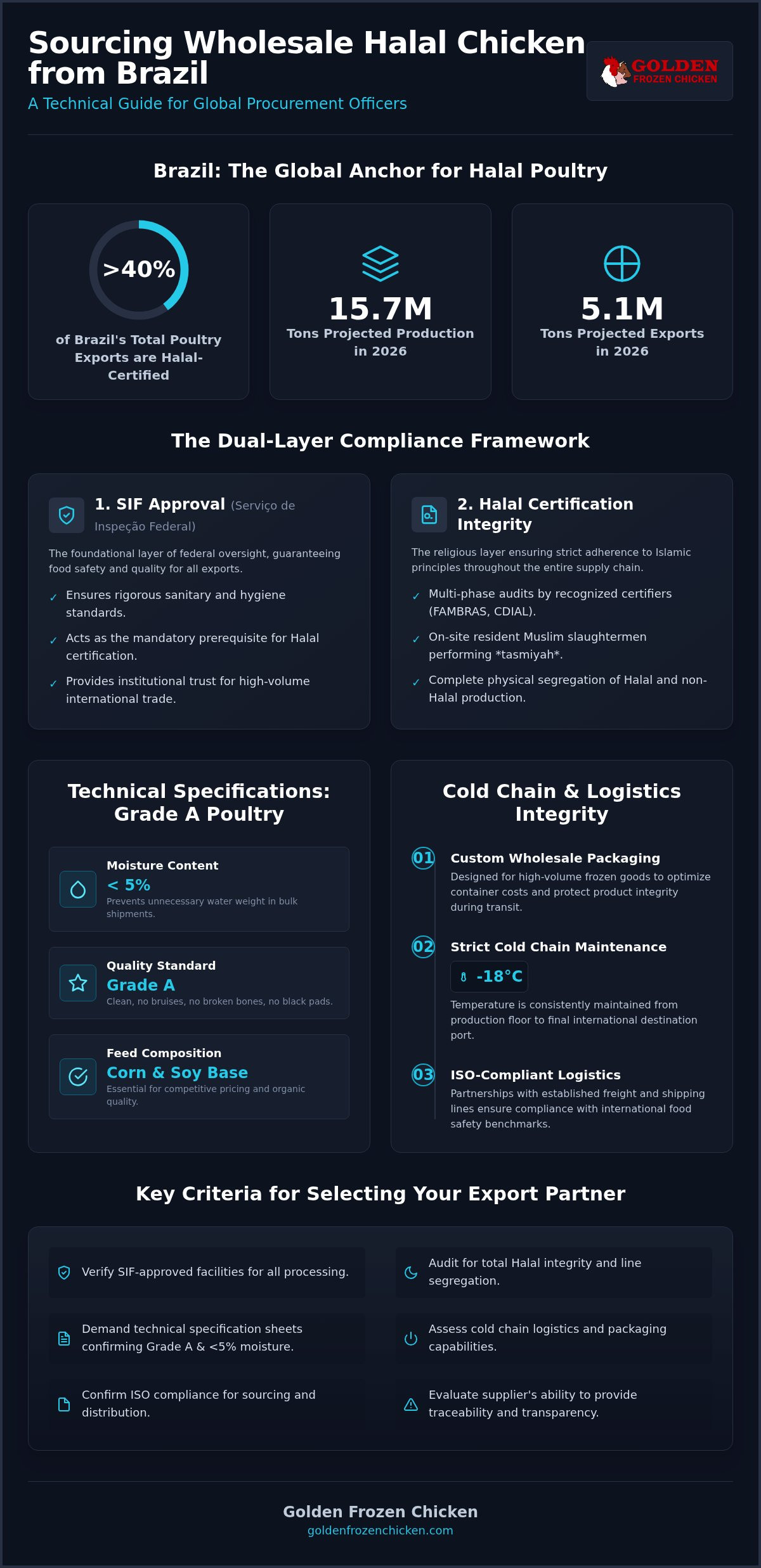
Over 40% of Brazil’s total poultry export volume is now Halal-certified, cementing the nation’s position as the world’s most critical partner for Islamic markets in 2026. For global procurement officers, the challenge isn’t simply locating volume; it’s identifying wholesale halal chicken suppliers brazil that can guarantee 100% authenticity without compromising on moisture standards or logistical reliability. You understand that a single lapse in certification or a failure in SIF compliance can disrupt an entire regional distribution network.
This guide provides the technical roadmap to master the complexities of sourcing high-volume, Halal-certified poultry with absolute confidence. We’ll detail the evolution of Brazilian export regulations, strategies for optimizing bulk container costs, and the rigorous ISO-compliant standards required to maintain a stable supply chain. By the end of this manual, you’ll possess the insights needed to secure a steady hand partnership that bridges the gap between Brazilian production floors and your final global destination.
Key Takeaways
- Understand the strategic role of a Brazilian exporter as a dependable bridge between local industrial production and your specific international market requirements.
- Learn to audit SIF-approved facilities and verify the rigorous protocols of resident Muslim slaughtermen to ensure total Halal integrity across your supply chain.
- Master the technical specifications for Grade A poultry, including maintaining moisture levels below 5% to prevent unnecessary water weight in bulk shipments.
- Discover how to optimize logistics costs by utilizing custom wholesale packaging and maintaining strict cold chain integrity at -18°C for international distribution.
- Evaluate the criteria for selecting leading wholesale halal chicken suppliers brazil that provide ISO-compliant sourcing for organic frozen poultry and beef parts.
The Strategic Role of Wholesale Halal Chicken Suppliers in Brazil
The role of wholesale halal chicken suppliers brazil extends beyond simple trade. These entities serve as the primary logistical and compliance bridge between Brazil’s massive production capacity and the specific needs of global industrial buyers. Brazil’s poultry production is projected to reach a record 15.7 million tons in 2026, with exports expected to hit 5.1 million tons. This scale isn’t accidental. It’s the result of decades of investment in vertically integrated supply chains that allow for high-volume scalability. Industrial food sectors in the Middle East, Southeast Asia, and Africa depend on this consistency to maintain their own processing lines and retail distribution networks. Markets such as the United Arab Emirates, Saudi Arabia, and China remain the primary destinations, accounting for a significant portion of the record 2.936 million tonnes exported in the first half of 2026 alone.
Why Global Distributors Prioritise Brazilian Poultry
Distributors choose Brazil because of the unmatched cost-efficiency found in its large-scale integrated production systems. The country’s abundance of corn and soy provides a stable feed base, which is essential for producing organic Grade A quality poultry at a competitive price point. Reliability is the cornerstone of this trade. Brazil’s export infrastructure is built for high-volume frozen goods, ensuring that products move from the production floor to international ports with total cold chain integrity. Partnerships with SIF-approved facilities and ISO-compliant manufacturers ensure that every shipment meets international food safety benchmarks equivalent to those in the EU or US. This established system provides a steady hand for global buyers who require a stable and ethical supply chain.
The 2026 Outlook for Halal Meat Sourcing
The global market is shifting toward higher demands for transparency and traceability. Buyers now require more than just a label; they demand proof of rigorous Halal certification standards throughout the entire processing cycle. This includes multi-phase audits and the presence of resident Muslim slaughtermen to ensure total compliance. There’s also a growing preference for organic and “clean label” wholesale poultry, as distributors move away from heavily processed options in favor of frozen parts that meet higher health standards. Leading wholesale halal chicken suppliers brazil are adapting by integrating advanced tracking and expanding their organic offerings to meet these sophisticated consumer preferences. Brazil remains the definitive global anchor for the Halal poultry trade, providing the only industrial-scale solution that aligns high-volume logistical efficiency with uncompromising religious integrity.
Rigorous Compliance: SIF Approval and Halal Certification Standards
Exporting poultry from Brazil requires adherence to a dual-layered regulatory framework that combines federal oversight with religious strictness. The Serviço de Inspeção Federal (SIF) serves as the primary governing body, ensuring every processing facility meets rigorous sanitary and hygiene standards before products reach the international port. According to Brazil’s poultry export statistics, the nation’s ability to export over 5 million tons annually relies heavily on this institutionalized trust. For wholesale halal chicken suppliers brazil, SIF approval is the prerequisite for any Halal certification process, acting as a guarantee of food safety and quality.
The Halal protocol in Brazil is managed by recognized certifiers like FAMBRAS and CDIAL, which maintain strict alignment with international authorities such as JAKIM in Malaysia, ESMA in the UAE, and IFANCA. This process isn’t a one-time check but a multi-phase audit that includes the facility’s layout, slaughtering methods, and even the cleaning chemicals used on the production floor. Resident Muslim slaughtermen must perform the tasmiyah at the moment of slaughter, ensuring the animal is healthy and that blood drainage is complete. A critical component is the total physical segregation of production lines. Facilities must demonstrate that Halal-certified poultry never comes into contact with non-Halal items, maintaining a dedicated cold chain and storage environment to prevent any risk of cross-contamination.
Understanding the SIF (Federal Inspection Service) Framework
SIF inspectors are stationed permanently within manufacturing plants to monitor every stage of production, from the arrival of birds to final packaging. This constant oversight guarantees that Hazard Analysis and Critical Control Point (HACCP) protocols are strictly followed, providing a level of safety that government procurement agencies and global distributors demand. SIF approval effectively acts as a passport for Brazilian meat, signaling that it meets the sanitary requirements of over 150 countries. Choosing SIF-approved exporters ensures that the meat has undergone thorough microbiological testing and meets the highest international hygiene benchmarks.
Verification and Traceability in the Halal Supply Chain
In 2026, the integration of technology into the supply chain has made verification more efficient through digital documentation and QR codes. This “Full Traceability” covers every step from the initial farm environment to the final destination port, allowing for immediate auditing of the bird’s origin and processing date. Ensuring this level of transparency allows buyers to verify the integrity of their shipments instantly, which is vital for maintaining consumer trust in the Middle East and Southeast Asia. Halal integrity remains a non-negotiable pillar of the Brazilian export model, safeguarding the religious and safety requirements of sensitive global markets. Professional wholesale halal chicken suppliers brazil like Golden Frozen Chicken specialize in navigating these complex certification landscapes to provide a secure supply chain for high-volume industrial contracts.
Evaluating Grade A Quality and Wholesale Chicken Specifications
Grade A frozen chicken is defined by rigid physical benchmarks that professional wholesale halal chicken suppliers brazil must maintain to meet international trade expectations. These criteria include a clean appearance free of bruising, moderate fat content, and perfect bone integrity. Beyond visual aesthetics, the technical specification for moisture content remains a critical factor for industrial procurement. Standard protocols typically dictate a moisture level below 5%. This prevents the inclusion of “water weight” in bulk orders, ensuring that large-scale buyers receive the actual protein volume they’ve contracted for without paying for excess ice. While whole birds, often referred to as grillers, remain a staple, there’s a significant shift toward specialized organic frozen chicken parts in premium retail sectors where consumers prioritize transparency and quality. Procurement teams seeking a deeper technical understanding of these benchmarks should consult a dedicated resource on grade a frozen chicken wholesale quality standards and 2026 compliance requirements.
Grade A vs. Industrial Grade: A Buying Framework
The distinction between Grade A and Industrial Grade centers on the final application of the product. Grade A certification requires the bird to be free of skin tears or broken bones, making it the preferred choice for whole-bird retail sales and high-end catering. Conversely, industrial food manufacturers may opt for specific cuts or lower-grade meat when the final application involves further processing into items like nuggets or sausages. ISO-compliant manufacturing processes ensure that these specifications remain consistent across every batch. This consistency provides a dependable baseline for global distributors who cannot afford variance in their raw material inputs.
Wholesale Chicken Parts: From Paws to Breast Fillets
The global market demonstrates a distinct and varied preference for specialized chicken parts. Frozen chicken paws and feet see massive demand in the Asian market, particularly in China, where specific size and skin-quality requirements are strictly enforced for culinary use. Mid-joint wings and wingsticks are also high-volume items, requiring precise weight-grading and blast-freezing to preserve their texture during long-distance transit. Procurement professionals sourcing these cuts at scale should review the comprehensive wholesale frozen chicken wings global sourcing guide for detailed specifications on GSO 2055-1:2026 compliance and electronic certification requirements. For industrial kitchens and large-scale catering operations, boneless and skinless breast fillets are the logistical standard. These are typically packed in 5kg or 10kg blocks to streamline high-volume food preparation. Leading wholesale halal chicken suppliers brazil provide these parts in customized wholesale packaging, ensuring that the specific cut, weight, and labeling requirements of the destination market are met with precision.
Logistics and Custom Packaging for International Distribution
Moving high-volume poultry from Brazilian processing floors to global ports requires a meticulous logistical strategy where temperature control is the absolute priority. For wholesale halal chicken suppliers brazil, this means ensuring every container maintains a constant temperature of -18°C throughout the entire maritime route. In the first half of 2026, Brazil exported a record 2.936 million tonnes of chicken meat, a feat only possible through a sophisticated port infrastructure and rigorous temperature monitoring. Stability is not just a preference; it’s a requirement for maintaining the structural integrity and safety of frozen organic parts across long-distance transit.
The Frozen Meat Container Shipping Process
The journey begins at SIF-approved warehouses where frozen chicken parts are loaded into refrigerated (reefer) containers under strict supervision. Logistics partners utilize digital data loggers to provide real-time temperature stability monitoring, which is essential when crossing multiple climate zones. The export flow depends on precise documentation. The Bill of Lading (B/L) and Veterinary Health Certificates are non-negotiable for customs clearance in major markets like the UAE or Saudi Arabia. Transit times from Brazilian ports to the Middle East typically range from 25 to 35 days. This duration requires total container integrity to prevent moisture fluctuations or spoilage during the voyage. To secure a supply chain that prioritizes logistical excellence, partner with wholesale poultry experts who manage every detail from the warehouse to your local port.
Custom Wholesale Packaging Solutions
Strategic sourcing involves more than just selecting the product. It requires packaging that withstands the rigors of international sea freight. Industrial-sized bulk packs are standard for food processors, while large-scale distributors often require private labeling for retail entry. High-quality, durable corrugated cardboard and specialized plastic liners are used to prevent puncture and freezer burn. By optimizing the dimensions of these packs, wholesale halal chicken suppliers brazil can significantly reduce “dead space” within a 40ft reefer container. This efficiency allows for a higher volume of product per shipment, effectively lowering the per-kilogram logistics cost. Optimized packaging also streamlines the unloading process at the destination, allowing for faster distribution into local cold storage facilities.
Sourcing from Golden Frozen Chicken: Your Strategic Export Partner
Golden Frozen Chicken operates as a premier international partner, bridging the gap between high-volume production and the rigorous demands of global distributors. As one of the definitive wholesale halal chicken suppliers brazil, the company maintains a comprehensive portfolio that includes Halal-certified organic frozen chicken parts, beef parts, and pork parts. Every product is sourced from ISO-compliant manufacturers and SIF-approved facilities, ensuring that Grade A standards are non-negotiable across all categories. This meticulous approach provides a sense of security for large-scale buyers who require a stable and ethical supply chain. By prioritizing reliability and international compliance, the brand sets the benchmark for industrial food production in the southern hemisphere.
The Golden Frozen Chicken Advantage
The brand presents a “steady hand” in a complex industry, navigating the intricacies of international shipping with professional confidence. By managing the seamless transition from the production floor to the international port, Golden Frozen Chicken provides total control over the supply chain. This flexibility allows for the fulfillment of large-scale industrial contracts across five continents, including Asia, Europe, and the Middle East. The integration of organic frozen chicken parts into the wholesale framework meets the rising global demand for transparency and health-conscious protein sources. Buyers benefit from a partner that’s deeply rooted in local Brazilian expertise but possesses a sophisticated, worldly outlook on trade regulations. This “global-local” connection ensures that while international standards are strictly met, the specific needs of individual regional markets are never overlooked.
Initiating Your Wholesale Export Contract
Establishing a partnership begins with a clear, structured onboarding process designed for international distributors and industrial manufacturers. Procurement officers can access technical specifications and request quotes through a dedicated B2B portal, streamlining the initial negotiation and compliance phase. This methodical flow mirrors the actual business process of wholesale trade, ensuring that every detail regarding packaging, labeling, and certification is addressed before the first container leaves the port. Whether you’re seeking a long-term supply of Halal-certified poultry or specialized organic beef cuts, the team provides the professional clarity needed to secure your market position. To begin the certification and quoting process, visit the Golden Frozen Chicken primary service page to connect with an export specialist and secure your 2026 sourcing requirements.
Securing Your Global Poultry Supply Chain for 2026 and Beyond
Sourcing from Brazil requires a meticulous balance of religious integrity and technical excellence. We’ve explored how SIF approval and rigorous Halal certification protocols form the foundation of a reliable export partnership. By prioritizing Grade A specifications and maintaining a strict -18°C cold chain, global distributors can ensure the quality and safety of high-volume shipments. Identifying professional wholesale halal chicken suppliers brazil that offer ISO-compliant sourcing is the final step in optimizing your industrial procurement strategy.
Golden Frozen Chicken stands as a dependable partner for corporations requiring 100% Halal authenticity and logistical transparency. Our worldwide logistics network and SIF-approved facility partnerships guarantee that every container of organic frozen chicken or beef meets the highest global standards. It’s time to transition from simple procurement to a strategic partnership that supports your long-term growth in the global marketplace.
Request a Wholesale Quote for Halal Frozen Meat from Golden Frozen Chicken and secure your 2026 inventory with confidence today.
Frequently Asked Questions
What certifications should I look for in a Brazilian halal chicken supplier?
Reliable wholesale halal chicken suppliers brazil must hold SIF (Serviço de Inspeção Federal) approval as a foundational requirement for food safety. Additionally, you should verify Halal certificates issued by recognized bodies such as FAMBRAS Halal or CDIAL Halal. These organizations are audited by international authorities like JAKIM or ESMA, ensuring the product meets the specific religious and sanitary standards required for global Islamic markets.
How is the Halal slaughtering process verified in Brazilian facilities?
Verification involves a multi-phase audit where resident Muslim slaughtermen perform the process while reciting the tasmiyah. Facilities must demonstrate absolute physical segregation between Halal and non-Halal production lines to prevent cross-contamination. Independent Islamic organizations conduct regular on-site inspections to ensure that blood drainage is complete and that the animals were healthy at the time of processing, maintaining the spiritual and sanitary integrity of the supply chain.
What is the difference between Grade A and Grade B frozen chicken in wholesale?
Grade A frozen chicken is the premium standard, characterized by a clean appearance, no broken bones, and no skin tears or bruising. This grade is typically required for whole birds and retail-ready parts. Grade B chicken may have slight cosmetic defects, such as minor skin discoloration or small tears. This makes it more suitable for industrial food processing where the meat is transformed into secondary products like nuggets or sausages.
Can I request custom packaging for bulk frozen chicken orders?
Yes, large-scale distributors can request custom wholesale packaging to meet specific market requirements. This includes private labeling for retail brands and industrial-sized bulk packs for food service providers. Packaging is engineered for durability during international sea freight, utilizing high-quality corrugated cardboard and specialized plastic liners. Optimized dimensions are also used to maximize container space, effectively reducing the logistical cost per kilogram for high-volume shipments.
What are the typical lead times for importing frozen chicken from Brazil?
Typical lead times for importing frozen poultry from Brazil depend on the destination port and current production schedules. Shipping transit times to the Middle East or Africa generally range from 25 to 35 days. When factoring in the time required for certification, SIF inspection, and container loading, buyers should plan for a total lead time of approximately 45 to 60 days from the initial contract signing to arrival at the port.
How is temperature stability maintained during international container shipping?
Temperature stability is maintained using refrigerated (reefer) containers set to a constant -18°C. Logistics partners employ digital data loggers to monitor the internal environment throughout the maritime route. This ensures that the cold chain remains unbroken, even when crossing different climate zones. Maintaining this thermal consistency is vital for preserving the texture and safety of organic frozen chicken parts during long-distance international distribution from Brazil.
Are there organic options available for wholesale frozen chicken parts?
Brazil is a major source of organic frozen chicken parts for the global market. These products are raised on organic feed and processed under strict SIF and Halal protocols. Leading wholesale halal chicken suppliers brazil provide various organic cuts, including breast fillets and wings, to meet the rising demand for “clean label” proteins. These organic offerings are blast-frozen to maintain their Grade A quality during the export process.
Which documents are required for importing Halal meat into the Middle East or Africa?
Importing Halal meat into the Middle East or Africa requires a specific set of official documents to ensure customs clearance. These include the Bill of Lading (B/L), the Veterinary Health Certificate issued by SIF, and the original Halal Certificate. Additionally, a Certificate of Origin (COO), commercial invoice, and detailed packing list are mandatory. Professional exporters ensure that all documentation is notarized and legalized according to the specific regulations of the destination country.