

In the high-stakes world of international food procurement, the difference between a Grade A shipment and a costly logistical failure often comes down to a single percentage point of moisture or a missing SIF certification. You recognize that securing a reliable supply of grade a frozen chicken wholesale isn’t just about the bird. It’s about the technical integrity of the entire supply chain. Many industrial buyers face the constant risk of receiving Grade B products disguised as premium stock, a situation that compromises both brand reputation and operational efficiency.
You deserve a procurement process that’s transparent and free from the complexities of shifting international regulations. This guide provides the technical benchmarks and regulatory insights you need to eliminate ambiguity and secure premium poultry for your industrial-scale operations. We’ll examine the 2026 USDA labeling mandates, the nuances of Halal and ISO compliance, and the specific logistical protocols that ensure your product arrives with its quality intact. By mastering these standards, you’ll transform your supply chain into a steady, predictable asset that meets the highest global expectations.
Key Takeaways
- Identify the specific visual integrity markers, including skin consistency and bone structure, that distinguish Grade A poultry from lower industrial tiers.
- Master the technical moisture thresholds and marbling requirements that define authentic grade a frozen chicken wholesale products in the 2026 market.
- Verify essential certification standards, including ISO 22000 and Halal compliance, to ensure food safety and ethical integrity across your global supply chain.
- Implement rigorous cold chain monitoring protocols, such as -18°C reefer specifications, to maintain product quality during long-haul international transit.
- Leverage Brazilian production expertise and customized wholesale packaging to create a seamless transition from the production floor to your distribution hub.
Defining Grade A Standards in Global Poultry Wholesale
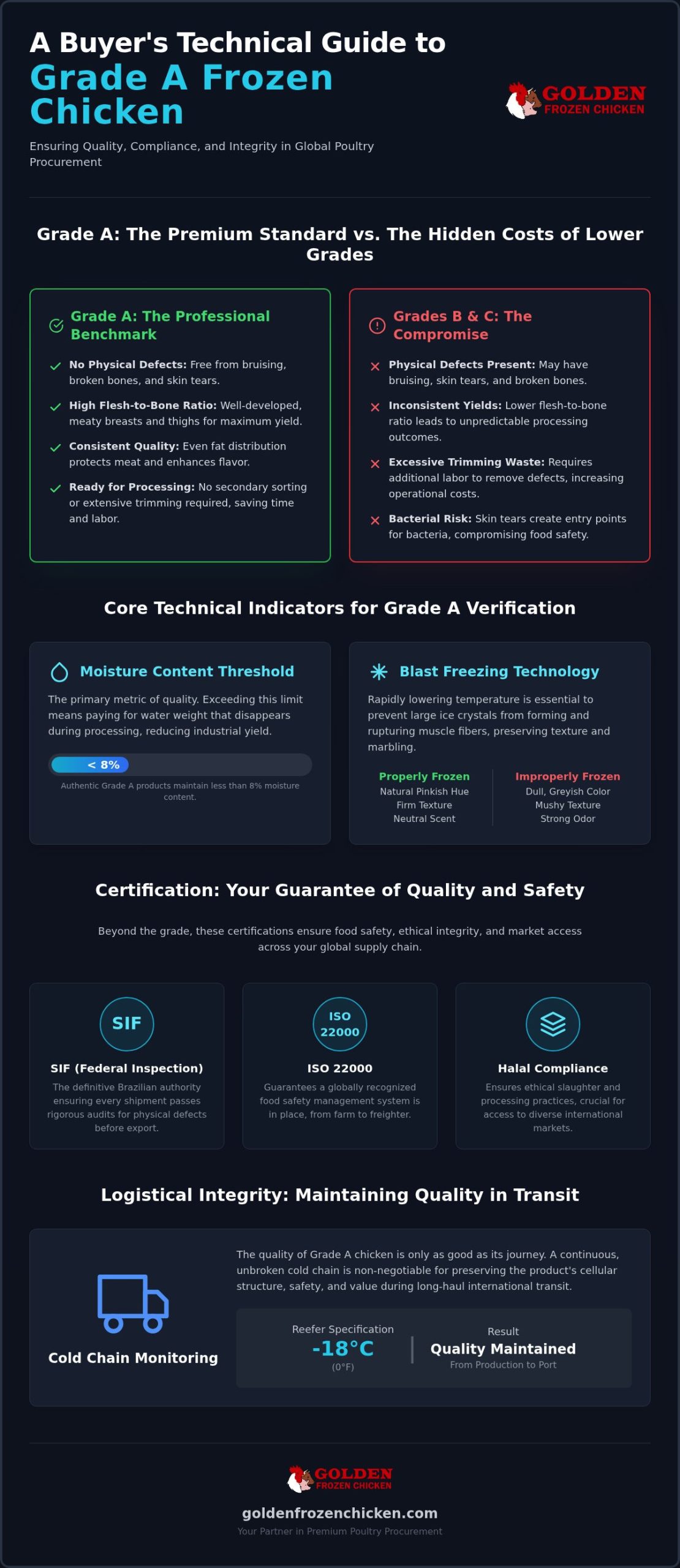
Grade A poultry represents the pinnacle of industrial meat quality. It’s the only classification that guarantees the structural and aesthetic integrity required for high-volume processing. While lower tiers like Grade B or C might appear cost-effective, they often carry hidden expenses in the form of excessive trimming waste and inconsistent yields. For professionals sourcing grade a frozen chicken wholesale, understanding the rigid criteria established by international Food grading standards is essential to maintaining a compliant supply chain.
Inspectors identify Grade A products through a lack of physical defects. A bird must be free from bruising, which often indicates poor handling or stress during the slaughter process. It must also lack broken bones and skin tears. These flaws aren’t just cosmetic; they create entry points for bacteria and lead to uneven cooking or processing in industrial settings. The Service of Federal Inspection (SIF) in Brazil acts as the definitive authority for these standards. Every shipment must pass through this rigorous audit process before it leaves the production floor. This ensures a seamless transition from the facility to the international port, maintaining a singular focus on quality.
The Biological Benchmark for Grade A Poultry
Grade A birds require a high flesh-to-bone ratio. This means the breast and thighs must be well-developed and meaty. Fat distribution is equally critical. A thin, even layer of subcutaneous fat protects the meat from freezer burn while enhancing the final flavor profile. We find that humane raising practices directly influence these biological markers. Birds raised in low-stress environments exhibit better muscle density and more consistent skin coverage, which are vital for grade a frozen chicken wholesale contracts.
Regulatory Definitions and International Variations
While SIF standards align closely with USDA and EU poultry grades, the Brazilian export protocol often exceeds baseline requirements to satisfy diverse global markets. Procurement officers verify these statuses through rigorous sample testing. This involves checking for ice crystal formation and ensuring the bird’s appearance remains consistent after thawing. Grade A status significantly affects market value by reducing import friction at customs. It ensures your facility receives a product that’s ready for immediate utilization without the need for extensive secondary sorting or waste management.
Technical Indicators of Grade A Frozen Chicken Products
The technical superiority of a product is often determined before it ever reaches the shipping container. For high-volume buyers, the primary metric of quality is moisture content. Authentic grade a frozen chicken wholesale must maintain a moisture threshold of less than 8%. When moisture exceeds this limit, industrial yields suffer significantly; you essentially pay for water weight that disappears during processing. This standard is a core component of USDA poultry grades and standards, which serve as a global benchmark for technical excellence.
Blast freezing technology is the essential mechanism for preserving the meat’s cellular structure. By rapidly lowering the temperature, we prevent the formation of large ice crystals that would otherwise rupture the muscle fibers. This process ensures that the texture remains firm and the marbling stays intact after thawing. Indicators of improper freezing include a dull, greyish color or a strong odor upon defrosting. Grade A products exhibit a natural pinkish hue and a neutral scent, confirming that the cold chain remained unbroken from the production floor to the warehouse.
Moisture Retention and Processing Standards
The choice between air-chilled and water-chilled processing has a direct impact on your final product weight and quality. Air-chilling is technically superior for preserving the natural flavor and preventing cross-contamination, though water-chilling remains prevalent in wholesale due to its efficiency. Regardless of the method, Grade A certification requires that no chemical residues, hormones, or antibiotics remain in the tissue. Rigorous lab testing confirms that the organic integrity of the meat is preserved, providing the security that large-scale corporations require for their ethical supply chains. If you’re looking for comprehensive procurement solutions that meet these rigorous lab standards, selecting a partner with integrated testing protocols is vital.
Anatomy of a Grade A Cut: Breasts, Wings, and Paws
Standardization is the hallmark of Grade A industrial cuts. Wholesale chicken breasts must show strict uniformity in size and weight calibration to ensure predictable cooking times in commercial kitchens. When sourcing chicken paws, the focus shifts to skin cleanliness and the absence of ammonia burns or black spots, which are common in lower-grade shipments. Chicken wings require the preservation of both the mid-joint and the wing-tip; any mechanical damage during the deboning or separation process immediately disqualifies the cut from Grade A status. Procurement officers navigating the 2026 regulatory landscape should consult our detailed wholesale frozen chicken wings global sourcing guide for a comprehensive breakdown of GSO 2055-1:2026 compliance and Grade A wing specifications. This meticulous attention to detail ensures that every part of the bird contributes to a high-yield, premium output for your operations.
Certification and Compliance: Beyond the Grade A Label
The “Grade A” designation provides a visual guarantee of quality, but industrial procurement requires deeper administrative verification to mitigate global supply chain risks. ISO 22000 and HACCP protocols serve as the structural backbone of food safety management in the export sector. These systems ensure that every step of production, from initial processing to final packaging, adheres to a rigorous hazard analysis framework. For corporations securing grade a frozen chicken wholesale, these certifications aren’t merely optional; they’re the primary defense against biological contamination and regulatory non-compliance.
Brazil’s poultry industry maintains its global leadership through meticulous third-party audits and the SIF (Service of Federal Inspection) oversight. This level of transparency allows procurement officers to track wholesale batches with farm-to-port precision. It creates a narrative of total control over the supply chain, ensuring that the transition from the production floor to the international vessel is documented and verifiable. This “steady hand” approach is vital for maintaining the integrity of high-volume shipments across five continents.
Halal Integrity in Industrial Poultry
Securing Halal-certified poultry involves more than just a specific slaughter method; it requires a dedicated infrastructure. Brazilian producers utilize accredited Halal certification bodies to verify that every bird meets the ethical and religious standards required for the Middle East and Southeast Asian markets. Technical blast freezing facilities must be partitioned to prevent cross-contamination, ensuring the organic integrity of the meat remains uncompromised. Documentation, including Halal certificates and health manifests, must accompany every shipment to clear customs efficiently in major international hubs. For buyers sourcing wholesale frozen chicken wings destined for markets with mandatory Halal enforcement, understanding the October 2026 Indonesian regulatory deadline is critical to maintaining uninterrupted market access.
ISO Compliance and Quality Management Systems
ISO 9001 certification ensures that high-volume wholesale orders remain consistent over long-term contracts. This quality management system works in tandem with the technical specifications found in the USDA Poultry Grading Manual, bridging the gap between local production and international expectations. While physical grading focuses on fleshing and fat covering, ISO standards focus on the repeatability of the process. You can verify the validity of these certifications through official international databases, ensuring your supplier isn’t just claiming compliance but is actively audited. This synergy between SIF inspections and ISO standards creates a reliable environment for industrial-scale trade.
Logistical Integrity: Maintaining Grade A Quality in Transit
The technical excellence of grade a frozen chicken wholesale remains vulnerable until the moment it reaches its final destination. A single breach in the cold chain can degrade premium poultry into industrial waste. To prevent this, we utilize specialized reefer containers engineered to maintain a constant internal temperature of -18°C for the duration of the transoceanic voyage. This isn’t just a recommendation; it’s a non-negotiable requirement for preserving the cellular integrity discussed in previous sections.
Reliability in global trade requires total transparency. We integrate digital data loggers within every shipment to provide a comprehensive temperature history. These devices monitor fluctuations in real-time, ensuring that any deviation is recorded and addressed. This level of oversight transforms the complex process of international shipping into a predictable, manageable operation for our partners across five continents. It’s this “steady hand” approach that distinguishes a logistical powerhouse from a mere supplier.
Temperature Stability Protocols
Thermal shock occurs when frozen meat is exposed to ambient air during the transition between the warehouse and the container. This causes moisture migration and ice recrystallization, which ruins the texture of the breast meat. Our standard operating procedures mandate rapid loading and unloading cycles within temperature-controlled docks. We also maintain strict contingency plans for port delays. If a vessel is held at anchor, our logistical team coordinates with port authorities to ensure the reefer units remain powered and monitored constantly.
Wholesale Packaging Standards for Global Export
Packaging for sea freight must withstand extreme humidity and the physical pressure of high-density stacking. We use high-grade, moisture-resistant cardboard that maintains its structural integrity throughout the voyage. Every pallet is optimized for 40ft high-cube reefer containers to maximize shipping efficiency without compromising airflow. Our labeling protocols include:
- Multi-language compliance for target markets in Asia and the Middle East.
- Standardized barcodes for rapid warehouse scanning and inventory management.
- Clear SIF and Halal certification markings for customs clearance.
This attention to detail ensures that your procurement arrives in the same condition it left the production floor. If you require a partner who prioritizes logistical integrity for wholesale poultry, our end-to-end service provides the security your operations demand.
Sourcing Grade A Poultry with Golden Frozen Chicken
Golden Frozen Chicken operates as a definitive bridge between Brazil’s massive poultry production capacity and the rigorous demands of the global industrial food sector. We understand that for large-scale corporations, reliability is the most valuable currency. By specializing in grade a frozen chicken wholesale, we ensure that every shipment meets the technical and ethical benchmarks discussed throughout this guide. Our role extends beyond mere supply; we act as a logistical powerhouse that navigates the complexities of international trade with precision and transparency.
Unlike smaller regional suppliers, our operations are built for industrial scalability. We provide customized procurement solutions that align with the high-volume needs of manufacturing plants and major distribution networks. This commitment to integrity means that every batch of organic frozen chicken parts undergoes the same rigorous SIF inspections and ISO-compliant processing. We maintain a singular focus on the output’s quality, ensuring that your brand reputation remains protected through a stable and ethical supply chain.
Our Global Export Footprint
Our reach spans five continents, serving critical markets in Asia, Europe, the Middle East, and Africa. We’ve established strategic partnerships with reliable international logistics providers to maintain the cold chain’s stability from the production floor to the final port. Navigating complex customs regulations is a core competency of our team. We manage the necessary documentation for Halal and ISO compliance, ensuring a seamless importation process that minimizes lead times and prevents costly border delays. This “steady hand” approach provides the security you need when managing high-volume grade a frozen chicken wholesale contracts.
Initiating a Wholesale Partnership
Starting a partnership is a methodical and transparent process. We encourage procurement officers to request detailed technical specifications and sample reports to verify our quality standards firsthand. For large retail and industrial brands, we offer custom wholesale packaging options that balance shipping efficiency with brand visibility. This flexibility allows us to meet the specific logistical needs of your distribution hub while adhering to rigid international quality frameworks. Our team is prepared to guide you through every stage, from initial inquiry to the final delivery at your port of choice.
Partner with Golden Frozen Chicken for your next wholesale order to secure a dependable supply of premium poultry for your global operations.
Mastering the Standard for Industrial Poultry Procurement
Securing a resilient supply chain in 2026 demands more than just a surface-level understanding of poultry grading. It requires a commitment to technical precision, from verifying moisture thresholds to ensuring an unbroken cold chain at -18°C. By prioritizing these benchmarks, you eliminate the risks of product inconsistency and regulatory non-compliance that often plague large-scale operations. Mastering the nuances of grade a frozen chicken wholesale allows your organization to maintain the high yields and aesthetic standards that your customers expect.
Golden Frozen Chicken stands ready to serve as your steady hand in this complex global market. We provide total transparency through our SIF Approved Facilities and a global ISO-compliant supply chain. Whether you require certified Halal or organic options, our end-to-end service ensures that every shipment meets the most rigorous international specifications. Your procurement process should be a source of strength for your business, not a point of vulnerability. We invite you to Secure Your Supply of Premium Grade A Halal Chicken and experience the reliability of a premier international partner. Build your future on a foundation of integrity and excellence.
Frequently Asked Questions
What specifically distinguishes Grade A frozen chicken from Grade B in a wholesale context?
Grade A is characterized by its total absence of deformities, bruising, and broken bones, whereas Grade B allows for minor skin tears and moderate flesh defects. In the professional context of grade a frozen chicken wholesale, these aesthetic differences translate directly to industrial yield. Grade A birds require significantly less trimming and produce more consistent cuts. Buyers prioritize Grade A to ensure uniform results and minimize waste in high-volume processing environments.
How is Halal certification verified for Brazilian frozen chicken exports?
Halal certification is verified through accredited Brazilian certification bodies that monitor the entire production cycle. These agencies ensure that slaughtering follows Islamic Law and that processing facilities maintain total separation from non-Halal products. Documentation, including the Halal Certificate and the Health Certificate issued by the Ministry of Agriculture, must accompany every export shipment to confirm compliance for international customs authorities in the Middle East and Southeast Asian markets.
What is the standard moisture percentage for premium Grade A poultry?
The standard moisture percentage for premium Grade A poultry must remain below the 8% threshold to ensure product integrity and industrial value. Excessive moisture often indicates “soaking” during the chilling process, which artificially inflates weight and leads to significant shrinkage during cooking. We utilize precise blast freezing and air-chilling techniques to maintain these levels. This provides a high-yield product that meets the technical specifications required by sophisticated global procurement officers.
How does Golden Frozen Chicken ensure temperature stability during international shipping?
We ensure temperature stability by utilizing advanced 40ft high-cube reefer containers set to a constant -18°C. Every shipment is equipped with digital data loggers that provide a continuous temperature history throughout the transoceanic voyage. This transparency allows us to identify and mitigate any thermal fluctuations immediately. Our logistical team maintains a “steady hand” over the supply chain, coordinating with port authorities to prioritize power connectivity for our refrigerated units during transit.
What certifications should a reliable wholesale frozen chicken supplier hold?
A reliable supplier of grade a frozen chicken wholesale should hold a comprehensive suite of international certifications. Essential credentials include ISO 22000 for food safety management, HACCP for hazard control, and SIF approval for federal inspection. Additionally, Halal certification from recognized bodies is vital for global market access. These certifications serve as a verifiable guarantee that the supplier adheres to rigorous safety, ethical, and qualitative standards across their entire production floor.
Can custom packaging be provided for large-scale industrial orders?
Yes, we provide customized wholesale packaging solutions tailored to the specific needs of large-scale industrial and retail partners. This includes moisture-resistant cardboard boxes with multi-language labeling and barcode integration for streamlined inventory management. Our team works with clients to optimize palletization for maximum shipping efficiency in reefer containers. This flexibility ensures that the product remains protected while meeting the unique branding and logistical requirements of your regional distribution hubs.
What is the typical shelf life for wholesale frozen chicken stored at -18°C?
Frozen chicken stored at a constant -18°C typically maintains its peak quality for 12 to 18 months in a wholesale environment. While the product remains safe for consumption indefinitely if the temperature is stable, the texture and flavor profile may begin to degrade after the 18-month mark. Maintaining an unbroken cold chain is essential to prevent freezer burn and enzymatic activity, ensuring the meat retains its Grade A characteristics upon arrival at your facility.
How does the SIF (Service of Federal Inspection) impact the quality of Brazilian meat?
The Service of Federal Inspection (SIF) is the primary regulatory authority ensuring the safety and quality of Brazilian meat exports. SIF agents are stationed within processing facilities to monitor slaughtering, hygiene, and packaging protocols in real-time. This rigorous oversight guarantees that every product leaving the plant meets international health standards. For global buyers, the SIF stamp is a non-negotiable symbol of trust, confirming that the poultry has undergone thorough federal scrutiny before export.