

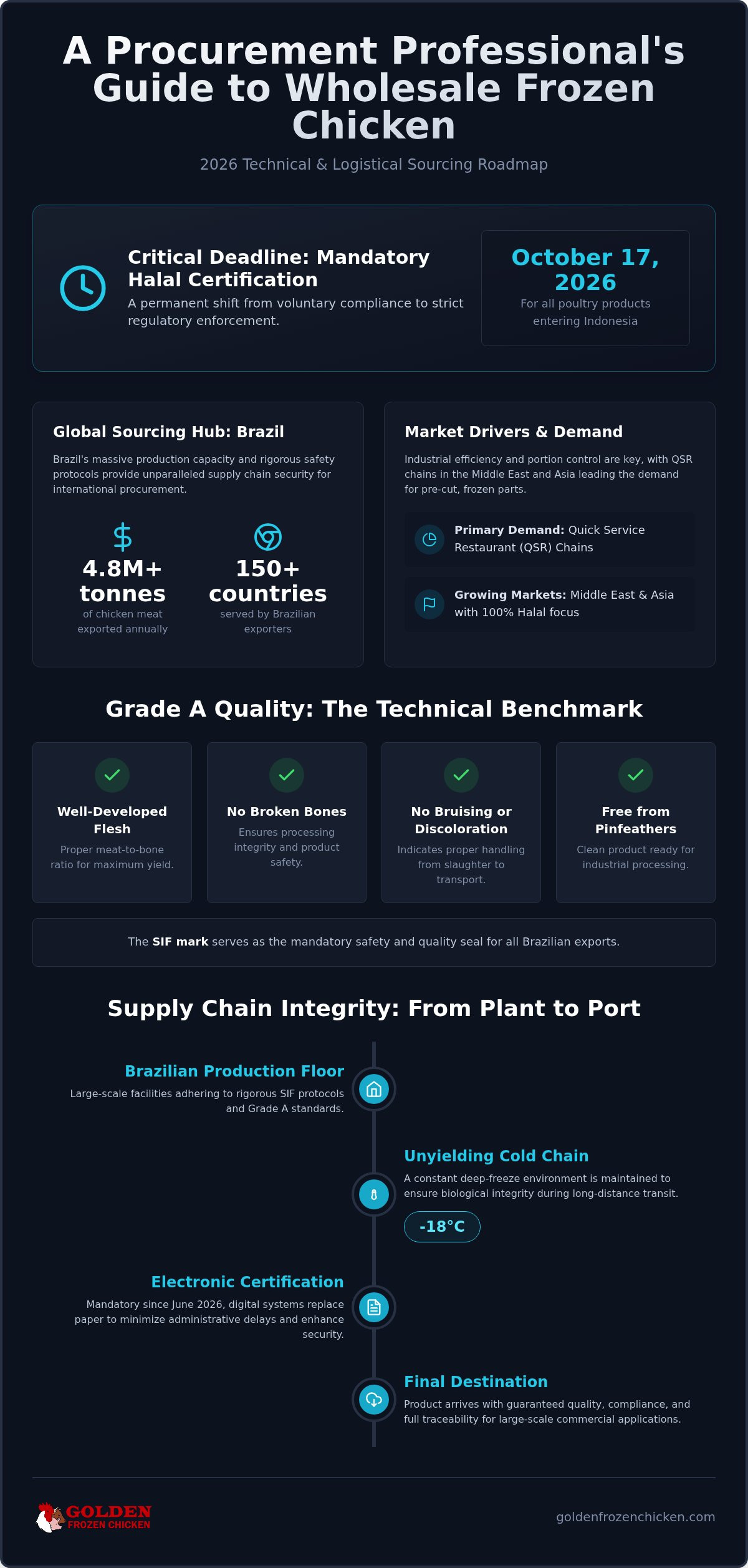
By October 17, 2026, every poultry product entering the Indonesian market must carry mandatory Halal certification, marking a permanent shift from voluntary compliance to strict regulatory enforcement across the global poultry sector. For procurement professionals, securing a reliable supply of wholesale frozen chicken wings now requires more than just a competitive price point. It demands a technical alignment with evolving GSO 2055-1:2026 standards and the logistical precision to handle mandatory electronic certifications that replaced paper systems in June 2026.
We understand that supply chain instability and inconsistent product grading remain significant barriers to your operational efficiency. You require a partner that bridges the gap between large-scale Brazilian production and your specific logistical requirements. This guide provides the technical roadmap to mastering international certifications, ensuring 100% food safety compliance, and securing Grade A quality through direct sourcing. We’ll analyze the critical SIF requirements for 2026 and detail the logistical protocols necessary to maintain cold-chain integrity from the processing plant to your final destination.
Key Takeaways
- Analyze the shifting global demand for wholesale frozen chicken wings to align your procurement strategy with the specific requirements of the industrial food processing sector.
- Identify Grade A quality benchmarks through the rigorous SIF protocol, ensuring your supply meets strict standards for appearance, meat-to-bone ratio, and processing integrity.
- Master the technical specifications of mid-joint wings and drumettes, focusing on precise weight calibration to ensure consistency in large-scale commercial applications.
- Secure your supply chain by implementing strict cold-chain requirements, maintaining a constant -18°C environment from the Brazilian production floor to the final destination.
- Leverage the strategic advantages of Brazilian sourcing to bridge the gap between high-volume manufacturing and complex international logistical requirements.
Understanding the Global Market for Wholesale Frozen Chicken Wings
In the context of international B2B trade, wholesale frozen chicken wings represent more than a simple food item; they’re a highly standardized commodity required for large-scale food processing and distribution. Industrial buyers categorize these parts based on technical specifications like weight calibration and cut precision to ensure consistency across vast supply chains. As the global consumption of chicken continues to rise, the market for frozen poultry has stabilized as the primary vehicle for cross-border trade. This preference for frozen over fresh stems from the necessity of maintaining biological integrity during long-distance maritime transit. It’s impossible to maintain safety standards across oceans without the deep-freeze protocols that define the wholesale sector.
Brazil has solidified its position as a primary global hub, exporting over 4.8 million tonnes of chicken meat annually to more than 150 countries. This dominance is built on a foundation of rigorous food safety protocols and massive production capacity that regional producers can’t match. For procurement officers, sourcing wholesale frozen chicken wings from Brazilian facilities offers a level of supply chain security that’s essential in a volatile global economy. The Brazilian industry provides a reliable bridge between high-volume production and the specific qualitative demands of international markets.
The Surge in Demand for Processed Poultry Parts
Quick Service Restaurant (QSR) chains are the primary drivers of bulk wing demand in 2026. These entities require pre-cut, frozen portions to maintain industrial efficiency and portion control across thousands of locations. The Middle East and Asian markets have shown particularly strong growth, with a heightened focus on 100% Halal compliance. The mandatory Halal certification deadline in Indonesia set for October 17, 2026, has shifted the landscape, forcing buyers to prioritize exporters who already hold recognized certifications. Transitioning to pre-cut Organic Frozen Chicken Parts (Halal) allows these large-scale operators to reduce labor costs and eliminate processing waste at the retail level.
Economic Advantages of Direct Brazilian Sourcing
Direct Brazilian sourcing provides distinct economic advantages through high-volume production. The scale of the Brazilian agricultural sector allows for a lower cost-per-kilogram on container-load orders compared to smaller domestic markets. In 2026, international trade contracts are increasingly influenced by the shift toward electronic certifications, which Brazil has integrated into its export workflows to minimize administrative delays. Buyers who secure direct partnerships with Brazilian exporters benefit from a structured approach where logistical expertise and technical compliance are bundled into every shipment. This scale doesn’t just lower prices; it ensures that the quality of Grade A wings remains consistent regardless of the order volume.
Ensuring Grade A Quality and Halal Certification in Wholesale Poultry
Grade A classification for wholesale frozen chicken wings isn’t a subjective marketing term but a rigorous technical benchmark. For industrial procurement, this designation signifies that the product is free from deformities, possesses a well-developed covering of flesh, and maintains a consistent layer of fat under the skin. As of early 2026, while 2026 wholesale chicken wing prices have remained stable, the value of the product is ultimately determined by its adherence to these physical standards. Buyers must verify that wings are free from pinfeathers, exposed flesh, and broken bones, as these defects compromise the yield in high-volume food processing environments.
The Technical Criteria for Grade A Frozen Chicken
Visual indicators provide the first layer of quality assurance. Procurement teams look for skin color consistency and the total absence of bruising, which can indicate poor handling during the slaughtering or transport phases. Moisture content standards are equally critical; preventing excessive “water weight” ensures that buyers aren’t paying for ice instead of protein. The SIF mark serves as the mandatory safety seal for all Brazilian poultry exports, confirming compliance with international health standards.
Halal Integrity in the Global Supply Chain
Halal certification has transitioned from a niche requirement to a strictly regulated mandatory standard for key global markets. For entry into Indonesia after October 17, 2026, or the Gulf countries under GSO 2055-1:2026, compliance must be absolute. This process involves hand slaughter by a Muslim practitioner, ensuring the bird is alive at the time of slaughter and that blood drainage is complete. Traceability is maintained through a transparent chain of custody that follows the product from the farm to the international port, meeting the specific dietary requirements of Middle Eastern and African jurisdictions.
The backbone of this safety framework is the integration of ISO 22000 and HACCP protocols. These systems provide a methodical approach to identifying and controlling biological, chemical, and physical hazards throughout the production cycle. By prioritizing wholesale frozen chicken wings that carry these international certifications, large-scale buyers secure an ethical and safe supply chain. If you’re looking for a partner that guarantees this level of compliance, exploring Organic Frozen Chicken Parts (Halal) from established Brazilian exporters is the most reliable strategy for 2026.
Technical Specifications: From Mid-Joint Wings to Bulk Drumettes
A whole wing consists of three distinct sections: the drumette, the mid-joint (flat), and the tip. In the context of wholesale frozen chicken wings, the configuration is often dictated by the destination market’s culinary standards and processing requirements. A 3-joint wing includes all three sections, while a 2-joint wing typically removes the tip or the drumette. For industrial consistency, weight calibration is the most critical metric. Standard gram ranges often fall between 30g and 50g for mid-joints and 40g and 60g for drumettes. Large-scale processors rely on these precise measurements to ensure uniform cooking times and predictable portion costs across their operations.
Mid-Joint Wings (MJW) vs. Drumettes
The mid-joint wing, or flat, commands a premium in Asian markets due to its high skin-to-meat ratio and suitability for regional cooking methods. Conversely, the drumette is highly sought after in the European and American food service sectors, where it’s often utilized as a standalone appetizer. Technical specifications for these cuts prioritize a high meat yield and a clean cut at the joint. An expertly processed mid-joint will typically measure between 7cm and 9cm in length, providing the structural integrity needed for industrial frying or baking processes.
Packaging formats are designed to withstand the rigors of international shipping while facilitating easy integration into the buyer’s inventory system. Standard 10kg and 20kg cartons are the industry norm for most wholesale frozen chicken wings orders. These cartons are constructed from high-burst-strength corrugated fiberboard to prevent crushing during palletization in refrigerated containers. For massive industrial applications, bulk bags within a master carton offer a cost-effective solution for high-volume processors who don’t require individual portioning at the point of arrival.
Industrial Packaging and Customization
Custom wholesale packaging allows distributors to receive products that are ready for immediate market entry through private labeling. Options include polybagging for moisture retention or Individually Wrapped Pieces (IWP), which are ideal for catering operations that need to defrost specific quantities. The choice between polybagging and IWP depends on the final use case. Polybagging is standard for bulk industrial use, whereas IWP provides superior protection against freezer burn for products that might experience multiple handling stages. Every packaging choice is made within the framework of maintaining the product at a constant -18°C throughout the logistical journey.
By sourcing Organic Frozen Chicken Parts (Halal) with these specific technical parameters, procurement officers ensure that their inventory meets the exact needs of their local markets. The Brazilian industry has perfected these cuts to meet the global demand for consistency and safety. This meticulous attention to detail at the production level is what separates premium exporters from the rest of the market.
Optimizing the Supply Chain for International Frozen Wing Exports
Preserving the biological integrity of wholesale frozen chicken wings requires a logistical strategy that prioritizes thermal stability above all else. While technical specifications define the product at the point of origin, the cold chain determines its value upon arrival at the destination port. A constant environment of -18°C must be maintained without interruption to prevent cellular degradation and moisture loss. This precision is especially vital for Grade A wings, where even minor temperature fluctuations can lead to freezer burn or compromised skin texture, rendering the product unsuitable for premium industrial use.
Maritime Logistics and Reefer Container Management
Successful export operations from Brazil rely on the meticulous management of 40ft reefer containers. These units must be calibrated with specific temperature and ventilation parameters to ensure uniform airflow throughout the cargo. Sourcing from South American hubs involves understanding lead times that can range from 20 to 45 days depending on the global destination hub. Continuous temperature logging is a mandatory requirement for cargo insurance to provide a verifiable record of thermal stability throughout the voyage. These logs serve as the primary evidence in risk mitigation, protecting the buyer’s investment against equipment failure or port delays.
Import Compliance and Regulatory Frameworks
Navigating the regulatory landscape of 2026 requires a proactive approach to documentation and digital filing. The mandatory transition to the PHIS electronic certification system in June 2026 has modernized the export process, yet it demands absolute accuracy to avoid port hold-ups. Procurement teams must coordinate with experienced customs brokers to manage health certificates, Bills of Lading, and the critical Certificate of Origin. Compliance with regional standards, such as FSANZ for Oceania or specific EU poultry regulations, remains a non-negotiable prerequisite for seamless port clearance.
A failure to align with these frameworks often results in costly demurrage fees or the total rejection of the shipment by local health authorities. Managing these complexities is a core competency of a logistical powerhouse that understands the “global-local” connection. If you require an international partner capable of navigating these technicalities while maintaining total control over the supply chain, you can secure your supply of Organic Frozen Chicken Parts (Halal) through our ISO-compliant facilities. Our end-to-end service ensures that the rigorous standards set during initial processing are maintained until the final moment of delivery.
Strategic Advantages of Partnering with Brazilian Exporters
The Brazilian poultry sector has established itself as the global benchmark for export reliability, shipping over 4.8 million tonnes of chicken meat annually. This dominance isn’t merely a result of volume but a byproduct of a sophisticated infrastructure that integrates high-capacity production with rigorous international compliance. When procurement officers source wholesale frozen chicken wings from this region, they’re engaging with a system designed specifically for large-scale maritime trade. This reliability is essential for global retail chains and regional distributors who can’t afford interruptions in their inventory cycles.
Golden Frozen Chicken serves as a critical bridge between this vast production capability and the specialized needs of the global marketplace. By specializing in Organic Frozen Chicken Parts (Halal), we provide a product that meets the most demanding ethical and religious standards while maintaining Grade A physical specifications. This focus on excellence allows our partners to build premium brands supported by a transparent and ethical supply chain. Our facilities are designed to scale, meeting the volume requirements of both expanding regional distributors and established global retail entities.
The Global-Local Connection in Wholesale Trade
Leveraging local Brazilian expertise is the most effective way to ensure superior product quality at a competitive price point. Direct sourcing from Brazilian facilities allows large-scale buyers to minimize middleman costs, which is a vital factor in optimizing the cost-per-kilogram for wholesale frozen chicken wings. This direct relationship also provides greater transparency regarding production methods. Our commitment to ethical and sustainable poultry production ensures that every shipment complies with modern ESG requirements, which are becoming increasingly important for corporate procurement in 2026.
Next Steps for Bulk Procurement
Initiating a large-scale procurement strategy begins with a formal Request for Quotation (RFQ) for container-load quantities. This process allows your organization to evaluate the technical alignment between your requirements and the exporter’s capabilities. It’s standard practice to review current certification documents, including SIF approval and Halal credentials, before finalizing any long-term contracts. Evaluating sample quality during the initial phase ensures that the physical product meets the Grade A benchmarks discussed throughout this guide.
For organizations ready to secure a stable and compliant supply chain, our team provides personalized consultations to align our production with your specific logistical needs. You can visit Golden Frozen Chicken to request a tailored quote and begin the process of integrating high-quality Brazilian poultry into your global distribution network. Our end-to-end service model is designed to navigate the complexities of international trade, providing you with the security and consistency required in the modern food processing sector.
Securing Your Global Poultry Supply Chain for 2026
Success in the international meat trade depends on more than just securing a competitive price. It requires a meticulous alignment with technical specifications, international safety certifications, and the logistical precision to navigate evolving global standards. Effective procurement of wholesale frozen chicken wings involves a deep understanding of Grade A quality benchmarks and the rigorous SIF protocols that define Brazilian exports. By prioritizing partners with 100% Halal certified poultry and a robust global logistics network, you ensure that your inventory maintains its biological and commercial integrity from the production floor to the final destination.
Building a resilient supply chain means bridging the gap between high-volume manufacturing and the specific needs of your local marketplace. Our ISO-compliant facilities are engineered to provide this level of consistency, offering the scalability required by both regional distributors and global retail chains. To discuss your specific volume requirements and logistical parameters, you can contact Golden Frozen Chicken for a wholesale export quote today. We look forward to establishing a secure and professional partnership that supports your long-term commercial growth.
Frequently Asked Questions
What is the minimum order quantity (MOQ) for wholesale frozen chicken wings?
The standard minimum order quantity for wholesale frozen chicken wings typically involves a full 40ft refrigerated container load, which equates to approximately 27 to 28 metric tons. This volume is necessary to optimize maritime shipping costs and ensure the efficiency of the cold chain during transit. For smaller regional distributors, some consolidated shipments may be possible, but direct Brazilian sourcing usually prioritizes high-volume industrial orders to maintain competitive pricing structures.
How is Halal certification verified for international poultry shipments?
Halal certification for international shipments is verified through official documentation issued by recognized Islamic certification bodies in the country of origin. Each consignment must be accompanied by a specific Halal Certificate that matches the batch numbers and production dates on the product packaging. This documentation ensures that the slaughtering process adheres to Islamic law, including hand slaughter and complete blood drainage, while maintaining a transparent chain of custody from the facility to the port.
What is the difference between Grade A and Grade B frozen chicken wings?
Grade A wholesale frozen chicken wings are characterized by a well-developed layer of fat, consistent skin color, and a total absence of broken bones or bruising. These are the industry standard for premium retail and food service applications. In contrast, Grade B wings may exhibit minor skin tears, slight discoloration, or small bone fractures. While Grade B parts are safe for consumption, they are typically diverted to processed food manufacturing where visual appearance is not a primary requirement.
How do you ensure the cold chain is not broken during 30-day sea transits?
Maintaining a constant -18°C environment during sea transits is achieved through the use of high-specification 40ft reefer containers equipped with independent cooling units. These containers utilize continuous temperature monitoring systems and digital data loggers that record thermal conditions at regular intervals. This verifiable record is essential for cargo insurance and quality assurance, providing proof that the thermal integrity of the Organic Frozen Chicken Parts (Halal) remained intact from the Brazilian port to the final destination.
Can I request custom packaging and private labeling for bulk wing orders?
Large-scale buyers can certainly request custom wholesale packaging and private labeling for bulk wing orders. This service includes the application of specific brand graphics, multi-language nutritional information, and unique barcoding to meet regional retail requirements. Industrial buyers often utilize this flexibility to receive products that are shelf-ready or specifically formatted for their processing lines. Customization options are typically finalized during the initial contract phase to ensure seamless integration at the production level.
What documents are required to import frozen chicken from Brazil to Asia?
Importing frozen poultry from Brazil to Asian markets requires a comprehensive set of documents to ensure smooth customs clearance. Essential paperwork includes the Bill of Lading, the International Health Certificate issued by the Ministry of Agriculture, and a formal Certificate of Origin. Additionally, shipments must include a detailed packing list, a commercial invoice, and the mandatory Halal Certificate. These documents are now increasingly managed through electronic systems to enhance accuracy and reduce administrative delays at the port of entry.
Are the chicken wings SIF approved for export to the Middle East?
Every production facility in Brazil must be SIF approved for export to the Middle East and other global regions. The Federal Inspection Service (SIF) ensures that the manufacturing plant meets rigorous international food safety and hygiene standards equivalent to those in the EU and the United States. This certification is a prerequisite for obtaining the necessary export licenses and serves as a guarantee that the facility is capable of handling the specific requirements of the Middle Eastern market.
What are the typical weight ranges for wholesale mid-joint wings?
The typical weight ranges for wholesale mid-joint wings are calibrated according to industrial standards to ensure portion consistency. Most export-grade mid-joints fall within the 30g to 50g range per piece. This precision is vital for food service operators who require uniform cooking times and predictable yields across their menus. Buyers can specify their preferred weight calibration during the ordering process to align with the technical requirements of their specific processing or retail equipment.