
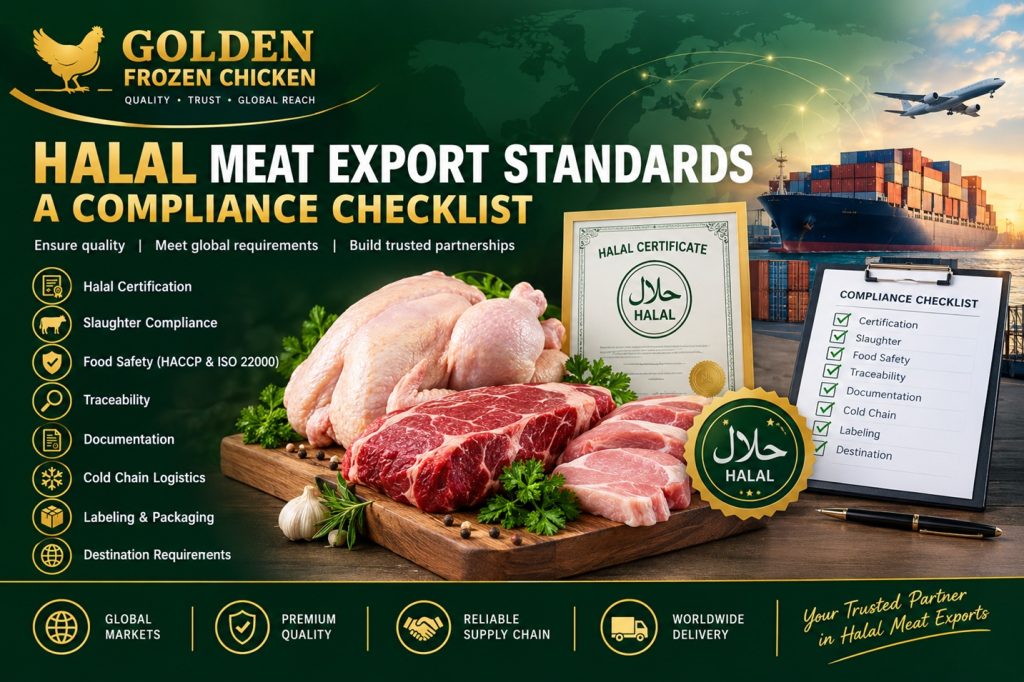
For international meat exporters, Halal Meat Export Standards are more than a religious requirement. They are an important part of product compliance, documentation, traceability, food safety, labeling, logistics, and access to international markets.
For importers, wholesalers, distributors, retailers, restaurants, hotels, and foodservice companies, choosing a supplier that understands the complete export process can help reduce documentation problems and improve supply-chain reliability.
At GOLDEN FROZEN CHICKEN, we specialize in the international supply of frozen chicken, chicken parts, beef, beef parts, and frozen pork products. Our company works with international buyers and supplies frozen meat products to markets around the world. Explore GOLDEN FROZEN CHICKEN
This guide provides a practical compliance checklist for businesses involved in Halal meat exports. It explains the key areas buyers and exporters should review before a shipment leaves the processing facility.
What Are Halal Meat Export Standards?
Halal Meat Export Standards refer to the requirements used to ensure that meat and meat products comply with Islamic dietary principles and the applicable requirements of the importing market.
The requirements can cover the entire supply chain, including:
- Animal eligibility
- Slaughter procedures
- Halal certification
- Processing
- Equipment and utensils
- Ingredients and additives
- Packaging
- Labeling
- Storage
- Transportation
- Traceability
- Documentation
- Import approval
The international Codex Alimentarius guidance on the use of the term “Halal” recognizes that there can be differences in interpretation among Islamic schools of thought and states that importing-country authorities may establish additional requirements.
This is an important point for exporters: one Halal certificate does not automatically mean that every destination market will accept the shipment without additional requirements.
The exporter should therefore identify the destination market before production and documentation are finalized.
Halal Meat Export Compliance Checklist
A successful Halal meat export program should begin with a structured checklist. The following areas are among the most important to review.
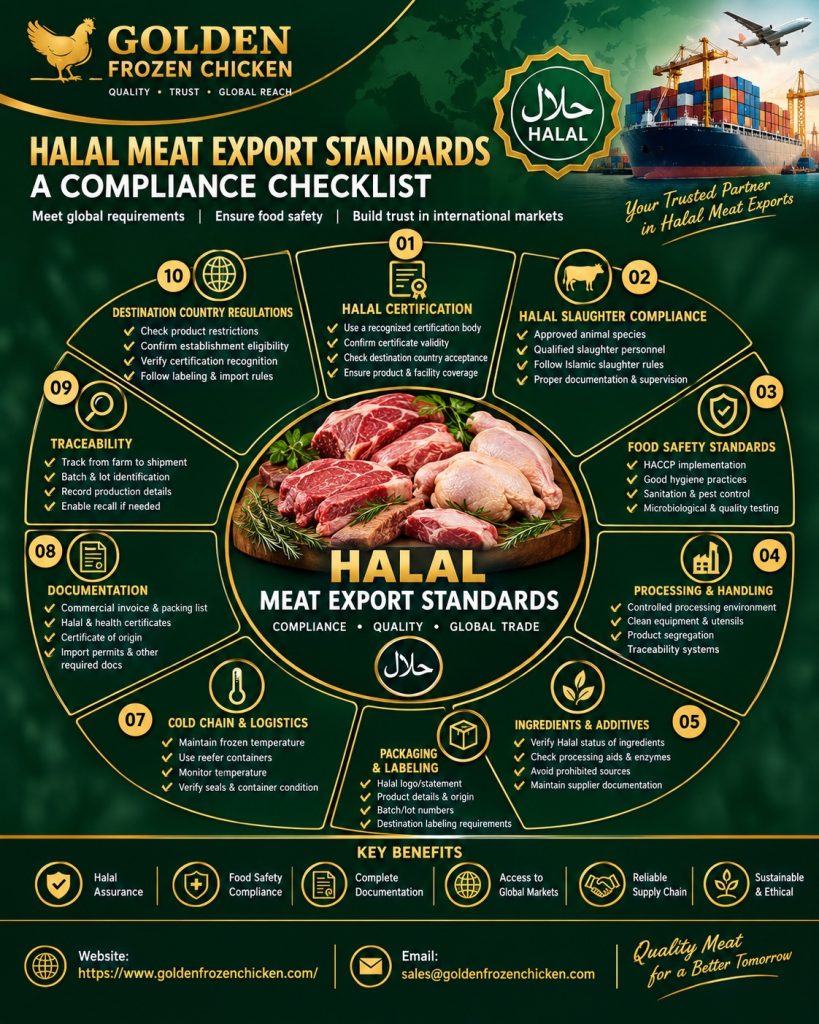
1. Verify That the Product Is Halal
The first step is determining whether the product itself is permissible under the applicable Halal requirements.
For meat exports, this includes verifying the animal species, slaughter method, processing environment, ingredients where applicable, and handling procedures.
Codex guidance identifies pigs and boars among animal sources considered unlawful for Halal food and also addresses slaughter and the handling of Halal food.
For a company supplying Muslim markets, product segregation and clear product identification are therefore essential.
At Golden Frozen Chicken, our website identifies Halal Frozen Chicken and Halal Frozen Beef among our product offerings.
Buyers can review our Halal frozen chicken and meat product range when evaluating wholesale sourcing options.
2. Use an Appropriate Halal Certification Body
Halal certification should be obtained through a certification body that is recognized or accepted for the destination market.
The certification process may involve documentation review, facility assessment, audits, production controls, and verification of Halal procedures.
For example, the Saudi Food and Drug Authority’s Saudi Halal Center provides Halal certification services and explains that eligible facilities can undergo an audit before a Halal certificate is issued.
The certification body should therefore be evaluated carefully before entering an export contract.
Certification checklist
Before shipment, verify:
- Name of Halal certification body
- Accreditation or recognition status
- Certification scope
- Facility covered by certification
- Products covered
- Certificate validity
- Production or shipment reference
- Batch or lot information
- Destination-country acceptance
- Required original or electronic documentation
For the UAE market, the Ministry of Industry and Advanced Technology provides information on Halal certification and registered Halal certification bodies.
3. Confirm Halal Slaughter Requirements
Slaughter is one of the most important elements of Halal Meat Export Standards.
The exporter must ensure that slaughter procedures follow the applicable Islamic requirements and the rules of the destination country or certification body.
Codex’s Halal guidance includes requirements concerning the person performing slaughter and the slaughter act itself.
However, exporters should not assume that every country interprets or implements these requirements identically.
Slaughter compliance checklist
The exporter should confirm:
- Approved animal species
- Animal condition before slaughter
- Qualified slaughter personnel
- Approved slaughter procedure
- Applicable invocation requirements
- Cutting requirements
- Blood drainage
- Equipment requirements
- Halal supervision
- Production records
- Certification records
The exact requirements should always be confirmed with the recognized Halal certification authority responsible for the destination market.
4. Maintain Food Safety Alongside Halal Compliance
Halal compliance and food safety are closely connected in a professional export operation, but they are not identical concepts.
A product can meet religious requirements while still needing to satisfy extensive food-safety regulations.
International food businesses commonly use preventive food-safety systems such as HACCP. Codex describes HACCP as a science-based, systematic approach that identifies hazards and establishes controls to prevent food-safety problems.
The Codex General Principles of Food Hygiene also provide a foundation for food hygiene throughout the food chain.
ISO 22000:2018 provides requirements for food-safety management systems applicable to organizations throughout the food chain and integrates HACCP principles.
Food-safety checklist
An exporter should review:
- HACCP plan
- Good Hygiene Practices
- Sanitation procedures
- Pest control
- Personnel hygiene
- Microbiological controls
- Water quality
- Cleaning procedures
- Allergen controls where applicable
- Foreign-material controls
- Temperature controls
- Verification and corrective actions
- Food-safety records
For buyers, certifications and audit records should be evaluated according to the requirements of the destination market rather than simply accepted as generic proof of compliance.
5. Control the Entire Processing Environment
Halal integrity should not stop at slaughter.
Processing, cutting, packaging, storage, and transportation can all affect the Halal status and compliance of a product.
OIC/SMIIC 1:2019 establishes general requirements for Halal food across stages of the food chain, including production, processing, storage, transportation, hygiene, traceability, packaging, and labeling.
This makes supply-chain control particularly important for frozen meat exporters.
A facility should have procedures for:
- Cleaning
- Sanitation
- Equipment control
- Product segregation
- Storage segregation
- Personnel procedures
- Packaging materials
- Ingredients
- Traceability
- Corrective actions
Where different product categories are handled in the same broader business environment, the company should maintain appropriate controls to prevent prohibited-material contamination or cross-contact.
6. Check Ingredients and Processing Aids
Whole meat may appear straightforward from a Halal perspective, but processed meat products can contain additional ingredients that require verification.
Examples may include:
- Marinades
- Seasonings
- Sauces
- Preservatives
- Enzymes
- Flavorings
- Gelatin
- Processing aids
- Coatings
Codex’s Halal guidance also addresses food additives derived from prohibited sources.
Therefore, exporters of processed meat should maintain supplier documentation for ingredients and verify that relevant ingredients meet the required Halal criteria.
For unprocessed frozen chicken or beef, the compliance process may be more straightforward, but destination-specific requirements still need to be checked.
7. Verify Product Specifications
A Halal certificate alone does not tell an importer everything they need to know about a shipment.
Commercial buyers also need an accurate product specification.
For frozen chicken, this may include:
- Whole chicken or specific parts
- Weight range
- Grade
- Bone-in or boneless
- Skin-on or skinless
- Freezing method
- Carton size
- Net weight
- Gross weight
- Production date
- Expiry or best-before information
- Storage requirements
- Country of origin
Golden Frozen Chicken offers a range of frozen chicken products, including breasts, drumsticks, wings, thighs, leg quarters, feet and paws, offals, and half chicken.
For example, buyers can review our frozen chicken drumsticks and skinless chicken breast pages for product-specific information.
8. Confirm Establishment Eligibility
An exporter may have a valid Halal certificate but still need to satisfy the importing country’s establishment-approval requirements.
This is particularly important for countries that maintain lists of approved foreign establishments or impose specific veterinary controls.
For example, Saudi Arabia publishes requirements for imported food products and animal-origin products through the SFDA. Its guidance states that shipments of meat and poultry intended for Saudi Arabia must be accompanied by relevant Halal slaughter certification issued by a certification body recognized by the Saudi Halal Center.
The U.S. Department of Agriculture’s FSIS export library likewise illustrates how destination-specific requirements can include establishment eligibility and Halal certification considerations for Saudi Arabia.
Establishment checklist
Confirm:
- Exporting country approval
- Processing establishment approval
- SIF or equivalent establishment identification where applicable
- Product eligibility
- Halal certification scope
- Veterinary authority approval
- Destination registration requirements
- Importer requirements
Never rely solely on a supplier’s general statement that a facility is “approved worldwide.” Approval is normally destination- and product-specific.
9. Prepare Complete Export Documentation
Documentation is one of the most important parts of Halal Meat Export Standards.
A shipment can meet product requirements but experience delays if its documentation is incomplete, inconsistent, or not accepted by the importing authority.
Depending on the destination and product, documents may include:
- Commercial invoice
- Packing list
- Certificate of origin
- Veterinary or sanitary certificate
- Halal certificate
- Halal slaughter certificate
- Health certificate
- Product specification
- Certificate of analysis where required
- Bill of lading
- Insurance documentation
- Import permits
- Establishment approval documentation
- Other destination-specific certificates
Saudi Arabia’s published food-import requirements specifically identify Halal slaughter certification for meat and poultry shipments.
The exporter and importer should agree on the required document set before production and shipment, not after the container has reached the port.
10. Maintain Traceability
Traceability connects the final carton back through the supply chain.
For frozen meat, an effective traceability system can link:
Farm → Slaughter → Processing → Batch/Lot → Packaging → Storage → Container → Shipment → Importer
This allows businesses to identify the origin and movement of products if a quality, safety, or documentation issue occurs.
OIC/SMIIC Halal standards specifically identify identification and traceability as part of Halal food requirements.
A strong traceability system should allow the exporter and importer to identify relevant production information quickly.
Important records can include:
- Production date
- Batch number
- Lot number
- Processing establishment
- Certification reference
- Container number
- Seal number
- Shipping date
- Destination
- Customer information
For high-volume international trade, digital recordkeeping can make this process more efficient.
11. Verify Packaging and Labeling
Packaging protects frozen meat from contamination, physical damage, dehydration, and other problems during storage and transportation.
Labeling is equally important because the carton must communicate the required product information to buyers, regulators, customs authorities, and end users.
Depending on the destination, labels may need information such as:
- Product name
- Product description
- Net weight
- Country of origin
- Production date
- Expiry date
- Storage instructions
- Batch or lot number
- Manufacturer or establishment information
- Halal statement or logo
- Certification information
- Importer information
- Language requirements
Codex’s Halal guidance states that where a Halal claim is made, the term “Halal” or an equivalent term should appear on the label, while the importing country’s authorities may apply additional requirements.
The UAE, for example, lists standards covering Halal food, Halal certification bodies, animal slaughter, hygiene, and labeling.
12. Protect the Frozen Cold Chain
Halal compliance does not replace the need for proper frozen-food logistics.
A shipment must remain within the appropriate temperature conditions from the processing facility through transportation, port handling, ocean freight, customs clearance, and final delivery.
An effective cold-chain program should address:
- Pre-loading temperature
- Reefer-container condition
- Loading procedures
- Temperature monitoring
- Container settings
- Seal verification
- Transit conditions
- Port procedures
- Delivery conditions
- Receiving inspection
Golden Frozen Chicken states that its international supply operation uses shipping lines and carriers and emphasizes frozen transportation conditions for international delivery.
For buyers, logistics should therefore be considered part of the supplier evaluation process rather than a separate afterthought.
13. Check Destination-Country Regulations
There is no single worldwide checklist that guarantees entry into every country.
This is one of the most important principles of Halal Meat Export Standards.
Codex explicitly recognizes the role of importing-country authorities in interpreting Halal requirements.
The importer and exporter should therefore identify the exact destination before confirming the final product specification.
Questions to ask
Is the product permitted?
Some countries have restrictions on particular products or animal-origin commodities.
Is the establishment approved?
The processing plant may need to be listed or registered with the destination authority.
Is the Halal certification body recognized?
A certificate from one organization may not automatically be accepted everywhere.
What labeling rules apply?
Language, Halal marks, establishment numbers, dates, and other information may be regulated.
Which veterinary documents are required?
Animal-origin products can require official health or veterinary certification.
Are there special import permits?
Some destinations require importer registration, product registration, or prior approval.
14. Review the Shipment Before Loading
A final pre-shipment inspection can prevent avoidable problems.
The exporter should compare the physical shipment with the approved documentation.
Pre-shipment checklist
☐ Product matches purchase specification
☐ Correct product and cut
☐ Correct quantity
☐ Correct packaging
☐ Correct labels
☐ Halal certification available
☐ Halal certificate matches applicable product/batch
☐ Health/veterinary certificate prepared
☐ Certificate of origin prepared
☐ Commercial invoice completed
☐ Packing list completed
☐ Establishment eligibility confirmed
☐ Import requirements verified
☐ Reefer temperature confirmed
☐ Container inspected
☐ Container number recorded
☐ Seal number recorded
☐ Shipping documents checked
This final review is particularly valuable for containerized frozen meat exports.
GOLDEN FROZEN CHICKEN: Supporting International Meat Buyers
At GOLDEN FROZEN CHICKEN, we understand that international meat procurement involves more than finding a product at a competitive price.
Our company supplies frozen chicken, beef, and pork products to international markets, with a focus on quality, reliability, and export logistics. Our website states that our frozen meat supply network serves importers, manufacturers, wholesalers, supermarket chains, restaurants, hotels, airlines, and distributors.
Buyers can explore our complete product catalog to see available frozen chicken and beef products.
Our frozen chicken category includes a range of wholesale chicken products and parts, while our frozen beef category provides access to different beef cuts for international buyers.
For beef buyers, our beef short rib bone-in and blade chuck roast pages provide examples of the cuts available through our product portfolio.
Our About GOLDEN FROZEN CHICKEN page provides more information about our international business and supply network.
For wholesale inquiries, buyers can contact our international sales team to discuss product specifications, quantities, packaging, destination requirements, and delivery arrangements.
Why Compliance Matters for Middle East Meat Imports
The Middle East is an important destination for Halal food products, but buyers should remember that the region is not one single regulatory market.
Saudi Arabia, the UAE, Qatar, Kuwait, Bahrain, Oman, Iraq, and other markets can have different procedures, authorities, certification expectations, and documentation requirements.
For this reason, professional procurement teams should evaluate suppliers according to the specific destination.
A reliable export process should bring together:
Halal compliance + Food safety + Certification + Traceability + Documentation + Cold chain + Destination requirements
When these elements are managed together, buyers can create a more dependable international sourcing program.
A Practical Halal Meat Export Standards Checklist
Before approving a frozen meat supplier, buyers can use this simplified checklist:
Halal
☐ Product is Halal-eligible
☐ Slaughter follows applicable Halal requirements
☐ Halal certification is valid
☐ Certification body is recognized for the destination
☐ Certificate covers the relevant product/facility
Food Safety
☐ HACCP or equivalent food-safety controls are implemented
☐ Sanitation procedures are documented
☐ Food-safety records are maintained
☐ Applicable microbiological and regulatory requirements are addressed
Product
☐ Product specification is clearly defined
☐ Cut and presentation are correct
☐ Weight and packaging are agreed
☐ Country of origin is confirmed
☐ Shelf-life requirements are satisfied
Documentation
☐ Halal certificate
☐ Halal slaughter certificate where required
☐ Health/veterinary certificate
☐ Certificate of origin
☐ Commercial invoice
☐ Packing list
☐ Shipping documents
☐ Import permits or registrations where required
Logistics
☐ Frozen storage conditions confirmed
☐ Reefer transportation arranged
☐ Temperature monitoring available
☐ Container and seal numbers recorded
☐ Destination clearance requirements checked
Destination
☐ Importer is properly registered
☐ Product is permitted
☐ Establishment is eligible
☐ Certification body is accepted
☐ Label complies with destination requirements
Final Thoughts on Halal Meat Export Compliance
The foundation of successful international Halal meat trading is consistency.
A professional exporter should be able to demonstrate that Halal requirements are integrated into the relevant stages of the supply chain, from approved slaughter and processing through packaging, documentation, storage, transportation, and delivery.
At the same time, buyers should avoid treating Halal certification as a substitute for food-safety certification, veterinary approval, import authorization, or other regulatory requirements.
The best approach is to create a destination-specific compliance checklist before each new market or product launch.
At GOLDEN FROZEN CHICKEN, we support international buyers looking for frozen chicken, chicken parts, frozen beef, and other frozen meat products for global markets. Our team can discuss wholesale requirements and the documentation and logistics needed for your destination.
If you are sourcing Halal frozen chicken or Halal frozen beef for international distribution, visit GOLDEN FROZEN CHICKEN or contact us directly to discuss your requirements.