
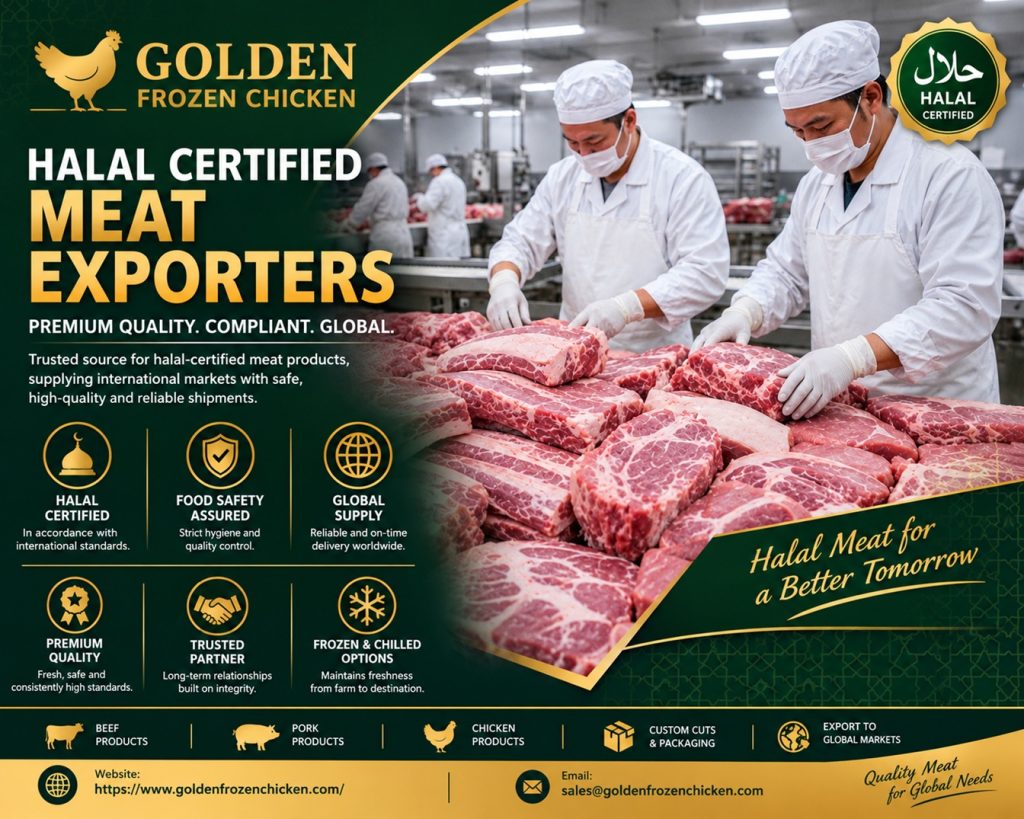
For importers, wholesalers, food manufacturers, distributors, and food-service companies, choosing the right meat exporter involves much more than comparing prices. International buyers need confidence that products meet food-safety requirements, destination-market regulations, documentation standards, and—where applicable—recognized Halal requirements.
Working with reputable Halal Certified Meat Exporters can help buyers establish a more transparent supply chain for permissible meat and poultry products. From certified slaughter and processing to labeling, traceability, documentation, and cold-chain logistics, every stage can influence whether a shipment is accepted and commercially successful.
At GOLDEN FROZEN CHICKEN, quality, compliance, and reliable international supply are central to our approach to frozen meat distribution. Our website states that the company supplies frozen chicken, beef, and pork through certified and ISO-compliant manufacturing partners in Brazil.
Important: Halal certification applies to permissible products. Pork and pork-derived products are not Halal. Therefore, Halal claims in a meat-export program must be limited to products that qualify under Islamic dietary requirements.
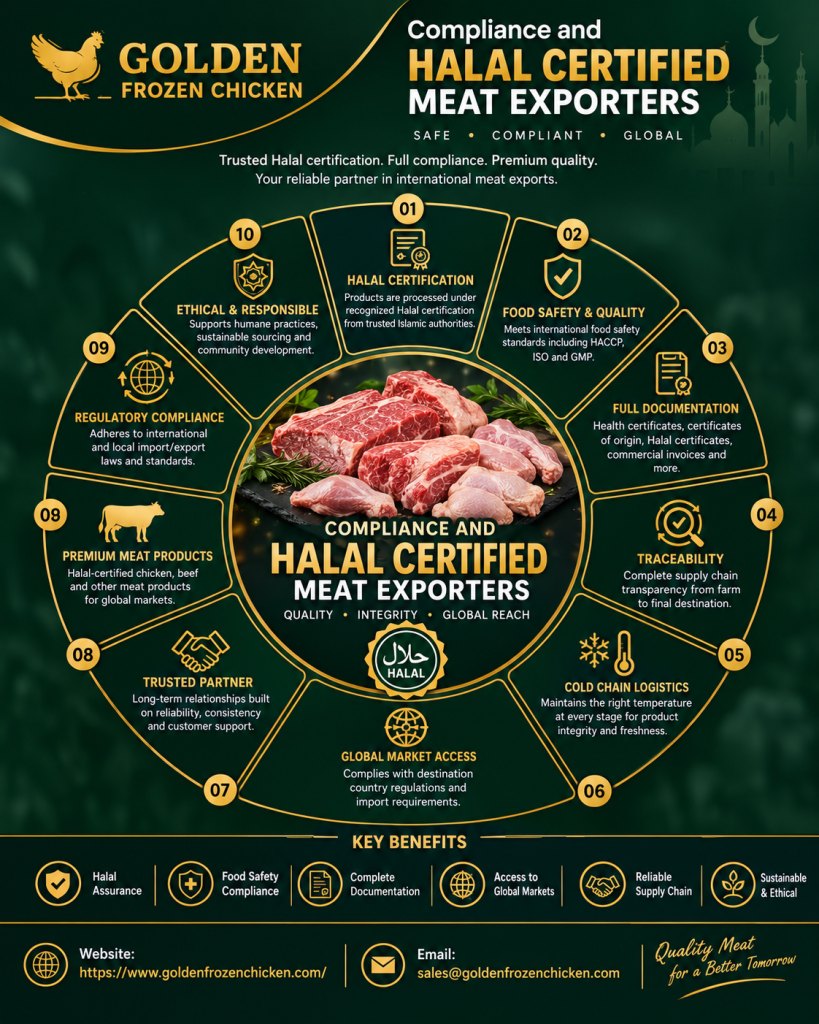
What Does Halal Certification Mean in Meat Export?
Halal means “permissible” under Islamic law. For meat and poultry, Halal requirements can involve the source of the animal, slaughter procedures, processing, handling, packaging, storage, transportation, and labeling.
The Codex Alimentarius General Guidelines for Use of the Term “Halal” state that Halal food must not contain unlawful ingredients and must be prepared, processed, transported, and stored in a manner consistent with the relevant requirements. The guidelines also identify pigs and boars as unlawful food sources.
This makes certification especially important for international buyers purchasing meat for Muslim-majority markets or customers requiring Halal products.
Why Work With Halal Certified Meat Exporters?
Choosing experienced Halal Certified Meat Exporters can provide buyers with a structured approach to compliance and documentation.
1. Verified Halal Processes
A recognized certification process can provide evidence that the applicable product and production procedures meet the relevant Halal requirements.
2. Better Documentation
International meat shipments can require multiple documents, including health certificates, certificates of origin, invoices, packing lists, and Halal documentation where required.
3. Market Access
Some importing markets have specific Halal certification requirements for meat and poultry. Saudi Arabia, for example, states that Halal slaughter certification is mandatory for shipments of meat, poultry, and their products entering the Kingdom.
4. Greater Buyer Confidence
Clear documentation and traceability make it easier for importers to verify the origin, specification, and certification status of a shipment.
Halal Certification vs. Food-Safety Certification
One common misconception is that Halal certification and food-safety certification are the same thing.
They are not.
Halal certification addresses Islamic dietary and processing requirements.
Food-safety systems address hazards, hygiene, sanitation, process controls, traceability, and other food-safety risks.
A professional exporter may therefore need to manage both requirements independently.
For example, Codex recognizes Halal as a religious or ritual preparation claim that should conform to the requirements of the appropriate religious authorities.
At the same time, food exporters must comply with the regulatory requirements established by the importing country.
Key Compliance Areas for International Meat Exporters
1. Product Eligibility
Before accepting an international order, exporters and importers should establish whether the specific product is eligible for the destination market.
This is particularly important because requirements can differ between countries.
A product accepted in one market may require additional certification, approved establishments, or specific labeling in another.
2. Halal Certification
Buyers should determine:
- Which Halal authority is recognized?
- Is the certification valid for the destination country?
- Does the certificate cover the specific product?
- Does it cover the slaughtering facility?
- Are processed products covered?
- Are additional endorsements required?
- Does the certificate need to accompany the shipment?
Saudi Arabia’s official guidance, for example, includes requirements relating to recognized Halal certification bodies and the certification of food-related service providers.
The exact requirements should always be checked for the destination market before shipment.
3. Slaughter Requirements
For Halal meat and poultry, slaughter is one of the most important parts of the certification process.
The Codex Halal guidelines specify requirements concerning the animal, the person conducting slaughter, the invocation, the slaughtering device, and the slaughter act.
However, interpretations and certification requirements can differ between Islamic authorities and importing countries.
Therefore, exporters should not assume that a generic Halal certificate will automatically satisfy every destination.
4. Processing and Handling
Halal compliance does not necessarily end at slaughter.
Processing, storage, packaging, and transportation can also be relevant.
Codex states that Halal food should be processed, packaged, transported, and stored in a way that prevents contact with unlawful food and maintains compliance with the relevant requirements.
For an exporter, this means establishing appropriate procedures for:
- Production
- Equipment
- Cleaning
- Product segregation
- Storage
- Packaging
- Transportation
- Traceability
This is particularly important for facilities handling multiple product categories.
5. Labeling and Product Identification
When a product carries a Halal claim, the labeling must accurately represent the certification status.
Codex guidance states that when a Halal claim is made, the word “Halal” or an equivalent term should appear on the label.
Commercial labels may also need to include information such as:
- Product name
- Net weight
- Country of origin
- Production date
- Expiry/best-before information
- Lot or batch number
- Storage instructions
- Establishment identification
- Certification information
The exact requirements depend on the destination country’s regulations.
Documentation: The Backbone of Meat Export Compliance
A successful export shipment requires accurate documentation.
Depending on the destination, the export file may contain:
- Commercial invoice
- Packing list
- Certificate of origin
- Health or veterinary certificate
- Halal certificate
- Product specification
- Certificate of analysis, where applicable
- Import permit, where applicable
- Bill of lading
- Establishment documentation
- Other destination-specific certificates
For example, Saudi Arabia’s food-import guidance lists certificates such as a certificate of origin, original Halal certificate, and original slaughter certificate among documents that may be required according to the food item.
The key lesson for buyers is simple:
Certification should be confirmed before production and shipment—not after the container reaches the destination port.
Traceability and Supply-Chain Transparency
Traceability allows an exporter and importer to connect a finished shipment to its production information.
A robust system can link:
Supplier → Processing Facility → Production Batch → Packaging → Container → Shipment → Importer
For commercial buyers, this information can be valuable when managing:
- Quality assurance
- Customer inquiries
- Product recalls
- Regulatory inspections
- Inventory management
- Supplier performance
GOLDEN FROZEN CHICKEN describes its approach as including product procurement, inventory management, product application, process improvements, and supply-chain solutions for international customers.
Cold Chain Compliance for Frozen Meat
Halal certification and food safety are only part of the export process. The physical condition of the product must also be protected throughout transportation.
Frozen meat should remain within the required temperature range from processing and storage through transportation and delivery.
For quick-frozen foods, Codex guidance emphasizes maintaining the cold chain during storage, transportation, distribution, and handling.
For exporters and importers, this means paying attention to:
- Freezing method
- Cold storage
- Reefer-container settings
- Loading procedures
- Temperature monitoring
- Transit time
- Port handling
- Destination cold storage
A strong compliance program combines documentation with physical control of the product.
How Buyers Can Evaluate Halal Certified Meat Exporters
Before placing a large order, importers should ask potential Halal Certified Meat Exporters for clear information about the following areas.
Certification
- Who issued the Halal certificate?
- Is the certifier recognized in the destination market?
- Does the certification cover the relevant product and facility?
Production
- Where is the product processed?
- Is the establishment approved for the destination?
- What quality-management systems are in place?
Product
- What is the exact specification?
- What are the packaging options?
- What are the available grades and sizes?
- What is the minimum order quantity?
Export
- Which markets does the exporter currently serve?
- What export documentation is available?
- Can destination-specific requirements be accommodated?
Logistics
- How is the cold chain maintained?
- What type of reefer transportation is used?
- How are shipments monitored?
These questions help distinguish an exporter with a genuine compliance program from a supplier simply using the word “Halal” as a marketing term.
GOLDEN FROZEN CHICKEN: Supporting Global Meat Buyers
GOLDEN FROZEN CHICKEN is an international producer and distributor of frozen chicken, pork, and beef. Its website states that it works with certified and ISO-compliant manufacturers in Brazil and supplies customers across multiple international markets.
The company’s product portfolio includes frozen chicken and beef products identified as Halal, while its pork portfolio is presented separately.
For buyers sourcing Halal poultry or beef, product-specific certification should be confirmed for the relevant shipment and destination.
Explore the company’s frozen chicken products and frozen beef products.
For international procurement inquiries, buyers can contact GOLDEN FROZEN CHICKEN.
Compliance Checklist for Halal Meat Imports
Before confirming a shipment, buyers should verify:
Product
- Exact meat or poultry product
- Cut and specification
- Frozen/chilled condition
- Packaging
- Label requirements
Halal
- Recognized certification body
- Valid Halal certificate
- Halal slaughter documentation
- Product-specific certification
- Destination-market recognition
Food Safety
- Approved processing establishment
- Applicable food-safety controls
- Traceability
- Health/veterinary documentation
Export
- Import permit, if applicable
- Certificate of origin
- Commercial invoice
- Packing list
- Shipping documentation
- Destination-specific certificates
Logistics
- Cold-storage requirements
- Reefer-container conditions
- Temperature monitoring
- Delivery arrangements
Frequently Asked Questions
What are Halal Certified Meat Exporters?
Halal Certified Meat Exporters are exporters supplying meat or poultry products that meet applicable Halal requirements and have the appropriate certification for the relevant market. Certification requirements can vary by country and certifying authority.
Is pork Halal?
No. Under the Codex General Guidelines for Use of the Term “Halal,” pigs and boars are identified as unlawful food sources.
Is Halal certification the same as ISO or HACCP certification?
No. Halal certification concerns Islamic dietary and processing requirements, while ISO/HACCP-related systems address food-safety and management controls. They can complement one another but serve different purposes.
Do all countries have the same Halal requirements?
No. Importing countries can establish different requirements concerning recognized certifiers, certificates, endorsements, labeling, approved establishments, and documentation. Codex itself notes that interpretation can vary according to Islamic schools of thought and importing-country authorities.
Why is documentation important for Halal meat exports?
Documentation allows importers and authorities to verify the shipment’s certification, origin, health status, product identity, and compliance with destination requirements.
Final Thoughts
International meat trade depends on compliance, certification, transparency, and supply-chain control.
For importers seeking Halal Certified Meat Exporters, the priority should be finding a supplier that can demonstrate the appropriate certification for the specific product and destination—not simply a supplier that advertises itself as Halal.
Halal certification should work alongside food-safety controls, traceability, accurate labeling, export documentation, and reliable cold-chain logistics.
At GOLDEN FROZEN CHICKEN, our international frozen-meat supply model is built around quality, reliability, and global distribution. For Halal chicken and beef requirements, buyers should contact our sales team to discuss the exact product, certification, destination, packaging, and shipment requirements.