
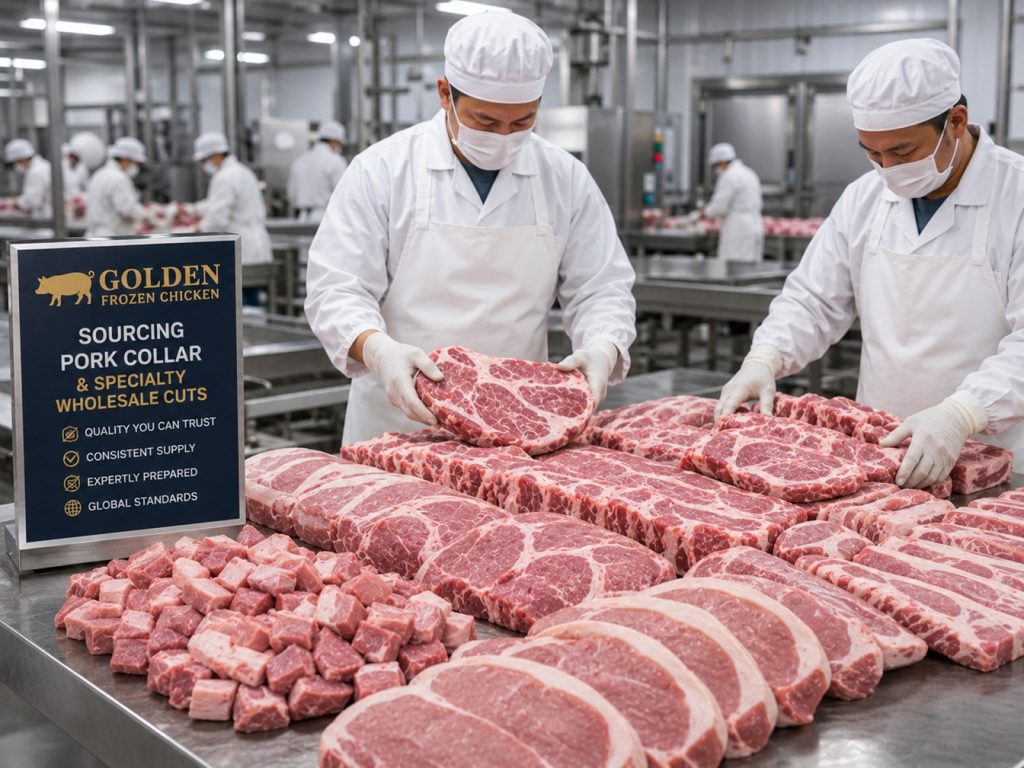
For international food manufacturers, importers, wholesalers, and food-service distributors, sourcing the right pork cuts requires more than comparing prices. The cut specification, fat distribution, trimming, freezing method, packaging, certification, and destination-market requirements can all affect the value of a shipment.
Among specialty products, Frozen Pork Collar Wholesale is gaining attention for its rich flavor, marbling, and versatility across different culinary and food-service applications. At the same time, other specialty wholesale cuts can provide manufacturers with opportunities to diversify their product portfolios and meet specific regional demand.
In this guide, GOLDEN FROZEN CHICKEN explains what buyers should consider when sourcing pork collar and other specialty pork cuts for international trade.
What Is Pork Collar?
Pork collar is taken from the neck/shoulder region of the pig and is known for its combination of lean meat and intramuscular fat. The cut is commonly valued for its rich flavor and tenderness when prepared correctly.
From a commercial sourcing perspective, pork collar can be supplied in different presentations depending on the processor and buyer specification. The exact definition and cutting method should therefore be agreed upon before purchasing.
Buyers should confirm:
- Bone-in or boneless
- Skin-on or skinless
- Trimming level
- Fat coverage
- Piece-weight range
- Thickness and dimensions
- Fresh or frozen condition
- Packaging configuration
- Country-of-origin requirements
USDA FSIS identifies the shoulder, loin, side, and leg as the four basic pork primal cuts, with multiple commercial cuts derived from these areas.
Why Buy Frozen Pork Collar in Wholesale Quantities?
The primary advantage of Frozen Pork Collar Wholesale purchasing is the ability to secure a consistent supply for manufacturing, food service, distribution, or resale.
A properly specified frozen product can offer several commercial advantages:
Consistent Raw Material
Manufacturers can establish a defined specification for every shipment, helping production teams plan recipes, portion sizes, and processing requirements.
Convenient Inventory Management
Frozen pork allows commercial buyers to manage inventory around production schedules rather than depending exclusively on immediate chilled supply.
Multiple Culinary Applications
Pork collar’s marbling and texture make it suitable for grilling, roasting, slicing, marinating, braising, and other applications depending on the cut presentation.
Global Distribution
Frozen meat is commonly transported internationally in temperature-controlled logistics systems. Codex guidance for quick-frozen foods emphasizes maintaining the appropriate cold chain through storage, transportation, distribution, and sale.
Understanding Specialty Wholesale Pork Cuts
Pork collar is only one option available to commercial buyers. Depending on the market and processing requirements, specialty pork programs can include products such as:
- Pork belly
- Pork neck steaks
- Pork ham
- Pork hock
- Pork feet
- Pork fillets
- Pork joints
- Pork loin
- Pork shoulder
- Other customized pork portions
The best choice depends on the buyer’s intended application.
For example, pork belly may be suited to bacon and other value-added products, while pork neck products can be positioned for grilling and restaurant applications. GOLDEN FROZEN CHICKEN currently lists several frozen pork products, including pork belly, pork ham, pig feet, pork fillets, pork hock, pork joint, pork neck steaks, and center-cut pork loin.
Key Specifications When Sourcing Frozen Pork Collar Wholesale
A professional purchase specification should remove ambiguity between the buyer and supplier.
1. Cut Specification
Start by identifying the exact cut.
The term “pork collar” can be interpreted differently across markets and cutting systems, so international buyers should provide a product specification, reference image, cutting description, or agreed commercial standard when necessary.
2. Bone and Skin Presentation
Specify whether the product must be:
- Bone-in
- Boneless
- Skin-on
- Skinless
This can significantly affect processing yield and labor requirements.
3. Fat and Trimming
Fat distribution is an important consideration for pork collar.
Buyers should specify acceptable external fat and trimming requirements rather than relying on general descriptions such as “lean” or “well trimmed.”
For food manufacturers, the goal is to establish a specification that balances:
Flavor + Yield + Processing Efficiency + Product Consistency
4. Weight Range
Piece weight can be particularly important for portioning, slicing, and automated processing.
A commercial specification may include:
- Target weight
- Minimum weight
- Maximum weight
- Average piece weight
- Number of pieces per carton
5. Freezing Format
The buyer should also define the required freezing and packaging format.
Depending on the product and processing facility, commercial frozen meat may be supplied using different freezing and packaging configurations.
Choosing Pork Collar for Different Applications
One reason Frozen Pork Collar Wholesale can be attractive to commercial buyers is its flexibility.
Food Service
Restaurants and catering companies can use pork collar for grilled, roasted, braised, or marinated dishes.
Meat Processing
Processors can incorporate appropriate pork cuts into sausages, seasoned products, prepared foods, and other formulations, subject to their own recipes and specifications.
Retail
Boneless and portioned presentations can be suitable for retail programs where consistent sizing and packaging are important.
Asian Cuisine
Pork neck and collar products are particularly relevant to markets where grilled and sliced pork preparations are popular.
Specialty Meat Distribution
Importers can use specialty cuts to expand beyond mainstream pork products and serve customers looking for particular cuts or presentations.
Pork Collar vs. Other Specialty Cuts
| Cut | Typical Commercial Appeal | Important Buyer Considerations |
|---|---|---|
| Pork Collar | Flavorful, marbled specialty cut | Fat, trimming, dimensions |
| Pork Belly | Popular for bacon and food service | Thickness, fat/lean balance |
| Pork Ham | Versatile whole-muscle and processed applications | Weight, bone-in/boneless |
| Pork Hock | Traditional culinary applications | Bone, skin, size |
| Pork Feet | Specialty and traditional markets | Skin, bone, cleanliness |
| Pork Fillet | Leaner, portion-oriented applications | Size, trimming |
| Pork Loin | Versatile and widely recognized | Dimensions, fat cover |
This comparison illustrates why buyers should avoid treating all pork cuts as interchangeable commodities.
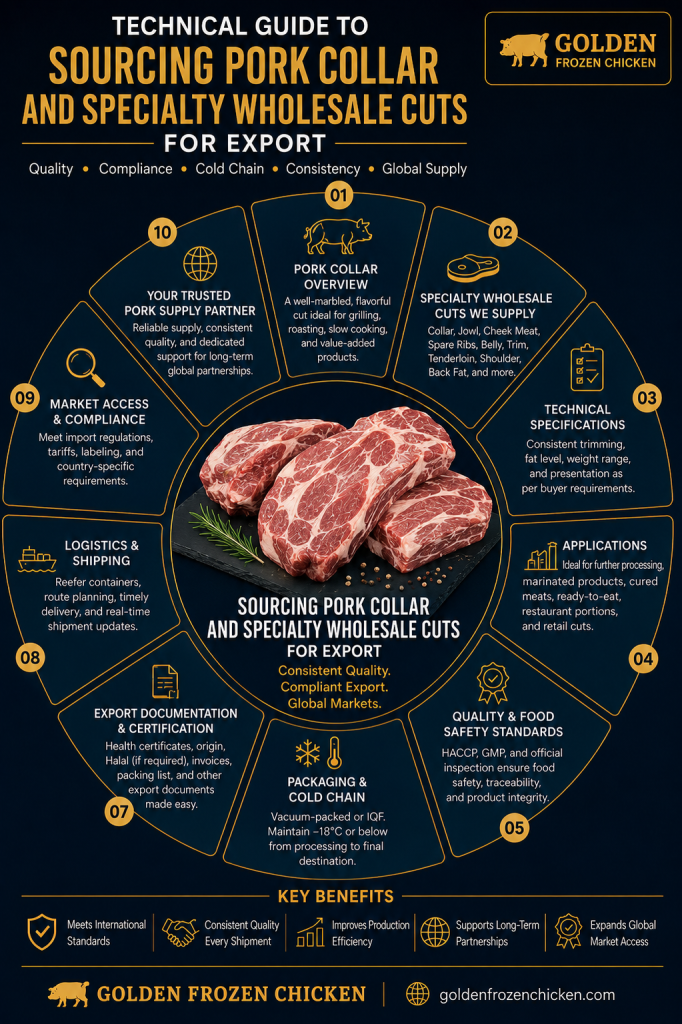
Quality Control for Frozen Pork
When sourcing Frozen Pork Collar Wholesale, product quality should be evaluated before the shipment leaves the exporting facility.
Important quality checkpoints include:
Appearance
The product should meet the agreed visual specification and be free from unacceptable defects.
Packaging Integrity
Cartons and inner packaging should protect the product against contamination, physical damage, and excessive dehydration.
Product Identification
Lot or batch information should allow the shipment to be traced through the supply chain.
Temperature Control
Frozen products should remain within the required temperature parameters throughout storage and transportation.
Codex guidance states that quick-frozen foods should generally be maintained at -18°C or colder throughout the cold chain, subject to applicable national tolerances.
Documentation
The shipment should be accompanied by the certificates and commercial documents required for the destination market.
Packaging and Cold-Chain Management
International frozen pork purchasing is only successful when the cold chain remains intact.
Codex guidance specifically addresses processing, packaging, frozen storage, transportation, and temperature monitoring for quick-frozen foods. It also emphasizes packaging that protects against dehydration, contamination, and deterioration of sensory quality.
For buyers, the purchasing specification should establish:
- Carton weight
- Inner packaging
- Outer carton requirements
- Product labeling
- Lot identification
- Pallet configuration
- Storage temperature
- Reefer-container requirements
- Delivery conditions
Temperature monitoring and proper handling become especially important when frozen pork travels long distances between the processing facility, port, importer, cold store, and final customer.
Export Compliance and Documentation
Exporting pork involves more than selecting a product and arranging a container.
The exporter and importer should verify the current requirements of the destination country before production and shipment.
Depending on the market, documentation can include:
- Veterinary or sanitary certificates
- Certificate of origin
- Commercial invoice
- Packing list
- Bill of lading
- Product specifications
- Establishment information
- Traceability documentation
- Halal certification where applicable
- Destination-specific certificates
Requirements can change according to animal-health conditions, country eligibility, establishment approval, and destination regulations. USDA APHIS specifically notes that import requirements can change and recommends confirming current certification requirements with the importing country’s relevant authority before shipment.
For U.S.-bound products, FSIS states that imported meat products must originate from eligible countries and certified establishments and meet applicable labeling and inspection requirements.
How to Evaluate a Frozen Pork Supplier
Price is important, but it should not be the only factor when choosing a supplier.
A professional buyer should evaluate the supplier across several areas:
Product Capability
Can the supplier consistently provide the exact pork collar or specialty cut required?
Manufacturing Standards
Does the supplier work with appropriately approved and controlled processing facilities?
Export Experience
Does the supplier understand international documentation, shipping, and destination-market requirements?
Cold-Chain Capability
Can the supplier maintain frozen conditions from production through loading and transportation?
Custom Specifications
Can the supplier adapt packaging, trimming, weight, or presentation to the buyer’s requirements?
Communication
Can the export team provide clear specifications, quotations, production information, and shipping documentation?
GOLDEN FROZEN CHICKEN describes itself as an international producer and distributor of frozen chicken, pork, and beef, with a supply network serving importers, manufacturers, wholesalers, retailers, food-service businesses, hotels, airlines, and distributors.
Why Choose GOLDEN FROZEN CHICKEN?
GOLDEN FROZEN CHICKEN supplies frozen meat products for international commercial buyers and provides access to frozen pork, beef, and chicken products.
The company lists frozen pork products including pork neck steaks, pork belly, pork ham, pig feet, pork fillets, pork hock, pork joint, and center-cut pork loin.
For buyers interested in Frozen Pork Collar Wholesale, the important step is to communicate the required specification clearly so the appropriate product, packaging, quantity, and destination requirements can be discussed.
Explore GOLDEN FROZEN CHICKEN’s frozen pork products
Buyer Checklist for Frozen Pork Collar Wholesale
Before placing a bulk order, confirm:
Product
- Exact cut
- Bone-in or boneless
- Skin-on or skinless
- Trimming level
- Fat specification
- Weight range
- Freezing format
Packaging
- Carton weight
- Pieces per carton
- Inner packaging
- Labeling
- Lot/batch identification
- Pallet configuration
Quality
- Product appearance
- Defect tolerance
- Traceability
- Food-safety requirements
- Required certifications
Export
- Destination eligibility
- Approved establishment
- Veterinary documentation
- Certificate of origin
- Import permits where applicable
- Labeling regulations
Logistics
- Reefer requirements
- Loading schedule
- Transit time
- Temperature monitoring
- Port and destination arrangements
A detailed checklist helps prevent misunderstandings and creates a more predictable purchasing process.
Final Thoughts
Sourcing Frozen Pork Collar Wholesale requires a combination of product knowledge, technical specifications, quality control, regulatory awareness, and dependable logistics.
Pork collar can be an attractive specialty product because of its flavor and versatility, while other wholesale cuts—including belly, ham, hock, feet, fillet, loin, and pork neck products—allow importers and manufacturers to build broader pork portfolios.
The most successful procurement programs focus on consistency rather than price alone. A clearly defined cut, controlled specification, reliable documentation, and properly managed cold chain can help buyers reduce uncertainty from production through final delivery.
For international buyers looking for frozen pork and specialty cuts, GOLDEN FROZEN CHICKEN can be contacted to discuss product requirements and export opportunities.