
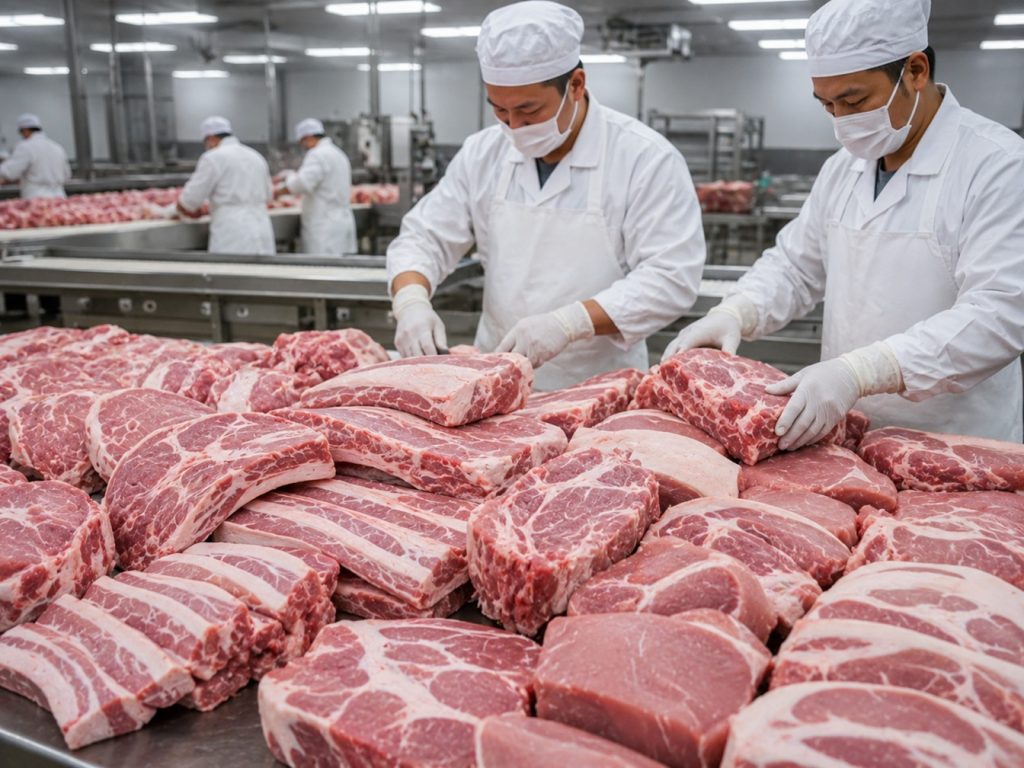
In international meat procurement, buying the right pork cut is only the beginning. For food manufacturers, the technical specification behind each shipment can influence processing efficiency, yield, portion control, product consistency, and export compliance.
For buyers sourcing wholesale cuts of pork, the most important questions are practical: Which primal or subprimal fits the manufacturing process? What level of trimming is required? Should the product be bone-in or boneless? What packaging and freezing format is appropriate? And what documentation is required for the destination market?
This technical guide from GOLDEN FROZEN CHICKEN explains the principal pork cuts used in commercial trade and the specifications manufacturers should evaluate before entering a wholesale export contract.
Key Takeaways
- Understand the four major pork primal areas and the commercial cuts derived from them.
- Match wholesale cuts of pork to the intended manufacturing application.
- Define specifications for bone-in/boneless format, trimming, fat coverage, weight, and presentation.
- Verify inspection, certification, traceability, labeling, and destination-market requirements.
- Maintain appropriate frozen-storage and transportation conditions throughout the cold chain.
- Work with an experienced exporter capable of coordinating product specifications and international logistics.
Table of Contents
- Understanding Wholesale Pork Primal Cuts
- Major Wholesale Cuts of Pork for Food Manufacturing
- Technical Specifications Buyers Should Define
- Choosing Pork Cuts by Manufacturing Application
- Quality Control and Food-Safety Requirements
- Packaging, Freezing, and Cold-Chain Management
- Export Documentation and Market Compliance
- Sourcing Wholesale Cuts of Pork with GOLDEN FROZEN CHICKEN
- Frequently Asked Questions
Understanding Wholesale Pork Primal Cuts
Pork is commonly divided into four major primal areas: shoulder, loin, side, and leg. These primal areas are further separated into subprimals and commercial cuts according to the requirements of processors, retailers, food-service companies, and manufacturers.
For industrial buyers, this distinction matters because the same primal can be processed into several different products.
A manufacturer producing sausages, for example, may have very different requirements from a company producing sliced retail products or ready-to-cook meals.
The terminology used in an export specification should therefore be precise.
A purchase specification can define:
- Primal or subprimal cut
- Bone-in or boneless
- Skin-on or skinless
- Fat thickness or trimming level
- Piece-weight range
- Number of pieces per carton
- Freezing method
- Packaging format
- Country of origin
- Inspection requirements
- Production and expiry information
The objective is simple: the product specification agreed before shipment should correspond with the product actually received.
Major Wholesale Cuts of Pork for Food Manufacturing
1. Pork Shoulder
The pork shoulder is one of the most versatile areas for industrial processing.
Depending on the cutting system, shoulder can be supplied as different commercial portions, including Boston butt/shoulder butt and picnic-style cuts. USDA information identifies shoulder butt, roast or steak, blade steak, boneless blade Boston roast, and picnic-related products among pork shoulder cuts.
For manufacturers, shoulder can be attractive because its flavor, fat, and connective-tissue characteristics work well in applications requiring further processing.
Typical applications include:
- Sausage manufacturing
- Ground pork
- Processed meat products
- Slow-cooked products
- Prepared meals
- Marinated products
- Food-service portions
When buying wholesale pork shoulder, manufacturers should clearly specify the desired trimming level and whether the product is intended for direct cooking or further processing.
2. Pork Loin
The loin is generally associated with leaner commercial cuts and can be processed into products such as:
- Whole loins
- Loin roasts
- Chops
- Tenderloin
- Sirloin-related cuts
- Sliced or portioned products
For manufacturers, consistency in dimensions can be particularly important when automated slicing, portioning, or packaging equipment is involved.
The procurement specification should therefore address dimensions and weight tolerances rather than simply stating “pork loin.”
For large-volume buyers, uniformity can reduce production adjustments and make downstream processing more predictable.
3. Pork Side
The side is an important commercial source of products such as pork belly and ribs.
Pork belly is especially relevant to processors producing bacon and other value-added products. Rib products can also enter food-service and prepared-food channels.
For these wholesale cuts of pork, fat distribution, thickness, trimming, and surface condition can have a direct impact on processing performance.
A bacon manufacturer, for example, may require a very different belly specification from a restaurant distributor.
4. Pork Leg
The pork leg provides cuts associated with ham and other processed or fresh pork products.
Manufacturers purchasing pork leg should define whether the requirement is:
- Bone-in
- Boneless
- Whole
- Portion-controlled
- Fresh/chilled
- Frozen
- Trimmed for further processing
The final application determines the most economical specification.
A processor making cured products may prioritize different characteristics from a food manufacturer producing ready-to-cook portions.
Technical Specifications Buyers Should Define
One of the biggest mistakes in international meat procurement is ordering according to a product name without establishing the technical details behind it.
When sourcing wholesale cuts of pork, buyers should build a written product specification.
Cut Identification
The specification should identify the exact commercial cut and, where necessary, the applicable cutting standard or nomenclature.
Avoid vague descriptions such as “pork shoulder.”
Instead, specify the required portion, presentation, and processing condition.
Bone-In vs. Boneless
Bone-in products can provide a traditional presentation and may be appropriate for particular culinary applications.
Boneless products can simplify:
- Portioning
- Slicing
- Further processing
- Packaging
- Yield calculations
The correct format depends on the manufacturing line.
Skin-On vs. Skinless
Skin requirements should also be defined in advance.
For some products, the skin forms part of the finished product. For other manufacturing applications, skin removal is preferred to reduce downstream processing.
Trimming and Fat
Fat is not simply a waste component. In many pork products, controlled fat content contributes to flavor, texture, moisture, and processing performance.
However, excessive external fat can increase trimming requirements and affect manufacturing yield.
A professional specification should therefore establish acceptable trimming parameters rather than relying on informal descriptions such as “lean” or “well trimmed.”
Weight and Size
Piece-weight consistency becomes increasingly important as manufacturing becomes more automated.
Buyers should establish:
- Minimum weight
- Maximum weight
- Target average weight
- Thickness
- Length/width where applicable
- Acceptable variation
This allows the manufacturer to calculate expected production yields more accurately.
Choosing Wholesale Cuts of Pork by Manufacturing Application
Different manufacturing operations require different cuts.
| Manufacturing Application | Potential Pork Cut | Important Specification |
|---|---|---|
| Sausage | Shoulder / trim | Fat-to-lean ratio, particle size |
| Bacon | Pork belly | Thickness, fat distribution, skin specification |
| Roasted products | Shoulder / loin | Size, trimming, bone-in/boneless |
| Sliced products | Loin / leg | Shape, dimensions, consistency |
| Ham production | Leg | Bone-in/boneless, weight, trimming |
| Prepared meals | Shoulder / loin | Portion size, trimming, packaging |
| Ground pork | Shoulder / trim | Lean-to-fat specification, food safety |
| Food service | Multiple cuts | Portion size and presentation |
These are broad commercial examples. The final product specification should always be based on the manufacturer’s own formulation, equipment, and destination-market requirements.
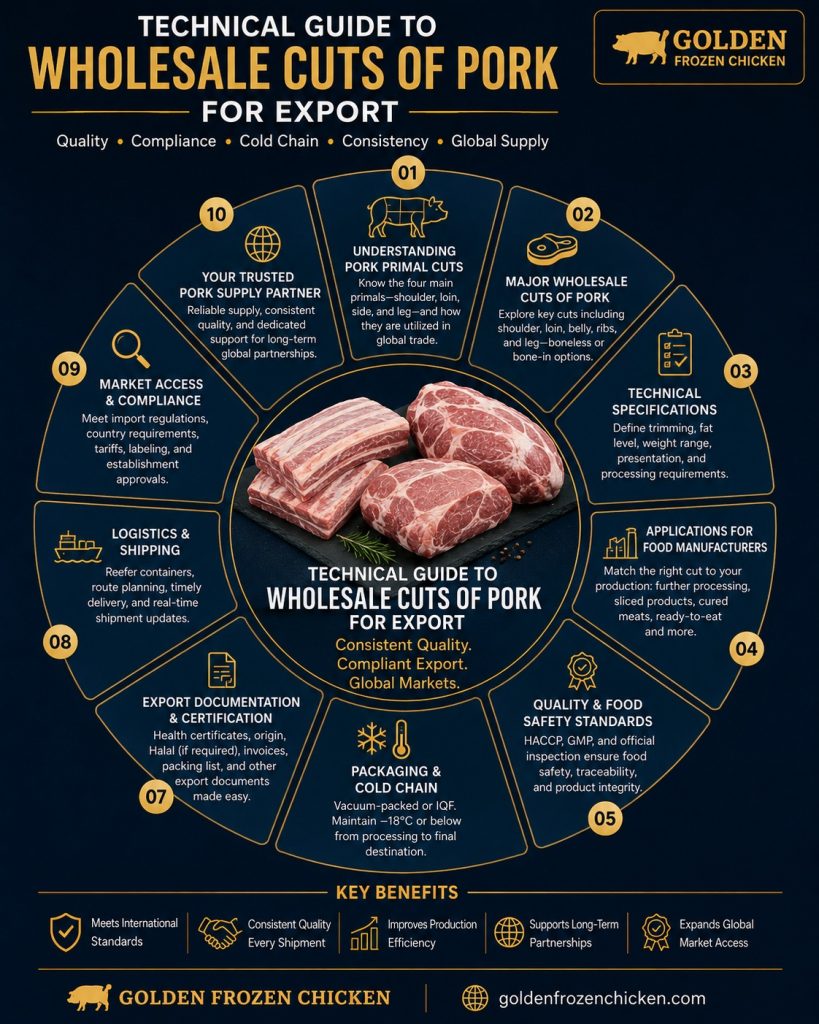
Quality Control for Wholesale Cuts of Pork
Quality control begins at the processing facility and continues through shipment and receiving.
For frozen pork, buyers should evaluate the product’s:
- Appearance
- Color
- Odor
- Surface condition
- Fat distribution
- Trimming
- Bone condition
- Packaging integrity
- Foreign-material controls
- Traceability
USDA FSIS describes inspection as a fundamental requirement for meat intended for commercial sale in the United States, including pork and other livestock products.
International buyers should also verify that the exporting establishment and product are eligible for the destination market. Import requirements can differ significantly between countries.
For example, Brazil’s Ministry of Agriculture and Livestock explains that establishments exporting meat to Singapore must meet the applicable SIF registration and Singapore Food Agency requirements.
Certification and Compliance
A reliable export program should not rely on a single certificate.
Depending on the destination and product, buyers may need documentation covering:
- Veterinary or sanitary certification
- Country of origin
- Establishment eligibility
- Product identification
- Batch/lot traceability
- Packaging and labeling
- Commercial invoice
- Packing list
- Shipping documentation
- Halal certification where applicable
- Additional destination-specific certificates
For U.S.-bound meat imports, FSIS states that products must originate from eligible countries and certified establishments and meet applicable import, labeling, and inspection requirements.
For exporters, this reinforces an important procurement principle: market eligibility should be confirmed before the order is produced, not after the container reaches the port.
Packaging and Cold-Chain Management
The technical quality of wholesale cuts of pork can be compromised if freezing, storage, or transportation is poorly controlled.
Codex guidance for quick-frozen foods emphasizes maintaining the cold chain during processing, storage, transportation, distribution, and handling.
Frozen storage is generally managed around -18°C or colder, with minimal temperature fluctuation as a key principle in Codex guidance for quick-frozen foods.
Export Packaging
Commercial pork packaging should protect the product from:
- Dehydration
- Physical damage
- Contamination
- Excessive temperature exposure
Codex guidance also states that packaging should protect sensory quality and prevent dehydration and contamination.
For containerized exports, buyers should define:
- Carton weight
- Carton dimensions
- Pallet configuration
- Product-to-carton ratio
- Labeling language
- Lot/batch identification
- Barcode requirements
- Reefer requirements
Good palletization is particularly important because the objective is not simply to fit the maximum number of cartons into a container. Airflow and temperature stability must also be considered.
Export Documentation and Market Compliance
International pork exports involve both commercial and regulatory documentation.
The exact requirements depend on the origin, destination, product, processing status, and trade agreement.
Before confirming an order, procurement teams should verify:
1. Destination eligibility
Is the exporting country approved for the product?
2. Establishment eligibility
Is the processing establishment approved or listed for the destination?
3. Product eligibility
Is the specific pork cut permitted?
4. Health certification
Which veterinary or sanitary certificate is required?
5. Labeling
What information must appear on the carton and product packaging?
6. Customs documentation
Are invoices, packing lists, certificates of origin, and other documents correctly prepared?
7. Cold-chain requirements
What temperature and transportation conditions apply?
These checks help reduce the risk of port delays, rejected documentation, or unexpected clearance problems.
Why Specification Consistency Matters to Food Manufacturers
For a food manufacturer, purchasing pork is ultimately about production economics.
Suppose a factory has a high-speed portioning or grinding line. Variations in incoming raw material can influence trimming, throughput, formulation, and finished-product consistency.
That is why manufacturers should evaluate suppliers based on repeatability rather than a single shipment.
A strong supplier relationship should provide consistency in:
- Cut identification
- Weight
- Trimming
- Packaging
- Documentation
- Production quality
- Cold-chain performance
- Shipment scheduling
The goal is to make incoming raw material predictable enough that the manufacturing operation can plan around it.
Sourcing Wholesale Cuts of Pork with GOLDEN FROZEN CHICKEN
GOLDEN FROZEN CHICKEN supplies frozen chicken, beef, and pork products for international buyers. The company’s website states that it works with certified and ISO-compliant manufacturers in Brazil and serves importers, manufacturers, wholesalers, retailers, food-service businesses, hotels, airlines, and other commercial buyers.
Its current product portfolio includes frozen pork products such as Berkshire pork belly, pork ham, pig feet, pork fillets, pork hock, pork joint, pork neck steaks, and center-cut pork loin.
This broader portfolio can be useful for manufacturers and distributors that need multiple pork cuts rather than relying on a single product category.
For large-volume procurement, buyers can discuss their required cut, processing format, packaging configuration, destination market, certification requirements, and shipping schedule directly with the export team.
A Practical Checklist for Importers
Before purchasing wholesale cuts of pork, confirm the following:
Product
- Exact cut name
- Primal/subprimal classification
- Bone-in or boneless
- Skin-on or skinless
- Trimming specification
- Weight range
- Quality requirements
Manufacturing
- Intended application
- Required yield
- Portioning requirements
- Further-processing requirements
- Equipment compatibility
Export
- Country of origin
- Approved establishment
- Sanitary certification
- Destination-market eligibility
- Labeling requirements
- Traceability documentation
Logistics
- Freezing specification
- Storage temperature
- Reefer-container requirements
- Pallet configuration
- Carton dimensions
- Shipment schedule
A detailed specification sheet can eliminate much of the ambiguity that commonly occurs in international meat procurement.
Frequently Asked Questions
What are the main wholesale cuts of pork?
The four major pork primal areas are shoulder, loin, side, and leg. Each can be further divided into commercial cuts for food manufacturing, food service, retail, and further processing.
Which pork cuts are commonly used by food manufacturers?
Shoulder, loin, side/belly, and leg can all serve manufacturing applications. The best cut depends on whether the manufacturer produces sausage, bacon, ham, prepared meals, sliced products, or other processed foods.
What should I include in a wholesale pork specification?
Specify the exact cut, bone and skin presentation, trimming level, weight range, freezing condition, packaging, labeling, certifications, and destination requirements.
Why is trimming important when buying wholesale pork?
Trimming affects usable yield, fat content, processing requirements, and the amount of material that must be removed before production.
What temperature should frozen pork be stored at?
Codex guidance for quick-frozen foods describes frozen storage at -18°C or lower, with temperature stability and appropriate cold-chain management being important for maintaining product quality.
Does every country have the same pork import requirements?
No. Import requirements vary by destination. Establishment eligibility, sanitary certificates, labeling, disease controls, and other conditions can differ by market. Brazil’s MAPA, for example, publishes market-specific export requirements for countries such as Singapore.
Why should manufacturers work with an experienced exporter?
A professional exporter can coordinate product specifications, documentation, packaging, inspection requirements, cold-chain logistics, and shipping arrangements, reducing procurement complexity.
Final Thoughts
The international trade of wholesale cuts of pork depends on much more than purchasing by price per kilogram.
Successful food manufacturers define the cut precisely, establish measurable quality requirements, verify export eligibility, and protect the product through packaging and cold-chain management.
Whether the requirement is pork shoulder for sausage production, belly for bacon, loin for portioned products, or leg for ham manufacturing, technical precision helps turn a commodity purchase into a predictable raw-material supply.
For manufacturers looking to source frozen pork internationally, GOLDEN FROZEN CHICKEN provides access to a broader frozen-meat portfolio and export-oriented supply network.
The right cut, the right specification, and the right supply partner can make the difference between a shipment that simply arrives and a supply chain that consistently performs.